






Seventy-five percent of consumers actively avoid businesses that fail to protect their personal information. This statistic reveals a fundamental shift in customer expectations, where data privacy has become a decisive factor in purchasing decisions. For small and medium businesses, understanding data privacy is no longer optional; it’s essential for building trust, ensuring compliance with regulations like GDPR and CCPA, and maintaining competitive advantage in digital marketing strategies that depend on ethical customer data handling.
Table of Contents
- What Is Data Privacy And Why It Matters For Small Businesses
- The Regulatory Landscape: GDPR, CCPA, And Other Key Laws Affecting SMBs
- Why Data Privacy Matters Beyond Legal Compliance: Building Trust And Protecting Value
- Common Misconceptions About Data Privacy In Marketing And How To Avoid Them
- Practical Frameworks And Strategies For SMBs To Implement Data Privacy Effectively
- Building Customer Trust Through Privacy Communication Strategies
- Conclusion And Next Steps: Making Data Privacy Part Of Your Marketing DNA
- Enhance Your Digital Marketing With Expert Support
Key takeaways
| Point | Details |
|---|---|
| Legal compliance protects SMBs | Understanding regulations like GDPR and CCPA prevents penalties up to 4% of revenue and safeguards reputation. |
| Privacy builds customer trust | Transparent data practices increase loyalty and differentiate brands in competitive markets. |
| Frameworks reduce breach risk | Privacy-focused systems cut breach incidents by 40% when properly implemented. |
| Misconceptions create vulnerabilities | Believing anonymized data is risk-free or more data equals better marketing leads to costly errors. |
| Communication drives marketing success | Clear privacy policies and consent options convert compliance into competitive advantage. |
What is data privacy and why it matters for small businesses
Data privacy refers to controlling how personal customer information is collected, stored, shared, and used throughout digital marketing activities. For SMBs, this includes email addresses, purchase histories, browsing behaviors, location data, and demographic details gathered through websites, social media campaigns, and email marketing platforms. This information fuels targeted advertising, personalized content, and customer relationship strategies that drive revenue.
Digital marketing fundamentally depends on ethical data handling practices to function effectively. Without proper privacy controls, businesses risk legal action, financial penalties, damaged reputations, and lost customer relationships. A single data breach can cost SMBs an average of $149,000, accounting for legal fees, regulatory fines, remediation costs, and business interruption.
Prioritizing data privacy transforms it from a compliance burden into a marketing asset. Customers share more information with businesses they trust, enabling more accurate targeting and higher conversion rates. Privacy-conscious companies also gain competitive differentiation in markets where consumers increasingly evaluate brands based on data protection standards.
Understanding why digital marketing matters means recognizing that success requires balancing data utilization with customer rights and regulatory obligations.
The regulatory landscape: GDPR, CCPA, and other key laws affecting SMBs
The General Data Protection Regulation (GDPR) governs how businesses handle personal data of European Union residents, regardless of where the company operates. It mandates explicit consent before collecting data, grants consumers rights to access, correct, or delete their information, and requires businesses to report breaches within 72 hours. GDPR penalties reach up to 4% of annual global revenue, creating severe financial risks for non-compliant SMBs.
The California Consumer Privacy Act (CCPA) applies to businesses serving California residents with revenues exceeding $25 million, handling data of 50,000+ consumers, or deriving 50% of revenue from selling personal information. Unlike GDPR’s opt-in approach, CCPA uses opt-out consent, allowing businesses to collect data unless consumers explicitly object. Consumers gain rights to know what data is collected, request deletion, and stop data sales.
| Regulation | Consent Model | Key Rights | Maximum Penalty | Geographic Scope |
|---|---|---|---|---|
| GDPR | Opt-in (explicit consent required) | Access, rectification, erasure, portability | €20 million or 4% global revenue | EU residents worldwide |
| CCPA | Opt-out (must honor deletion/opt-out requests) | Know, delete, opt-out of sales | $7,500 per intentional violation | California residents |
Other regulations like Canada’s PIPEDA, Brazil’s LGPD, and Virginia’s CDPA create additional compliance layers. SMBs must identify which laws apply based on customer locations and transaction volumes. Even businesses believing they fall outside these thresholds should implement privacy frameworks, as regulations expand and consumer expectations rise.
Failure to comply results in immediate financial consequences and long-term reputation damage. Proactive compliance establishes operational foundations for safer, more sustainable marketing practices that protect both customers and business assets.
Why data privacy matters beyond legal compliance: building trust and protecting value
Customer trust directly impacts marketing effectiveness and revenue generation. Research shows 75% of consumers avoid companies lacking strong data protection, while privacy-conscious brands experience 23% higher customer retention rates. Trust functions as a marketing multiplier, increasing email open rates, social media engagement, and conversion percentages across all channels.

Data breaches cost SMBs far beyond immediate fines. Average breach expenses include $88,000 in lost sales, $45,000 in legal and forensic services, $28,000 in customer notification and credit monitoring, and immeasurable reputation damage that reduces customer lifetime value. Recovery takes 6 to 12 months, during which marketing campaigns underperform and customer acquisition costs spike.
Implementing customer trust strategies transforms privacy from expense to investment. Businesses demonstrating data protection commitment attract quality customers willing to pay premium prices and share valuable feedback. Privacy becomes a differentiator in crowded markets where competitors ignore these standards.
Pro Tip: Audit your data collection practices quarterly to identify unnecessary information gathering. Reducing data volume lowers breach risks, simplifies compliance, and improves system performance while maintaining marketing effectiveness.
Financial risk mitigation extends beyond avoiding fines. Website security strategies protect payment systems, customer databases, and operational continuity. Insurance premiums decrease when businesses demonstrate robust privacy controls, creating cost savings that compound annually.
Competitive advantage emerges when privacy becomes central to brand identity. Companies transparently communicating data practices attract privacy-conscious demographics, particularly younger consumers who research brand ethics before purchasing. This positions SMBs for sustainable growth as regulations tighten and consumer awareness increases throughout 2026 and beyond.
Common misconceptions about data privacy in marketing and how to avoid them
Many marketers believe anonymized data eliminates privacy risks, but anonymization techniques frequently fail under sophisticated re-identification methods. Researchers have demonstrated that combining anonymized datasets with publicly available information reveals individual identities in 87% of cases. Even aggregated data poses risks when sample sizes are small or data points are unique.
The assumption that collecting more data automatically improves marketing performance contradicts both regulatory principles and practical effectiveness. Data minimization, collecting only information necessary for specific purposes, reduces breach exposure, simplifies compliance, and often improves targeting accuracy by forcing marketers to focus on high-value signals rather than noise.
SMBs frequently underestimate privacy requirement complexity, believing basic security measures satisfy legal obligations. Compliance demands documented consent processes, data processing agreements with vendors, privacy impact assessments, breach response plans, and ongoing staff training. This confidence gap creates vulnerabilities that regulators and bad actors exploit.
- Believing GDPR only applies to large corporations ignores that regulations target any business handling EU resident data
- Assuming customers don’t care about privacy contradicts research showing it influences 81% of purchase decisions
- Thinking privacy policies are one-time documents overlooks requirements for regular updates as practices evolve
- Relying solely on legal teams without marketing involvement creates disconnects between policies and actual data usage
Pro Tip: Schedule monthly privacy reviews with your marketing team to ensure campaigns align with documented policies. This practice catches compliance gaps before they become violations and keeps privacy awareness high across your organization.
Addressing these misconceptions requires continuous education and honest assessment of current practices. Many SMBs benefit from consulting digital marketing ethics principles and debunking common myths that lead to risky decisions. Informed privacy management protects businesses while enabling effective marketing that respects customer rights.
Practical frameworks and strategies for SMBs to implement data privacy effectively
Building effective data privacy requires systematic approaches focused on core principles that reduce risks while maintaining marketing capabilities. Start with transparency, clearly documenting what data you collect, why you need it, how you use it, and how long you retain it. This documentation forms the foundation for customer communication and regulatory compliance.
Implement these steps to create your privacy framework:
- Conduct a data inventory identifying all customer information collected across marketing channels, noting storage locations and access permissions.
- Establish consent management processes ensuring explicit opt-in for data collection with clear, non-technical language explaining purposes.
- Deploy encryption for data at rest and in transit, protecting information throughout its lifecycle from collection to deletion.
- Create data retention schedules automatically deleting information when business purposes expire or legal minimums are met.
- Implement access controls limiting who can view or modify customer data based on job requirements and business necessity.
- Schedule quarterly audits reviewing data practices, vendor compliance, and security measures to identify vulnerabilities before breaches occur.
| Framework Component | Recommended Tools | Expected Benefits |
|---|---|---|
| Consent Management | OneTrust, Cookiebot, Osano | Automates opt-in tracking, reduces compliance burden |
| Data Encryption | BitLocker, VeraCrypt, cloud provider tools | Protects data from unauthorized access |
| Privacy Audits | Internal checklists, third-party assessments | Identifies gaps, demonstrates due diligence |
| Staff Training | Regular workshops, online courses, policy reviews | Maintains awareness, prevents human errors |
Research shows implementing these frameworks reduces breach incidents by 40% in SMBs. The initial investment in systems and training pays dividends through lower insurance costs, reduced breach risks, and improved customer confidence.
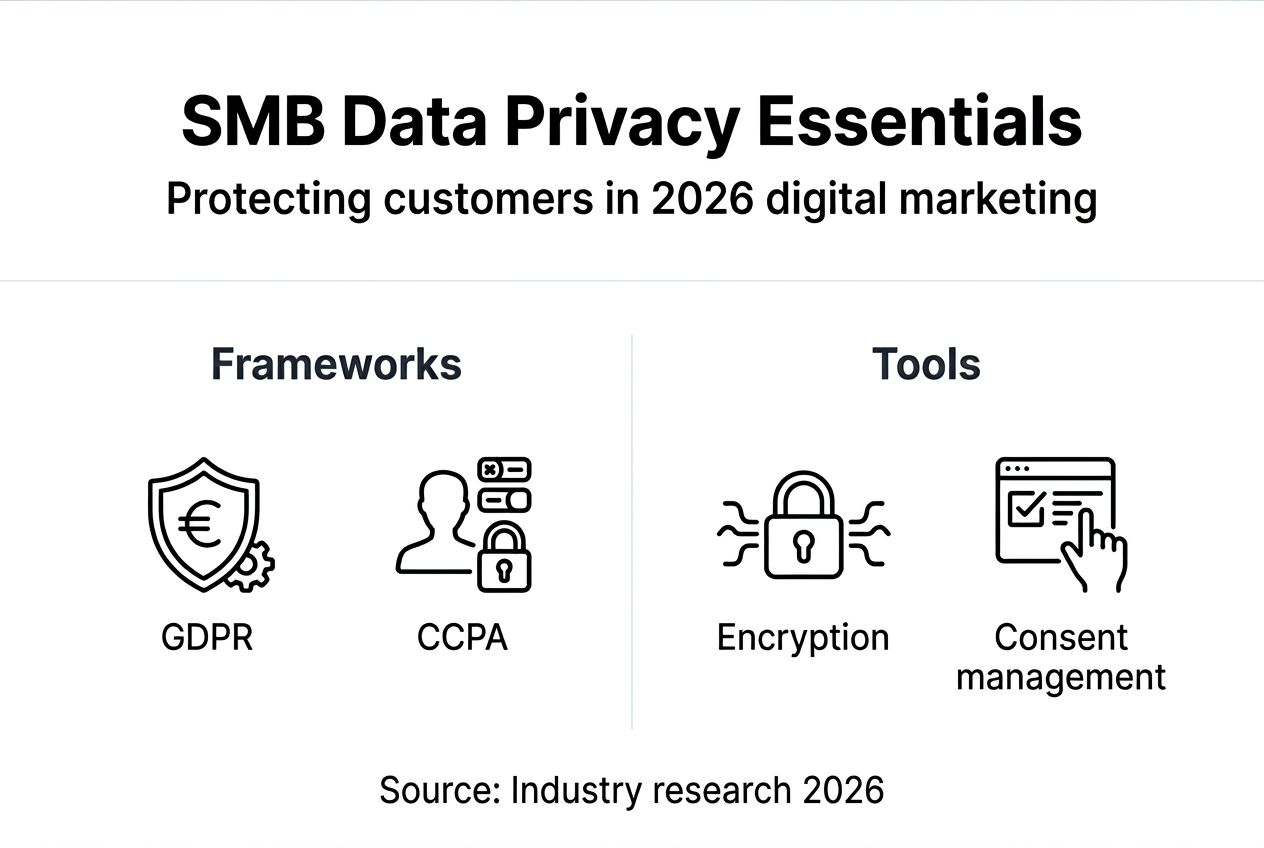
Privacy-enhancing technologies integrate seamlessly with existing marketing stacks. Consent management platforms connect to email systems, analytics tools, and advertising platforms, automatically enforcing privacy choices across channels. This automation reduces manual work while ensuring consistent compliance.
Pro Tip: Create a privacy champion role within your marketing team responsible for staying current on regulations, coordinating audits, and serving as the first point of contact for privacy questions. This dedicated focus prevents privacy from becoming an afterthought in campaign planning.
Staying informed about 2026 digital marketing trends and dark social marketing impacts helps SMBs anticipate privacy challenges in emerging channels. Proactive framework development positions businesses to adopt new marketing technologies while maintaining customer trust and regulatory compliance.
Building customer trust through privacy communication strategies
Transparent privacy communication transforms compliance obligations into marketing advantages. Customers reward honesty with loyalty, sharing more information and engaging more deeply with brands that clearly explain data practices. Effective communication starts with privacy policies written in plain language, avoiding legal jargon that confuses rather than informs.
Best practices for privacy communication include making policies easily accessible from every page, using visual aids like icons or infographics to explain complex concepts, and providing layered information allowing customers to choose detail levels. Highlight what customers gain from sharing data, such as personalized recommendations or exclusive offers, creating value exchanges rather than one-sided extractions.
Implement these trust-building tactics:
- Send proactive updates whenever privacy practices change, explaining reasons and impacts rather than hiding modifications in policy fine print
- Create dedicated FAQ sections addressing common privacy concerns specific to your industry and customer base
- Display visible opt-out mechanisms on every communication, making it effortless for customers to adjust preferences
- Showcase privacy certifications or third-party audits demonstrating commitment to protection standards
- Train customer service teams to answer privacy questions confidently and accurately, turning inquiries into trust-building opportunities
Leveraging digital trust strategies positions privacy as a brand differentiator rather than a regulatory checkbox. Companies excelling at privacy communication attract customers frustrated with competitors who treat data carelessly. This advantage compounds as word-of-mouth recommendations and positive reviews mention privacy protections alongside product quality.
Regular communication maintains trust over time. Send annual privacy reminders explaining current practices and reconfirming consent. This proactive approach prevents surprises, reduces unsubscribe rates, and demonstrates ongoing respect for customer relationships. Privacy becomes part of your brand story, woven into marketing messages that resonate with increasingly privacy-conscious audiences.
Conclusion and next steps: making data privacy part of your marketing DNA
Data privacy represents both a legal requirement and a strategic opportunity for SMBs in 2026. Businesses that embed privacy into marketing operations avoid costly fines, reduce breach risks, and build customer relationships that drive sustainable growth. The frameworks and strategies outlined here provide actionable starting points for transforming privacy from burden to competitive advantage.
Urgency matters because regulatory scrutiny intensifies and consumer expectations rise continuously. Delaying privacy implementation increases vulnerability to breaches, penalties, and reputation damage that can cripple small businesses. Start today by conducting data inventories, establishing consent processes, and training teams on privacy principles.
Commit to making privacy a core marketing value rather than an afterthought. Schedule regular audits, maintain transparent communication with customers, and stay informed about regulatory changes affecting your business. Integrate privacy considerations into every campaign plan, vendor selection, and technology adoption decision. This proactive approach positions your business for long-term success in increasingly privacy-focused markets.
Enhance your digital marketing with expert support
Integrating data privacy with effective marketing strategies requires expertise in both compliance and growth tactics. Professional support helps SMBs navigate complex regulations while optimizing campaigns for maximum impact. Expert services ensure your marketing drives results without compromising customer trust or regulatory standing.
Explore proven SEO strategies that align with privacy best practices, building organic visibility without invasive tracking. Discover social media marketing approaches that engage audiences while respecting data boundaries. Consider professional SEO campaigns designed to grow your business sustainably, combining technical excellence with ethical data handling that protects your brand and customers throughout 2026 and beyond.
FAQ
What are the main differences between GDPR and CCPA?
GDPR requires explicit opt-in consent before collecting any personal data from EU residents, while CCPA allows businesses to collect California resident data unless consumers explicitly opt out. GDPR applies globally to any business handling EU data, whereas CCPA targets larger businesses or those selling personal information. Penalties differ significantly, with GDPR fines reaching 4% of global revenue compared to CCPA’s per-violation structure.
How can SMBs reduce the risk of data breaches effectively?
Implement privacy frameworks emphasizing transparency, data minimization, and regular security audits. Deploy encryption for stored and transmitted data, establish strict access controls limiting who can view customer information, and use consent management platforms to automate compliance. Train staff quarterly on privacy practices and create incident response plans addressing potential breaches before they occur.
Why is transparency important in communicating privacy policies?
Transparency builds customer confidence by demonstrating respect for their data and rights. Clear communication about data practices increases engagement rates and differentiates brands in competitive markets where consumers actively choose privacy-conscious companies. Transparent policies reduce customer service inquiries, prevent misunderstandings, and create trust that translates to higher lifetime values and referral rates.
What common misconceptions should SMBs avoid regarding data privacy?
Avoid believing anonymized data is completely risk-free, as re-identification techniques often succeed in revealing individual identities. Reject the idea that collecting more data always improves marketing, since data minimization often enhances targeting accuracy while reducing compliance burdens. Don’t assume privacy regulations only apply to large corporations, as GDPR and CCPA affect businesses of all sizes handling relevant customer data.
Recommended