






Many B2B companies underestimate their true customer acquisition cost by up to 40% because they omit key sales expenses. This oversight drains budgets and distorts marketing decisions. Understanding every component of CAC and learning how to calculate it accurately transforms your ability to allocate resources, optimize campaigns, and drive profitable growth. This guide shows you how to measure CAC correctly and reduce it using proven digital marketing strategies tailored for competitive B2B markets.
Table of Contents
- Understanding Customer Acquisition Cost (CAC)
- How to Accurately Calculate CAC
- Key Factors That Drive CAC in Competitive B2B Markets
- Common Misconceptions About Customer Acquisition Cost
- Comparing Marketing Channels: CAC by Channel Type
- Practical Strategies to Reduce CAC Using Digital Marketing
- Case Studies Showing Real-World CAC Reduction
- Summary and Next Steps for Marketing Managers
- Boost Your CAC Optimization with Web Spider Solutions
- Frequently Asked Questions
Key Takeaways
| Point | Details |
|---|---|
| Accurate CAC calculation | Combines all marketing and sales expenses divided by new customers acquired in the same period |
| Common underestimation | Excluding sales costs inflates profit projections by 20-40% and misguides budget allocation |
| Channel cost differences | Organic SEO reduces CAC by up to 40% long-term while paid channels offer faster but costlier results |
| Optimization strategies | Data-driven segmentation, retargeting, and funnel improvements lower CAC and boost marketing ROI |
| Continuous monitoring | Regular CAC analysis by channel reveals waste and guides smarter marketing investments |
Understanding Customer Acquisition Cost (CAC)
Customer acquisition cost represents the total expense required to acquire one new customer. Accurate CAC calculation requires combining marketing costs and sales expenses then dividing by new customers in the same timeframe. Marketing costs include advertising spend, content production, marketing software, and agency fees. Sales expenses cover salaries, commissions, CRM tools, and training programs.
CAC serves as a vital metric for B2B marketing managers because it directly impacts profitability and growth planning. When you know your true cost per customer, you can forecast budgets accurately, set realistic revenue targets, and evaluate which marketing channels deliver the best return. Without precise CAC data, you risk overspending on inefficient campaigns or underfunding high-performing channels.
Typical CAC ranges vary significantly across B2B sectors and competitive landscapes:
- Software and SaaS companies often see CAC between $200 and $1,500 depending on product complexity and sales cycle length
- Professional services firms typically experience CAC from $500 to $2,000 due to relationship-driven sales processes
- Manufacturing and industrial B2B companies face CAC ranging from $800 to $3,000 reflecting longer evaluation periods and multiple decision makers
- High competition in any sector drives CAC upward by 30-50% as advertising costs increase and differentiation becomes harder
Understanding these benchmarks helps you evaluate whether your acquisition costs align with industry standards or signal inefficiencies requiring immediate attention. The CAC calculation methodology you adopt must account for every dollar spent influencing a prospect’s journey from awareness to closed deal.
How to Accurately Calculate CAC
Calculating CAC accurately demands methodical tracking and honest cost aggregation. Follow these five steps to measure your true customer acquisition cost:
- Aggregate all marketing and sales costs within a defined period. Include advertising spend, content creation expenses, marketing automation subscriptions, social media management fees, sales team salaries, commissions, CRM licenses, training costs, and overhead allocation for both departments. Choose a consistent timeframe like monthly or quarterly that matches your sales cycle.
- Identify the number of new customers acquired in that same period. Count only customers who completed purchases or signed contracts during your measurement window. Exclude renewals, upsells, or existing customer expansions unless you’re calculating a separate metric.
- Divide total expenses by new customers to get CAC. If you spent $50,000 on marketing and sales in one quarter and acquired 25 new customers, your CAC equals $2,000. This single number becomes your baseline for optimization efforts.
- Analyze CAC drivers like sales cycle length and channel efficiency. Break down costs by marketing channel to identify which sources deliver lower acquisition costs. Examine how sales cycle duration affects resource consumption. Longer cycles typically increase CAC because prospects require more touchpoints and sales attention before converting.
- Use data-driven optimizations based on CAC analysis. Shift budget toward channels with lower CAC and higher conversion rates. Test new targeting strategies to reduce wasted spend. Implement automation to handle repetitive tasks and free sales teams for high-value interactions.
Accurate CAC calculation includes marketing and sales expenses, overhead, and matching acquisition timeframe to cost aggregation. Many companies make the mistake of tracking marketing spend separately from sales costs, creating an incomplete picture that undermines strategic decisions.

Pro Tip: Create a shared spreadsheet where marketing and sales teams input expenses monthly. This transparency ensures nothing gets overlooked and builds accountability for CAC performance across both departments. You can explore B2B digital marketing overview strategies that integrate seamlessly with your CAC tracking for better results. The detailed CAC calculation process becomes simpler when teams collaborate on data collection from day one.
Key Factors That Drive CAC in Competitive B2B Markets
Several internal and external factors influence why your CAC rises or falls compared to industry benchmarks. Understanding these drivers helps you anticipate cost changes and adjust strategies proactively.
- Long B2B sales cycles increase CAC due to prolonged resource use. When prospects take six months or longer to make purchasing decisions, your marketing and sales teams invest more hours nurturing relationships, creating custom proposals, and addressing objections. Each additional touchpoint adds cost without immediate revenue return. Companies with 90-day sales cycles typically see CAC 50-70% lower than those with 180-day cycles in similar industries.
- Different digital channels have varying cost efficiencies impacting CAC. Paid search advertising delivers immediate visibility but requires continuous spend to maintain traffic. Organic SEO builds authority gradually with lower ongoing costs once rankings improve. Social media ads target specific demographics effectively but face rising CPCs in competitive markets. Email marketing to owned lists costs less per contact but depends on list quality and engagement rates.
- Target audience complexity raises acquisition expenses. Selling to enterprise clients with multiple stakeholders demands more personalized content, longer sales engagement, and higher-touch service compared to small business buyers. Geographic expansion into new markets increases CAC as you build brand awareness from scratch and adapt messaging to local preferences.
You can learn more about managing B2B digital campaigns that account for these variables. Recognizing which factors you control versus external market conditions helps prioritize optimization efforts. Focus energy on improving conversion rates, shortening sales cycles through better qualification, and selecting channels aligned with your ideal customer profile.
Common Misconceptions About Customer Acquisition Cost
Several widespread misunderstandings about CAC lead marketing managers to make costly strategic errors. Correcting these beliefs improves budget allocation and campaign performance.
- Spending more does not always lower CAC. Increasing ad budgets without improving targeting or conversion rates often raises CAC because you attract less qualified leads. Indiscriminate spending dilutes message relevance and wastes impressions on audiences unlikely to convert. Smart budget increases focus on proven high-performing segments and channels rather than blanket expansion across all tactics.
- Excluding sales expenses underestimates CAC by 20-40%. Marketing teams sometimes calculate CAC using only their department budgets, ignoring the substantial costs sales teams incur closing deals. This incomplete view makes acquisition appear cheaper than reality and skews ROI projections. Accurate CAC accounting includes every dollar both teams spend from initial lead generation through contract signature.
- Paid channels don’t always reduce CAC better than organic channels. While paid advertising delivers faster results, organic strategies like SEO and content marketing often produce lower long-term CAC once initial investments mature. Paid channels require continuous spending to maintain traffic, whereas organic rankings compound over time with decreasing marginal costs per visitor. The optimal approach blends both for balanced immediate results and sustainable growth.
Pro Tip: Run a quarterly audit comparing CAC across all active channels. Calculate the fully loaded cost including creative production, platform fees, and internal labor hours. This exercise reveals hidden expenses and highlights which channels truly deliver the lowest acquisition costs versus which simply feel effective based on incomplete data.
Comparing Marketing Channels: CAC by Channel Type
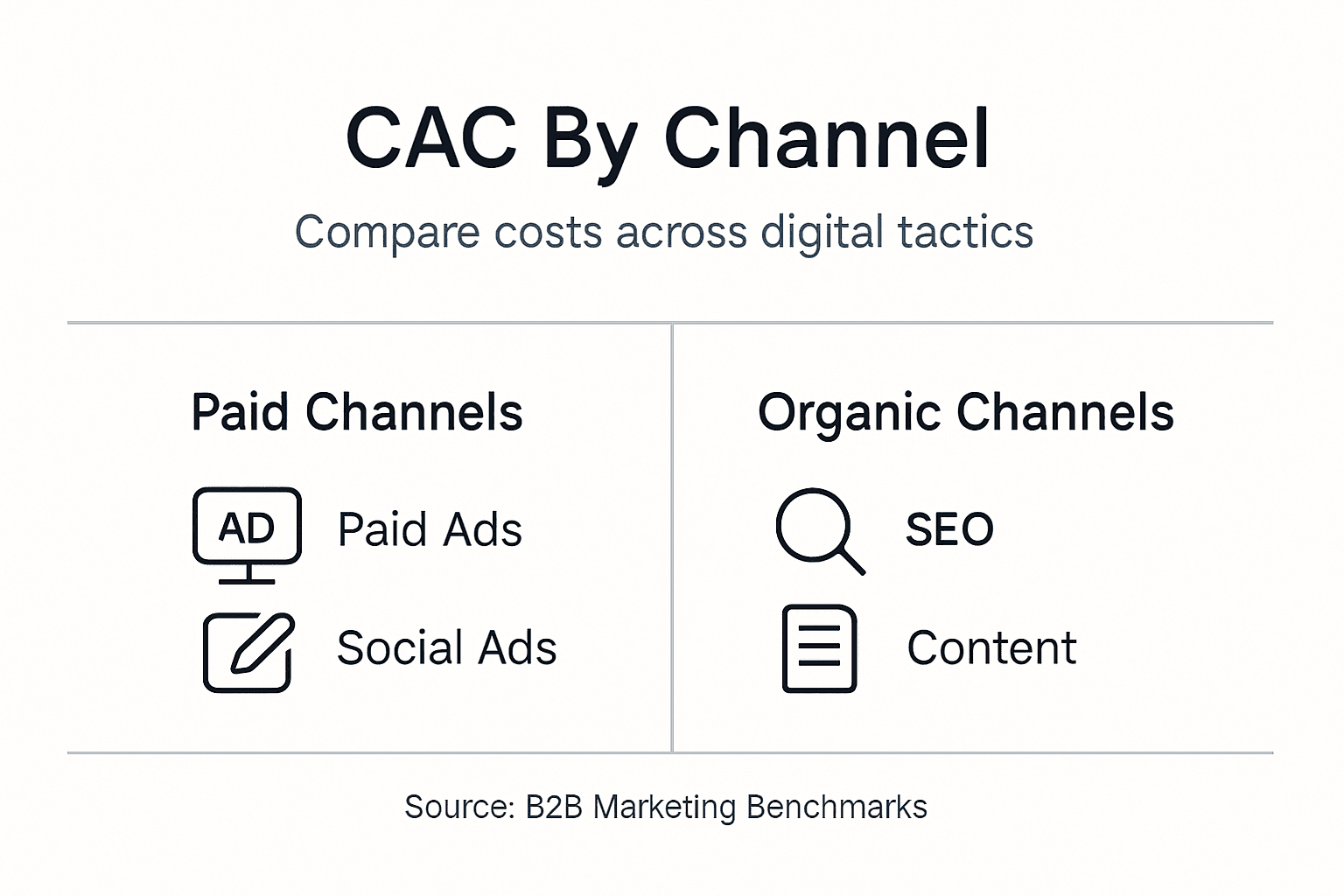
Different digital marketing channels produce widely varying CAC based on their mechanics, competition levels, and time horizons. Understanding these differences guides smarter budget allocation decisions.
| Channel Type | Typical B2B CAC Range | Key Characteristics | Best Use Cases |
|---|---|---|---|
| Organic SEO | $500 – $1,200 | Reduces CAC 40% long-term, requires 6-12 months to mature, compounds over time | Sustainable growth, thought leadership, evergreen content strategies |
| Paid Search (PPC) | $800 – $2,500 | Immediate traffic, variable CAC based on keyword competition, scales quickly | Product launches, seasonal campaigns, testing new markets |
| Paid Social Ads | $600 – $2,000 | Precise targeting, higher CAC but faster lead gen, creative-dependent performance | Account-based marketing, event promotion, brand awareness |
| Content Marketing | $400 – $1,500 | Builds authority gradually, lower ongoing CAC, supports other channels | Lead nurturing, customer education, SEO foundation |
| Email Marketing | $200 – $800 | Lowest CAC for owned lists, high ROI, engagement varies by list quality | Retention campaigns, upselling, nurturing warm leads |
Paid social ads offer faster lead generation but come with higher upfront costs per customer. Organic SEO reduces CAC significantly once your content ranks well, though it demands patience and consistent effort before results materialize. PPC provides immediate traffic with CAC fluctuating based on keyword competition and ad quality scores. The smartest B2B marketing strategies mix channels to balance short-term lead flow with long-term cost efficiency.
Channel mixing optimizes CAC and ROI by leveraging each tactic’s strengths while compensating for weaknesses. Use paid channels to generate immediate pipeline while organic strategies build sustainable traffic. Retarget website visitors through social ads to improve conversion rates without expanding cold audience spend. Track CAC by channel monthly to identify shifts requiring budget reallocation.
Explore B2B digital marketing services that integrate multiple channels for optimized CAC performance. Review B2B digital marketing overview strategies and study B2B marketing examples showing successful channel mix implementations across competitive industries.
Practical Strategies to Reduce CAC Using Digital Marketing
Reducing CAC requires disciplined execution of data-driven tactics that improve targeting precision, conversion efficiency, and resource allocation. Implement these strategies to lower acquisition costs while maintaining or improving lead quality.
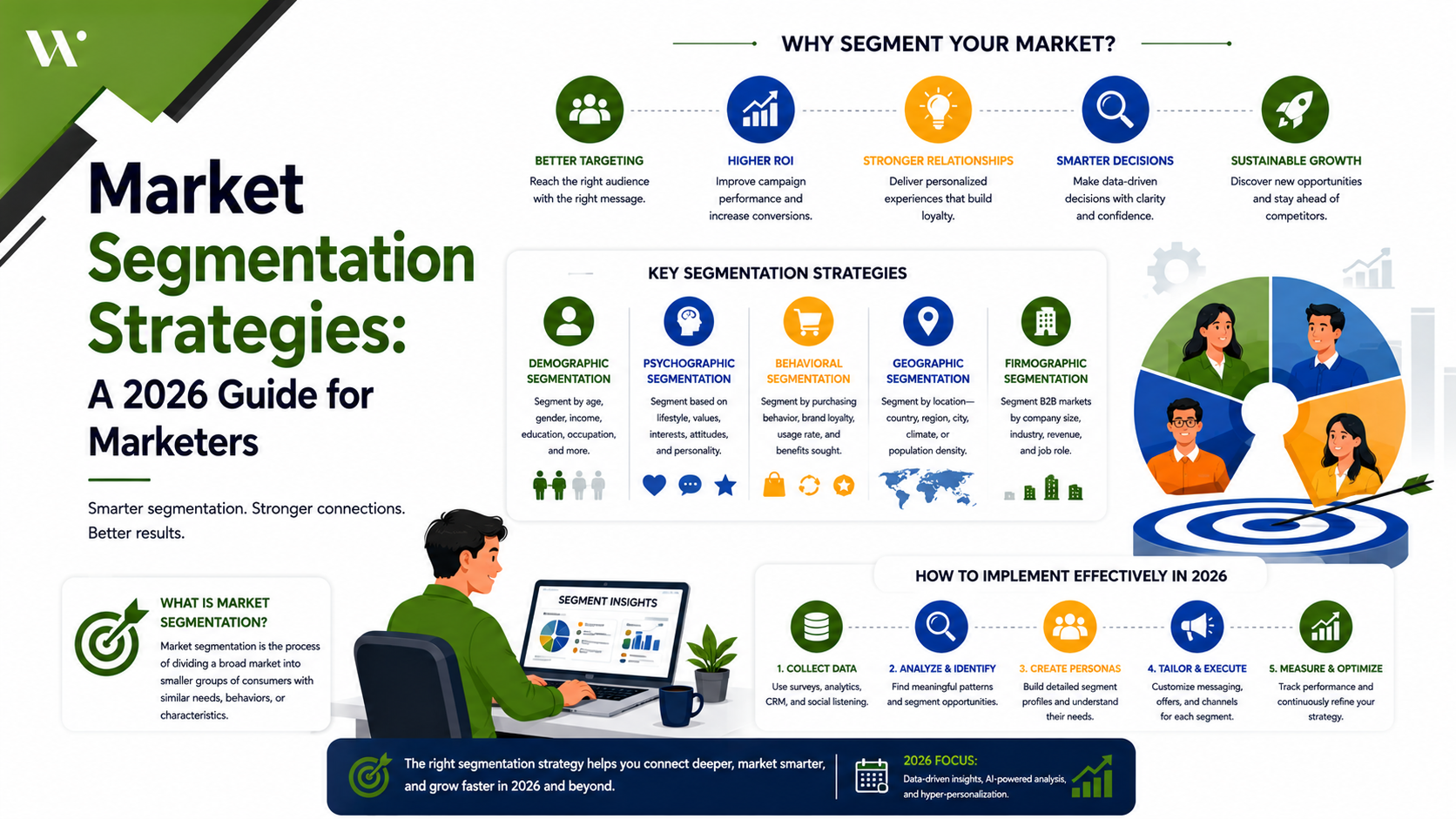
- Use data-driven audience segmentation to target high-value leads. Analyze your CRM and marketing automation data to identify characteristics of customers with highest lifetime value and shortest sales cycles. Build lookalike audiences and exclusion lists that focus ad spend on prospects matching these profiles. This precision targeting reduces wasted impressions and improves conversion rates, directly lowering CAC.
- Implement retargeting campaigns to nurture warm leads cost-efficiently. Website visitors who don’t convert immediately represent partially qualified prospects requiring additional touchpoints. Retargeting ads cost 50-70% less per click than cold prospecting because you’re reaching audiences already familiar with your brand. Create segmented retargeting campaigns based on pages visited, content downloaded, or time spent on site to deliver relevant follow-up messages.
- Optimize sales funnel stages to improve conversion rates. Map your customer journey and identify where prospects drop off most frequently. Test landing page variations, simplify form fields, improve call-to-action clarity, and remove friction points that prevent progression. Even small conversion rate improvements compound across the funnel to significantly reduce overall CAC.
- Leverage analytics tools to evaluate channel performance and reduce waste. Connect Google Analytics, your CRM, and marketing platforms to track which channels, campaigns, and keywords produce customers at lowest cost. Pause underperforming initiatives quickly and reallocate budget to winners. Set up automated reports tracking CAC by channel weekly so you spot trends before they drain budgets.
Pro Tip: Calculate CAC separately for each buyer persona or customer segment. You’ll often discover certain profiles cost significantly less to acquire than others. This insight allows you to adjust targeting, messaging, and channel selection to favor lower-cost segments while maintaining portfolio diversity.
Discover B2B lead generation strategies aligned with CAC reduction goals. Learn techniques for managing digital campaigns that prioritize efficiency and explore how marketing automation for B2B streamlines repetitive tasks to lower labor costs per customer.
Case Studies Showing Real-World CAC Reduction
Real B2B companies have achieved substantial CAC reductions by applying the strategies outlined above. These examples demonstrate practical impact across different industries and company sizes.
- SaaS company cut CAC 35% using customer journey analytics and funnel adjustments. A mid-market software provider analyzed drop-off points in their trial-to-paid conversion funnel and discovered 60% of users abandoned during the payment information step. By simplifying the checkout process, adding trust badges, and offering flexible payment terms, they increased conversion rates from 12% to 18%. This improvement reduced CAC from $1,850 to $1,200 while maintaining lead quality.
- Manufacturing firm lowered CAC 42% with channel mix optimization and retargeting. An industrial equipment manufacturer had been allocating 70% of their digital budget to trade publication ads with minimal tracking. After shifting 40% of spend to SEO content creation and implementing LinkedIn retargeting for website visitors, they reduced CAC from $3,200 to $1,856 over 18 months. The organic content continued generating leads at decreasing marginal costs while retargeting converted previously lost prospects.
- Professional services consultancy reduced CAC 28% through audience segmentation refinement. A B2B consulting firm analyzed three years of customer data and identified that clients in the healthcare vertical had 40% higher lifetime value and 50% shorter sales cycles than other sectors. They reallocated budget to target healthcare decision-makers specifically, resulting in CAC dropping from $2,500 to $1,800 while average deal size increased 25%.
“We thought we understood our customer acquisition costs until we included full sales expenses and tracked by channel. The real numbers showed our paid social campaigns cost nearly double what we calculated initially, while our SEO investments delivered 60% lower CAC than we realized. This clarity transformed our 2026 budget planning.” – Marketing Director, B2B Technology Company
Review more B2B marketing success stories showing measurable improvements in acquisition efficiency across competitive markets.
Summary and Next Steps for Marketing Managers
Accurate CAC measurement stands as a critical capability for B2B marketing managers responsible for budget allocation, growth planning, and demonstrating marketing ROI. The insights covered in this guide provide a foundation for better decision-making.
- Accurate CAC measurement requires including all marketing and sales expenses. Partial calculations that omit sales costs or overhead create misleading metrics that undermine strategic planning and profit projections.
- Common misconceptions about CAC lead to budget waste and missed opportunities. Understanding that higher spending doesn’t automatically lower CAC and that organic channels can outperform paid tactics long-term prevents costly strategic errors.
- Channel-specific CAC analysis reveals where your marketing dollars work hardest. Regular comparison of acquisition costs across channels guides smarter budget reallocation and identifies underperforming initiatives requiring adjustment or elimination.
- Continuous optimization fueled by data improves CAC and marketing ROI. Implementing segmentation, retargeting, funnel improvements, and analytics-driven decision-making reduces acquisition costs while maintaining or improving customer quality.
Taking next steps with analytics and targeted digital marketing transforms CAC from a reactive metric into a proactive tool for competitive advantage. Start by calculating your current CAC accurately including all costs, then analyze performance by channel to identify quick wins. Test one or two optimization strategies from this guide and measure results monthly. Small improvements compound over time to deliver substantial cost reductions and better marketing efficiency.
Boost Your CAC Optimization with Web Spider Solutions
Reducing customer acquisition costs while scaling lead generation requires expertise across multiple digital marketing disciplines. Web Spider Solutions offers tailored SEO, PPC, and content marketing services designed specifically to lower CAC for B2B companies in competitive markets. Our team stays current with 2026 digital marketing trends and algorithm updates, ensuring your strategies leverage the latest best practices for maximum efficiency. We combine technical SEO optimization, data-driven paid advertising management, and strategic content development to improve targeting precision and conversion rates across your entire funnel. Explore our SEO strategy guide for organic growth tactics, review our PPC advertising guide for paid channel optimization, and discover how our content marketing services build sustainable lead generation systems that reduce long-term acquisition costs.
Frequently Asked Questions
What is customer acquisition cost (CAC)?
CAC represents the total cost required to acquire one new customer, including all marketing and sales expenses divided by the number of customers gained in the same period. This metric encompasses advertising spend, content creation, software tools, sales salaries, commissions, and overhead allocation.
Why is CAC important for B2B marketing managers?
CAC directly impacts profitability and guides budget allocation decisions for sustainable growth. Knowing your true cost per customer helps forecast accurately, evaluate channel performance, set realistic revenue targets, and demonstrate marketing ROI to leadership. Without precise CAC tracking, you risk overspending on inefficient campaigns or underfunding high-performing channels.
How can I reduce CAC using digital marketing?
Implement data-driven audience segmentation to target high-value prospects more precisely and reduce wasted ad spend. Optimize your sales funnel to improve conversion rates at each stage, deploy retargeting campaigns to nurture warm leads cost-efficiently, and regularly evaluate channel performance to reallocate budget toward tactics delivering lowest acquisition costs. Small improvements across multiple touchpoints compound to significantly reduce overall CAC.
What common mistakes should I avoid when calculating CAC?
Include both marketing and sales costs fully rather than tracking departments separately, which typically underestimates true CAC by 20-40%. Match your expense aggregation period exactly to your customer acquisition timeframe to avoid distorted metrics. Analyze CAC by channel and customer segment rather than using a single company-wide average, as this granular view reveals optimization opportunities masked by aggregate numbers.
Recommended