






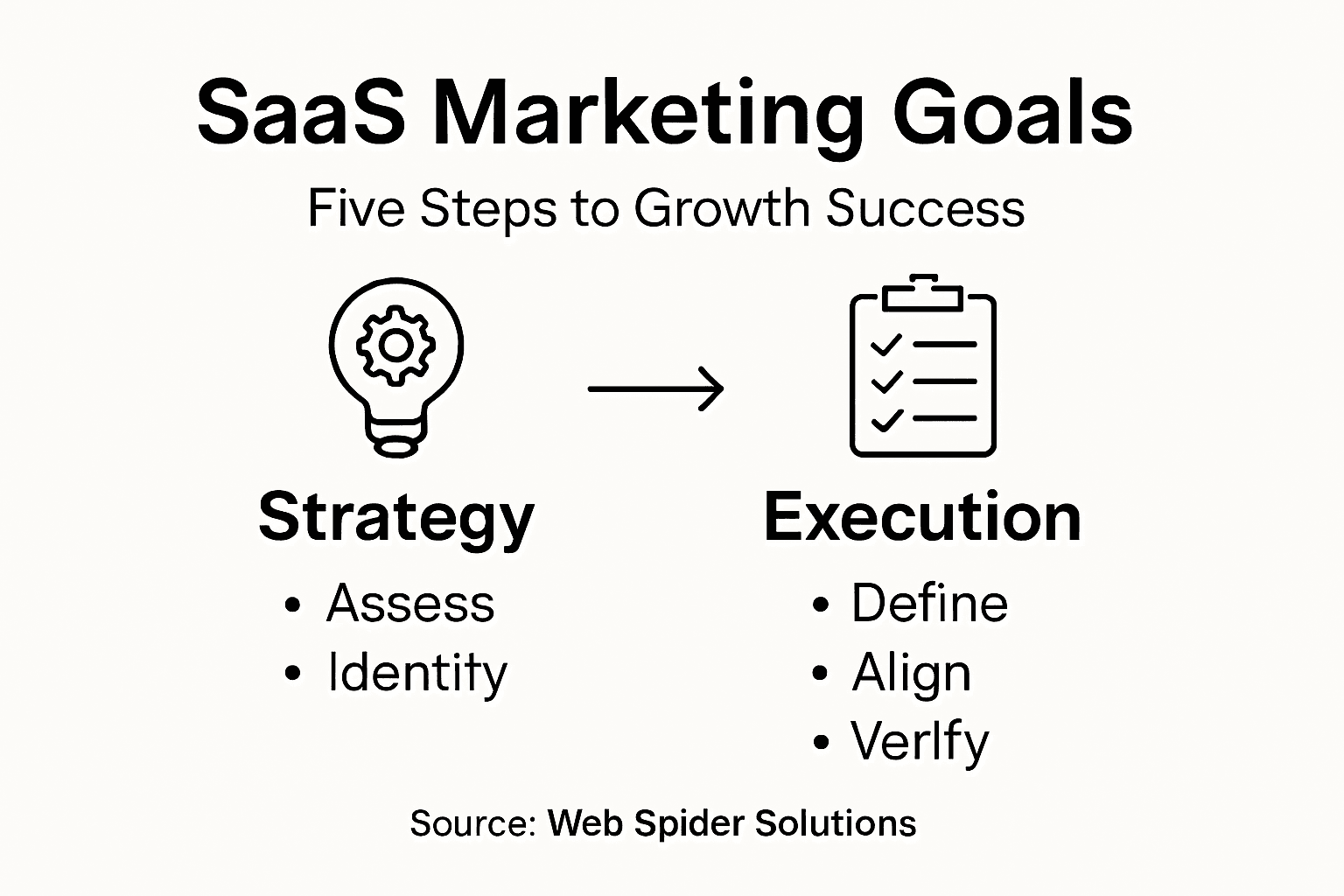
Every marketing manager knows how challenging it can be to set clear goals that actually fuel growth. Without a strategic assessment, targets often feel vague or disconnected from real business results. By focusing on measurable objectives and key SaaS marketing metrics like Customer Acquisition Cost and Customer Lifetime Value, you gain a practical blueprint for aligning your efforts with scalable online visibility and lasting success.
Table of Contents
- Step 1: Assess Current Marketing Performance
- Step 2: Identify Business Growth Priorities
- Step 3: Define Measurable Marketing Objectives
- Step 4: Align Goals With Available Resources
- Step 5: Verify Goal Relevance And Impact
Quick Summary
| Key Message | Explanation |
|---|---|
| 1. Assess marketing performance thoroughly | Use metrics like CAC, CLV, and churn rate to evaluate strengths and weaknesses in your SaaS marketing strategy. |
| 2. Align growth priorities with business objectives | Focus on key areas such as customer acquisition and revenue expansion to guide your marketing efforts strategically. |
| 3. Establish clear, measurable marketing objectives | Apply the SMART criteria to set specific, attainable goals that drive results and align with your overall strategy. |
| 4. Match goals with available resources | Assess your team’s capabilities and budget to ensure ambitious marketing objectives are realistic and achievable. |
| 5. Validate goal relevance regularly | Conduct reviews to ensure that marketing objectives align with evolving market conditions and business priorities. |
Step 1: Assess current marketing performance
To drive successful SaaS growth, you must first understand your current marketing performance through a strategic and data-driven assessment. This critical step helps you identify strengths, weaknesses, and opportunities within your existing marketing approach.
Start by gathering comprehensive marketing metrics that provide a holistic view of your performance. Evaluate key SaaS marketing metrics such as:
- Customer Acquisition Cost (CAC)
- Customer Lifetime Value (CLV)
- Monthly Recurring Revenue (MRR)
- Churn Rate
- Conversion Rates
To conduct a thorough assessment, leverage analytics tools to track these metrics across different channels. Compare your current performance against industry benchmarks to understand how your marketing efforts stack up. Look for patterns in user engagement, conversion rates, and customer retention that can reveal insights about your marketing strategy’s effectiveness.
Here’s how key SaaS marketing metrics influence business decisions:
| Metric | Business Impact | Typical Analytics Use |
|---|---|---|
| CAC | Guides budget allocation | Identifies cost efficiency |
| CLV | Informs pricing strategy | Predicts revenue potential |
| MRR | Tracks subscription health | Supports growth forecasting |
| Churn Rate | Highlights retention issues | Drives customer loyalty efforts |
| Conversion Rate | Measures campaign success | Optimizes user acquisition funnel |
A comprehensive marketing performance assessment links strategic objectives directly to measurable outcomes.
Analyze not just the numbers, but the story behind them. Identify which marketing channels are driving the most qualified leads, which campaigns have the highest return on investment, and where potential optimization opportunities exist.
Pro tip: Schedule quarterly marketing performance reviews to maintain ongoing visibility into your strategy’s effectiveness and quickly adapt to changing market dynamics.
Step 2: Identify business growth priorities
Successfully scaling your SaaS business requires a strategic approach to identifying and prioritizing key growth objectives. This step involves aligning your marketing efforts with broader business goals to create a focused and actionable growth strategy.
Strategic growth metrics play a critical role in defining your business priorities. Consider the following key areas for focused growth:
- Customer Acquisition
- Revenue Expansion
- Product Development
- Market Penetration
- Customer Retention
To effectively prioritize your growth initiatives, analyze your current business performance and market positioning. Look beyond simple revenue numbers and examine deeper metrics that indicate sustainable growth potential. This means understanding not just where you are, but where you can realistically expand.
Successful SaaS growth strategies connect tactical marketing efforts to overarching business objectives.
Break down your growth priorities into specific, measurable goals. For instance, if customer acquisition is a primary focus, determine specific targets for new customer sign-ups, conversion rates, and customer acquisition cost. Ensure these priorities are aligned with your overall business model and market opportunity.

Pro tip: Conduct quarterly strategic reviews to reassess your growth priorities and maintain alignment with evolving market dynamics and company capabilities.
Step 3: Define measurable marketing objectives
Crafting precise marketing objectives is the cornerstone of driving strategic growth for your SaaS business. By establishing clear, quantifiable goals, you create a roadmap that transforms abstract ambitions into concrete, actionable strategies.
SMART marketing goals provide the framework for effective objective setting. Focus on developing objectives that are:
- Specific: Clearly defined and unambiguous
- Measurable: Quantifiable with concrete metrics
- Attainable: Realistic and achievable
- Relevant: Aligned with broader business strategy
- Time-bound: With clear deadlines and milestones
Translate your high-level growth priorities into specific marketing objectives. For example, instead of a vague goal like “increase customers,” define a precise target such as “acquire 500 new enterprise customers with an average contract value of $5,000 within the next two quarters.”
Effective marketing objectives bridge the gap between strategic vision and tactical execution.
Ensure your objectives are data-driven by linking them to key performance indicators (KPIs) that directly reflect business impact. This might include metrics like customer acquisition cost, conversion rates, monthly recurring revenue, or customer lifetime value. By anchoring your goals in measurable outcomes, you create a clear mechanism for tracking progress and making informed strategic adjustments.
Pro tip: Develop a quarterly objective tracking dashboard that visualizes your progress, enabling real-time insights and rapid strategic recalibration.
Use this summary to differentiate between SMART objective components:
| Component | Definition | Example for SaaS |
|---|---|---|
| Specific | Clear, focused goal | “Increase trial sign-ups” |
| Measurable | Quantified outcome | “Boost by 30% quarterly” |
| Attainable | Realistic target | “Based on current team size” |
| Relevant | Business-aligned aim | “Supports revenue growth” |
| Time-bound | Deadline-driven | “Achieve in 6 months” |
Step 4: Align goals with available resources
Successful SaaS marketing requires a strategic approach that balances ambitious goals with realistic resource constraints. Your growth strategy must be grounded in a thorough understanding of your team’s capabilities, budget, and operational capacity.
Scaling with operational precision demands a comprehensive assessment of your available resources. Conduct a detailed inventory of your current capabilities:
- Human Resources: Team skills, bandwidth, and expertise
- Financial Resources: Marketing budget and investment capacity
- Technical Infrastructure: Existing tools and technology
- Operational Capabilities: Internal processes and scalability
- Time and Bandwidth: Real-world constraints on team availability
Map your marketing objectives directly to your resource inventory. This means being honest about what you can realistically achieve given your current constraints. If your team lacks specific skills or technologies, consider either upskilling, hiring, or finding strategic partnerships to bridge those gaps.
Resource alignment transforms ambitious goals from wishful thinking to achievable strategies.
Prioritize your objectives based on resource efficiency. Focus on initiatives that offer the highest potential return with the least strain on your existing capabilities. This might mean starting with lower-risk, high-impact projects that can be executed with your current resources, then gradually expanding as you build capacity.
Pro tip: Create a quarterly resource allocation matrix that visually maps your marketing objectives against available resources, enabling dynamic adjustments and preventing overextension.
Step 5: Verify goal relevance and impact
Validating your marketing goals requires a strategic approach that ensures every objective contributes meaningfully to your SaaS company’s growth trajectory. This critical step transforms theoretical goals into tangible drivers of business success.
Marketing KPIs for strategic validation help you assess the true potential of your marketing objectives. Implement a comprehensive verification process by examining:
- Business Alignment: How directly goals connect to core business outcomes
- Measurability: Clarity of metrics and tracking mechanisms
- Growth Potential: Potential impact on revenue and customer acquisition
- Competitive Positioning: Comparative advantage against market benchmarks
- Strategic Flexibility: Ability to adapt goals to changing market conditions
Cross-reference your marketing goals with key performance indicators that demonstrate genuine business impact. This means moving beyond surface-level metrics to understand how each objective contributes to sustainable growth, customer engagement, and competitive positioning.
Meaningful marketing goals are not just targets, but strategic instruments of organizational transformation.
Conduct periodic reviews that challenge the relevance of your existing goals. Market conditions evolve rapidly, and what seemed strategic six months ago might now be obsolete. Be prepared to pivot, refine, or completely redesign objectives that no longer serve your core business mission.
Pro tip: Create a quarterly goal relevance scorecard that objectively rates each marketing objective against current business priorities and market dynamics.
Unlock Your SaaS Growth Potential with Strategic Marketing Support
Setting clear marketing goals for SaaS growth can be challenging when you face questions about aligning objectives with resources and measuring real impact. This article highlights how critical it is to focus on SMART marketing objectives, regularly assess performance, and ensure every goal directly supports sustainable growth. If you struggle with customer acquisition cost, conversion tracking, or defining measurable targets, you are not alone.
At Web Spider Solutions, we specialize in helping businesses like yours transform complex growth strategies into actionable marketing campaigns that deliver results. Whether you need expert guidance on optimizing paid advertising or want creative content marketing that drives qualified leads, our team crafts tailored solutions that empower your goals. Explore our Paid Advertising Archives – Web Spider Solutions to see how precise ad strategies can lower your CAC and boost conversions. For broader insights and success stories, visit our Stories Archives – Web Spider Solutions.
Ready to make your SaaS marketing goals measurable, relevant, and achievable? Connect with us today at Web Spider Solutions to schedule a free consultation and start turning your objectives into tangible growth.
Frequently Asked Questions
How can I assess my current marketing performance for SaaS growth?
To assess your current marketing performance, gather key metrics such as Customer Acquisition Cost (CAC), Customer Lifetime Value (CLV), and Churn Rate. Utilize analytics tools to analyze these metrics across different channels and compare your performance against industry benchmarks within the next month.
What are the key growth priorities I should focus on for my SaaS business?
Focus on growth priorities like Customer Acquisition, Revenue Expansion, and Customer Retention. Analyze your market positioning and prioritize these areas based on your current performance, aiming to establish specific targets for each area within three months.
How do I define measurable marketing objectives for my SaaS company?
Define measurable marketing objectives by using the SMART criteria: Specific, Measurable, Attainable, Relevant, and Time-bound. For example, instead of saying “increase customers,” set a goal to “acquire 500 new customers within the next quarter.”
How can I align my marketing goals with my available resources?
Align your marketing goals by mapping them to your team’s capabilities, budget, and tools. Conduct a thorough assessment of your resources and prioritize initiatives that provide the highest return on investment with your current capabilities within the next quarter.
What steps should I take to verify the relevance and impact of my marketing goals?
To verify the relevance and impact of your marketing goals, evaluate their alignment with core business outcomes and assess their growth potential. Conduct periodic reviews to challenge the goals, ensuring they remain aligned with your business objectives and market conditions; aim for these reviews every quarter.