







Every SaaS leader knows that building online trust is a daily challenge with high stakes. Without clear signals of reliability and competence, even the most innovative platforms can struggle to win over discerning prospects. Online trust in SaaS depends on more than technical features—it grows through strong security, consistent support, and a solid provider reputation. This article clarifies how trust shapes every stage of the customer journey, offering practical strategies to help your brand inspire confidence and loyalty.
Table of Contents
- Defining Online Trust for SaaS Businesses
- Core Pillars of Digital Trust Online
- Strategies to Increase SaaS Brand Credibility
- Compliance, Privacy, and Security Expectations
- Mitigating Risks and Common SaaS Pitfalls
Key Takeaways
| Point | Details |
|---|---|
| Online Trust is Multidimensional | Trust in SaaS involves technical, institutional, and interpersonal factors, which include platform reliability and customer support quality. |
| Core Pillars of Digital Trust | Digital trust is built on ability, benevolence, integrity, security, and consistency, necessitating a balance of technology and human interaction. |
| Brand Credibility Strategies | Enhancing brand credibility involves transparent pricing, consistent performance, authentic testimonials, and effective communication with customers. |
| Risk Management is Essential | Proactive risk management strategies help address common SaaS pitfalls and build user trust through transparency and effective mitigation actions. |
Defining Online Trust for SaaS Businesses
Online trust represents a complex psychological and technological contract between SaaS providers and their potential customers, encompassing far more than simple transactional interactions. At its core, online trust emerges from multiple interconnected factors that signal reliability, competence, and genuine commitment to solving customer problems.
Research reveals that trust in SaaS environments is multidimensional, involving technical, institutional, and interpersonal elements. Comprehensive trust analysis demonstrates that users evaluate trust through several critical dimensions:
- Technical reliability of the platform
- Security and data protection measures
- Transparency in service delivery
- Consistent customer support quality
- Provider’s reputation and market standing
The technological infrastructure plays a pivotal role in establishing trust. SaaS businesses must demonstrate robust security protocols, seamless user experiences, and consistent performance. SaaS trust mechanisms indicate that perceived usefulness, ease of use, and responsive customer service are fundamental trust-building components.
Moreover, trust is not a static concept but a dynamic relationship continuously shaped by user interactions, platform updates, and ongoing communication. Digital marketing strategies that prioritize transparency, showcase customer testimonials, and provide clear value propositions can significantly enhance trust perceptions.
The table below summarizes the distinct roles of technical and human-centered trust strategies for SaaS businesses:
| Trust Strategy Type | Key Focus Area | Typical Activities | Business Impact |
|---|---|---|---|
| Technical | Platform reliability | Security updates, uptime tracking | Reduces security concerns |
| Human-Centered | User relationships | Personalized support, transparency | Strengthens long-term loyalty |
Pro tip: Implement a comprehensive trust dashboard that visibly displays security certifications, uptime statistics, and real-time customer satisfaction metrics to instantly communicate reliability.
Core Pillars of Digital Trust Online
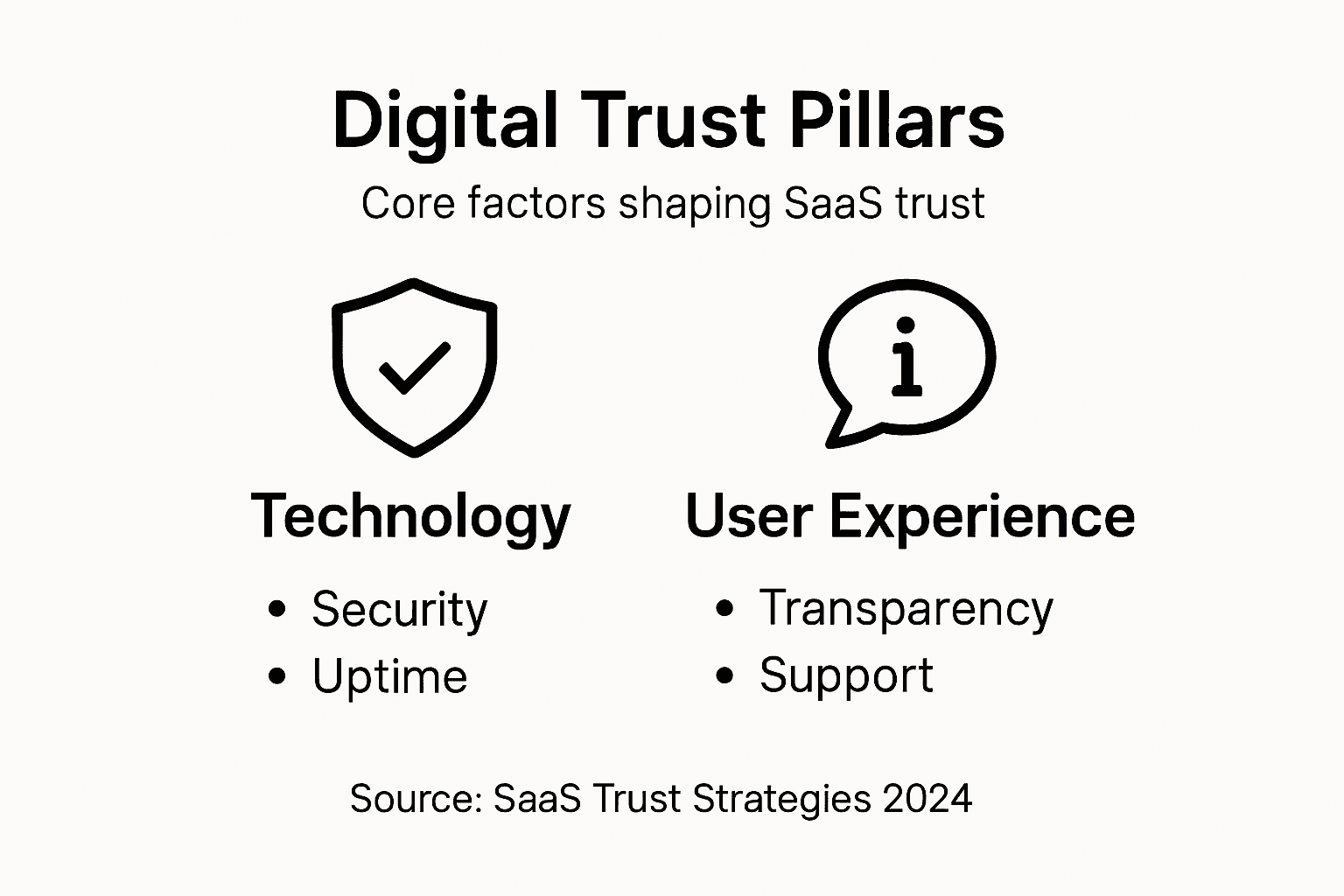
Digital trust represents a sophisticated framework of interconnected elements that define how users perceive and engage with online platforms. Comprehensive trust framework reveals that digital trust extends beyond simple technological interactions, encompassing complex psychological and operational dimensions.
The core pillars of digital trust can be structured around several critical components:
- Ability: Demonstrating technical competence and platform reliability
- Benevolence: Showing genuine commitment to user success
- Integrity: Maintaining transparent and ethical operational practices
- Security: Implementing robust data protection mechanisms
- Consistency: Delivering predictable and reliable user experiences
Online trust mechanisms highlight that these pillars are not isolated elements but interconnected factors that collectively shape user perception. Technical reliability serves as the foundation, while interpersonal elements like communication and responsiveness create deeper trust connections.
Successful digital trust strategies require a holistic approach that balances technological infrastructure with human-centric design. This means creating platforms that are not just functionally robust but also emotionally intelligent, anticipating user needs and proactively addressing potential concerns.
Pro tip: Create a transparent trust center on your platform that visually maps your security protocols, data handling practices, and ongoing commitment to user protection.
Strategies to Increase SaaS Brand Credibility
Brand credibility in the SaaS world represents a delicate ecosystem of perception, performance, and trust. SaaS brand trust research reveals that credibility is not just about technological capabilities, but about consistently demonstrating value and understanding customer needs.
Key strategies to enhance SaaS brand credibility include:
- Provide transparent pricing structures
- Deliver consistent and reliable product performance
- Showcase authentic customer testimonials
- Develop comprehensive onboarding and support processes
- Maintain regular communication about product improvements
- Demonstrate measurable business outcomes for customers
Building credibility requires a multifaceted approach that goes beyond marketing rhetoric. Companies must align their messaging with actual service quality, creating a narrative that resonates with potential customers’ specific business challenges. This means developing robust technical infrastructure, maintaining predictable service levels, and proactively addressing potential user concerns.

Customer support plays a critical role in establishing brand credibility. Responsive, knowledgeable support teams that can quickly resolve issues and provide strategic guidance become powerful ambassadors for the brand. The goal is to transform technical interactions into trust-building opportunities that demonstrate genuine commitment to customer success.
Pro tip: Create a public roadmap that transparently showcases planned product improvements, demonstrating ongoing innovation and responsiveness to customer feedback.
Compliance, Privacy, and Security Expectations
Compliance in the digital ecosystem represents a critical foundation for building trust with SaaS customers. Global privacy and security frameworks demonstrate that modern users have sophisticated expectations about data protection and regulatory adherence.
Key compliance and security considerations include:
- Adherence to international data protection regulations
- Transparent data handling and processing practices
- Regular third-party security audits
- Comprehensive data encryption protocols
- Clear incident response and breach notification procedures
- Granular user consent and permission management
Trust and accountability mechanisms underscore the importance of proactive security strategies. SaaS companies must move beyond minimum compliance requirements, developing robust frameworks that anticipate and mitigate potential risks while maintaining complete transparency with users.
Effective security strategies involve continuous monitoring, rapid vulnerability assessment, and adaptive protection mechanisms. This means implementing multi-layered security approaches that protect not just data, but also user privacy, system integrity, and overall digital ecosystem health.
Pro tip: Develop a publicly accessible security whitepaper that details your comprehensive approach to data protection, demonstrating commitment to transparency and user trust.
Mitigating Risks and Common SaaS Pitfalls
Risk management is a critical component of successful SaaS strategy, requiring proactive and comprehensive approaches to identify and neutralize potential vulnerabilities. SaaS adoption risk analysis reveals multiple complex challenges that can undermine user trust and platform reliability.
Common SaaS risks and corresponding mitigation strategies include:
- Data Breaches: Implement multi-layered encryption and regular security audits
- Service Disruptions: Develop robust redundancy and failover mechanisms
- Vendor Lock-in: Create flexible data migration and integration protocols
- Performance Inconsistencies: Establish clear service level agreements (SLAs)
- Scalability Limitations: Design adaptable infrastructure with predictable performance
- Compliance Gaps: Maintain continuous regulatory alignment
Systematic trustworthiness assessment demonstrates that effective risk mitigation requires more than technical solutions. SaaS providers must develop holistic strategies that balance technological robustness with transparent communication, creating an ecosystem of trust and reliability.
Successful risk management involves continuous monitoring, rapid response capabilities, and proactive communication. This means developing sophisticated early warning systems, maintaining transparent incident reporting, and demonstrating a commitment to user protection that goes beyond minimal compliance requirements.
This table highlights common SaaS risks and how effective mitigation strengthens user trust:
| Common SaaS Risk | Effective Mitigation Action | Resulting Trust Benefit |
|---|---|---|
| Data Breaches | End-to-end encryption, audits | Increased confidence in security |
| Service Disruptions | Infrastructure redundancy | Improved reliability perception |
| Vendor Lock-in | Open integration protocols | User control over data migration |
| Performance Issues | Monitored SLAs and auto-scaling | Trust in consistent service levels |
Pro tip: Create a dedicated risk transparency portal that provides real-time updates on security measures, potential vulnerabilities, and mitigation strategies.
Elevate Your SaaS Brand Through Trusted Digital Marketing
Building trust online is essential for SaaS businesses facing challenges like demonstrating platform reliability, ensuring transparency, and delivering consistent customer experiences. The article highlights key pain points such as strengthening technical trust, fostering customer loyalty, and maintaining security compliance. At Web Spider Solutions, we understand these challenges and focus on tailored digital marketing strategies that showcase your SaaS brand’s credibility while improving visibility and driving targeted leads.
Our comprehensive services blend data-driven SEO, engaging content marketing, and strategic PPC advertising to communicate your commitment to transparency and user success. Discover how our expertise can amplify your SaaS growth by exploring insights on B2B marketing strategies and real-world success stories in our Stories archive. Ready to build trust that converts and retains users? Visit Web Spider Solutions today and take the first step toward transforming your SaaS brand presence.
Frequently Asked Questions
What are the key components of online trust for SaaS businesses?
Online trust for SaaS businesses involves technical reliability, security measures, transparency in service delivery, quality customer support, and a strong market reputation.
How can SaaS companies build brand credibility?
SaaS companies can enhance brand credibility by providing transparent pricing, delivering consistent product performance, showcasing authentic customer testimonials, and maintaining clear communication about product improvements.
What role does compliance play in building online trust?
Compliance is crucial for online trust, as it demonstrates adherence to data protection regulations, transparent data handling practices, and proactive security measures, which can enhance user confidence.
How can risks be mitigated in a SaaS business?
Risks in SaaS businesses can be mitigated by implementing multi-layered security measures, developing infrastructure redundancy, creating flexible data integration protocols, and maintaining clear service level agreements to ensure reliability.
Recommended