






Every decision-maker in B2B SaaS knows how quickly a promising prospect turns cold when trust wavers. Customer trust is not just a hopeful ideal—it shapes whether businesses engage, invest, and advocate for your brand. For digital marketing managers, mastering the art of building real trust means more than ticking boxes. This article explores practical, research-backed strategies to strengthen customer trust in digital environments, revealing how transparent content, genuine communication, and the right credibility signals drive better engagement and lasting brand reputation.
Table of Contents
- Defining Customer Trust in Digital Marketing
- Types of Trust and Common Misconceptions
- Key Trust Signals in SaaS Markets
- Content and Communication Strategies That Build Trust
- Maintaining Trust for Long-Term Customer Loyalty
- Avoiding Common Trust-Damaging Mistakes
Key Takeaways
| Point | Details |
|---|---|
| Customer Trust is Essential | Trust serves as the foundation for customer interaction, crucial for conversion and long-term loyalty, especially in B2B SaaS. |
| Types of Trust Matter | Understanding and addressing affective, cognitive, institutional, and relational trust is key to influencing customer decisions. |
| Trust Signals Drive Engagement | Displaying security certifications, third-party reviews, and transparent pricing significantly enhances prospects’ confidence in your brand. |
| Maintain Trust Through Consistency | Consistent quality and proactive communication across all customer touchpoints are vital for sustaining trust over time. |
Defining Customer Trust in Digital Marketing
Customer trust in digital marketing isn’t some abstract concept floating in the digital void. It’s the foundation that determines whether a prospect clicks your ad, opens your email, or actually completes a purchase. For B2B SaaS companies, this becomes even more critical because you’re asking businesses to invest time and money into your solution.
At its core, trust in digital spaces means customers believe your company will deliver what you promise without misrepresenting features or withholding critical information. Research on consumer digital trust shows that reducing customer suspicion of omitted or falsified content directly impacts conversion rates and customer lifetime value. When users question whether your claims are legitimate, they simply move to a competitor.
For SaaS companies specifically, trust operates on multiple levels. There’s the trust customers place in your actual product or service. Then there’s trust in your marketing communications. Finally, there’s trust in how you handle their data and personal information. All three must align.
Digital trust gets disrupted quickly. A misleading product demo, hidden pricing tiers, or slow customer support response creates cracks that spread fast through reviews and social channels. Conversely, companies that maintain transparent content and verify creator authenticity see measurable improvements in engagement and conversions across their digital channels.
Your approach to digital marketing directly influences this trust equation. This is where many SaaS companies stumble. They chase leads aggressively but fail to build the credibility that actually converts those leads into paying customers. The companies that win understand that trust matters in digital marketing because it mitigates customer skepticism and creates reliable online relationships that foster long-term loyalty.
Building this trust starts with understanding exactly what your customers need to believe about your company before they’ll move forward. It’s not magic. It’s strategy.
Pro tip: Audit your current marketing materials today, specifically looking for claims without evidence, pricing you bury on page three, or customer stories lacking real details. These are trust killers that repel high-quality leads.
Types of Trust and Common Misconceptions
Trust isn’t a single thing. Most SaaS companies treat it that way, and that’s their first mistake. When you lump all trust into one bucket, you miss the specific levers that actually move customer behavior.
Research identifies multiple types of trust operating simultaneously in digital environments. There’s affective trust, which is emotional. This is whether a customer likes your brand and feels a genuine connection. Then there’s cognitive trust, which is rational. This is whether your company appears competent, secure, and reliable based on evidence.
Institutional trust matters too. Customers ask themselves: Does this company follow regulations? Do industry bodies vouch for them? Have government agencies blessed their practices? For SaaS, this includes compliance certifications, data protection standards, and industry recognition.
Relational trust is what develops over time through consistent interactions. It’s the accumulated belief that your company keeps its word repeatedly. A prospect might have zero relational trust initially, but strong institutional and cognitive trust can move them forward.
Here’s a comparison of key trust types in SaaS and how they influence purchase decisions:
| Trust Type | Description | How It Shapes Decisions | Ways to Strengthen |
|---|---|---|---|
| Affective | Emotional connection with brand | Speeds up emotional buy-in | Social proof, stories |
| Cognitive | Perceived competence, reliability, security | Validates product capabilities | Certifications, data sheets |
| Institutional | Trust in company’s conformity to rules & standards | Reduces regulatory concerns | Compliance badges, awards |
| Relational | Built over time through consistent actions | Fosters long-term loyalty | Frequent, reliable support |
Here’s where companies go wrong. Many assume that one strong area compensates for weakness elsewhere. A SaaS company with exceptional security practices (cognitive trust) might ignore customer reviews and social proof (affective and relational trust). The result? Prospects respect the security but don’t feel emotionally connected, so they drag their feet on purchasing decisions.
Another misconception: trust is static. It’s not. Trust in SaaS adoption involves dynamic dimensions including perceived usefulness, security concerns, and social validation. Your customers reassess trust constantly as they interact with your marketing, product, and support team. One bad support experience doesn’t destroy everything, but it weakens the structure.
Final misconception: you build trust equally across all channels. Wrong. A prospect might trust your product documentation (cognitive) but distrust your sales team (affective). They might believe your company is legitimate (institutional) but doubt your feature roadmap (relational).
Pro tip: Audit each trust type separately in your marketing strategy: identify where affective, cognitive, institutional, and relational trust are strongest or weakest, then target improvements where gaps exist.
Key Trust Signals in SaaS Markets
Your prospects don’t have time to deeply investigate your company. They make rapid judgments based on visible signals. In SaaS, those signals determine whether someone books a demo or keeps scrolling.
The most powerful trust signals in SaaS are security certifications and compliance badges. SOC 2 Type II, ISO 27001, GDPR compliance, HIPAA certification—these aren’t optional extras. Prospects handling sensitive data won’t move forward without them. Display these prominently on your website and in sales materials.
Customer reviews and independent ratings rank second. But not all reviews carry equal weight. Trust signals must align with service context to maximize credibility. A five-star rating on a large review platform like G2 or Capterra matters far more than glowing testimonials from your own website. Third-party validation removes skepticism in ways self-promotion never can.
Transparent pricing and service reliability information signals honesty. When you hide pricing behind contact forms, you trigger red flags. Customers assume you’re trying to trap them into expensive contracts. Conversely, trust signals for SaaS include clear compliance disclosures and transparent uptime information that reduce friction and build confidence immediately.
Uptime guarantees matter more than you realize. If your SaaS platform goes down, customers lose revenue. A 99.9% uptime guarantee with public status pages shows you stand behind your reliability. Similarly, professional certifications from recognized bodies signal competence. If your team holds industry certifications, mention them. If your product won second place in a respected awards program, display it.

These signals work together. A company with SOC 2 compliance, transparent pricing, strong customer reviews, and public uptime data sends a consistent message: we’re serious, we’re secure, and we keep our promises.
This table summarizes the most effective SaaS trust signals and why they matter:
| Trust Signal | Why It Builds Trust | Where to Display |
|---|---|---|
| Security & Compliance Badge | Shows data safety, reduces risk | Homepage, footer |
| Third-party Reviews | Offers unbiased credibility | Product pages |
| Transparent Pricing | Signals honesty and openness | Pricing section |
| Uptime Guarantees | Demonstrates reliability promise | Status page |
| Professional Certifications | Validates skills and expertise | Team bios |
Pro tip: Start with whatever trust signals you currently possess, then systematically add missing ones over the next quarter—prioritize compliance certifications and G2/Capterra reviews, as these move conversion rates most significantly.
Content and Communication Strategies That Build Trust
What you say matters less than how consistently you say it. For SaaS companies, content and communication form the backbone of trust building. Prospects evaluate every message you send, every blog post you publish, and every customer email they receive.
Start with transparent communication about what your product does and doesn’t do. Many SaaS companies oversell capabilities to close deals faster. That strategy backfires immediately after the customer signs. Instead, clearly describe your product’s strengths and limitations. When you acknowledge what you can’t do, prospects believe what you claim you can do.
Educational content builds trust faster than promotional content. Prospects don’t trust companies that only talk about themselves. They trust companies that solve problems before asking for money. Write content that answers real questions your customers face. Create guides, tutorials, and case studies that demonstrate expertise without pushing the sale.
Consistency across all communication channels signals reliability. If your website promises 24-hour support but your email response time is 48 hours, trust crumbles. If you claim transparent pricing but bury pricing pages, customers notice. Every touchpoint either builds or undermines trust.
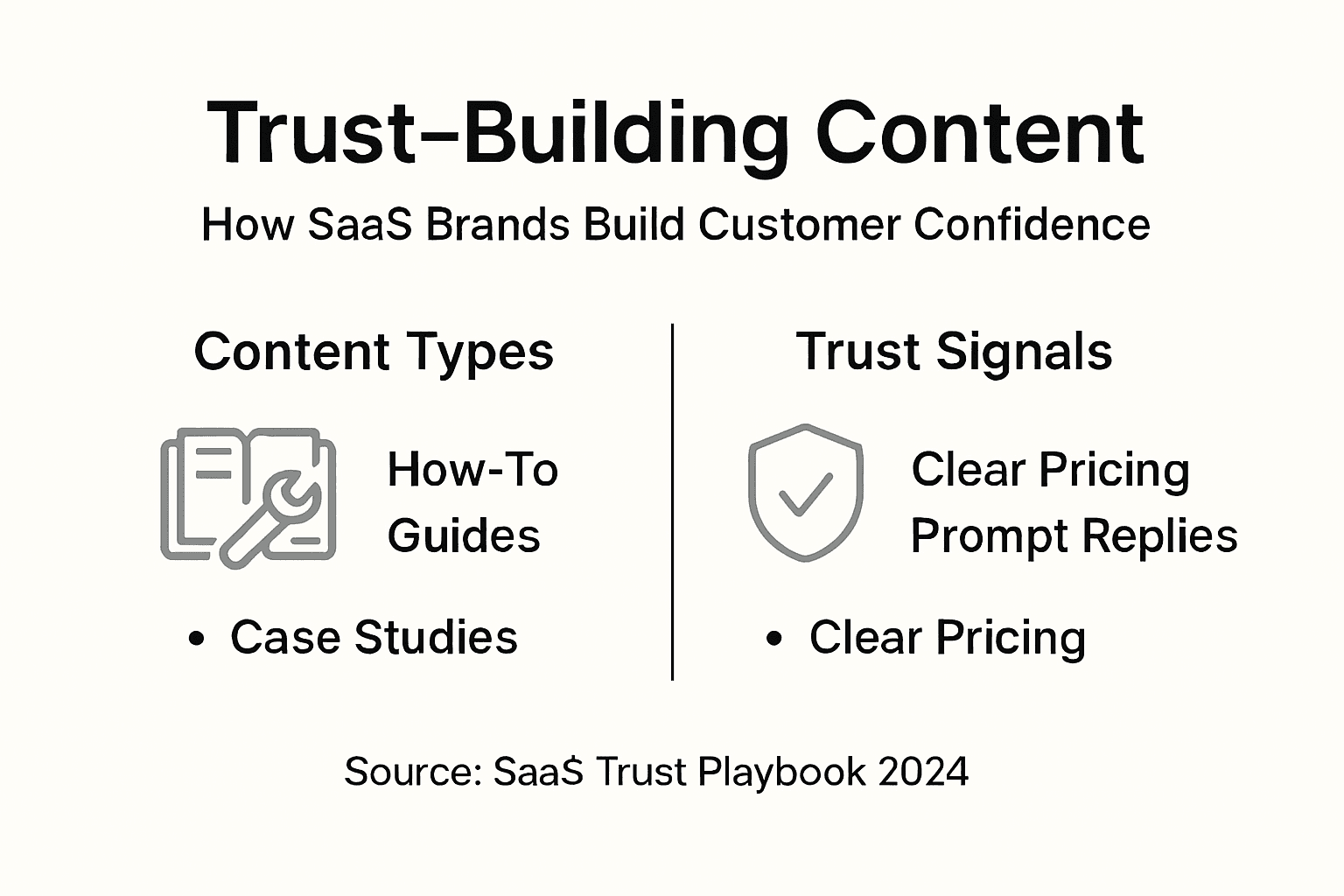
Customer success stories provide powerful social validation. But only if they’re specific and credible. Generic testimonials like “Company X was great to work with” mean nothing. Real case studies that detail specific problems, solutions implemented, and measurable results convince prospects that your product delivers.
Respond to customer feedback publicly and promptly. When someone leaves a negative review, your response matters more than the review itself. A thoughtful, solution-oriented reply shows you care about customer outcomes. Ignoring criticism signals you don’t.
Transparent roadmaps and regular communication about product updates demonstrate that you’re invested in continuous improvement. Research shows that trust in digital environments requires reducing suspicion of omitted or misrepresented content, so share what’s coming and why you’re building it.
Pro tip: Audit your last 20 pieces of marketing content and count how many focus on solving customer problems versus promoting your product—aim for at least 70 percent educational content to maximize trust building.
Maintaining Trust for Long-Term Customer Loyalty
Building trust is one thing. Maintaining it over years is entirely different. Your first month with a customer sets expectations. Your fifth year determines whether they renew or leave.
The brutal truth: trust decays without active maintenance. A customer who loved your onboarding experience becomes frustrated when your support response time slips. Someone who appreciated your transparency gets annoyed when feature updates stop being communicated. These small erosions accumulate.
Consistent quality across all customer touchpoints prevents trust erosion. This means your support team delivers the same professionalism as your sales team. Your product updates maintain the same reliability standards they always have. Your billing accuracy never wavers. Customers notice inconsistency immediately, and it damages trust more than occasional failures do.
Personalization strengthens long-term trust significantly. Personalized experiences and ongoing customer engagement strengthen loyalty in digital environments. This doesn’t mean sending generic “Happy Birthday” emails. It means understanding each customer’s unique workflows, pain points, and goals. Reference their specific use cases in conversations. Suggest features tailored to their business model.
Proactive communication prevents trust breaches. Don’t wait for customers to discover problems. Alert them immediately when something changes, whether it’s a planned maintenance window, a security update, or a pricing adjustment. Trust influences loyalty through customer satisfaction and commitment, so every proactive communication reinforces commitment.
Deliver continuous value beyond the product itself. Educational webinars, industry insights, best practice guides, and peer networking opportunities make your platform invaluable. Customers who gain value from multiple sources become stickier and more loyal.
Finally, act on customer feedback. When customers suggest improvements, acknowledge them publicly and explain your roadmap decisions. This demonstrates respect for their input and builds trust in your strategic direction.
Pro tip: Create a quarterly trust audit: survey 20 percent of your customer base on satisfaction and trust levels, then address the lowest-scoring areas within 30 days—this prevents small problems from becoming churn risks.
Avoiding Common Trust-Damaging Mistakes
Trust is fragile. It takes months to build and seconds to destroy. The mistakes that damage trust most aren’t usually intentional. They’re oversights, shortcuts, and priorities misaligned with customer needs.
The biggest mistake is overpromising and underdelivering. Your sales team gets excited about closing deals and makes claims your product can’t fully support yet. Customers sign up expecting features that don’t exist. The disappointment happens fast and spreads faster through reviews. Be honest about current capabilities and future roadmap timelines.
Poor security practices destroy trust instantly. Data breaches, exposed customer information, or inadequate encryption make customers feel violated. Avoiding common pitfalls like inadequate security measures is non-negotiable for SaaS companies. Invest in security testing, maintain compliance certifications, and communicate your security practices clearly.
Hiding or burying important information is another trust killer. Customers discover hidden fees, restrictive terms, or data usage policies and feel deceived. Put pricing, data policies, and terms of service in obvious places. Make them easy to understand. If customers feel you’re hiding something, they’ll assume the worst.
Ignoring customer support requests damages trust rapidly. A customer waiting five days for a response to a critical issue loses confidence. They start looking for alternatives. Slow support responses signal that you don’t care about their success. Set clear response time expectations and meet them consistently.
Inconsistent product quality frustrates customers. Data bias and methodological errors undermine trustworthiness in any context, and SaaS is no exception. Regular feature bugs, performance slowdowns, or reliability issues signal negligence. Invest in quality assurance and testing before releasing updates.
Finally, silence during problems erodes trust dramatically. When your system goes down or a bug affects customers, communicate immediately and honestly. Explain what happened, what you’re doing to fix it, and when customers can expect resolution. Transparency turns a crisis into an opportunity to demonstrate integrity.
Pro tip: Create a trust vulnerability checklist covering security, transparency, support response times, and product quality, then audit it monthly—this catches issues before customers discover them.
Build Unshakable Customer Trust with Expert Digital Marketing
The challenge of establishing and maintaining customer trust outlined in “Building Customer Trust Strategies for SaaS Growth” is critical for any B2B SaaS company aiming to convert leads and foster long-term loyalty. Key pain points like transparency, consistent communication, and clear trust signals demand a strategic marketing partner who understands these nuances. At Web Spider Solutions we specialize in tailored digital marketing services that help you showcase your compliance certifications, optimize your social proof through compelling content, and maintain transparency in messaging across every channel.
Elevate your SaaS brand by unlocking:
- Targeted SEO strategies that increase organic visibility among cautious prospects
- Content marketing that educates and builds cognitive and affective trust
- Paid advertising campaigns designed to highlight your compliance and security credentials
Don’t let overlooked trust signals slow your growth. Explore Stories Archives at Web Spider Solutions to see how digital marketing can directly influence trust and conversion. Take the first step to transform your customer relationships by visiting Web Spider Solutions today and request a free consultation tailored to boost your SaaS company’s credibility online. Your prospects are ready to trust a brand that proves it deserves their business—show them yours now.
For insights into avoiding trust pitfalls and enhancing long-term loyalty, check our Uncategorized Archives for the latest strategic guidance.
Frequently Asked Questions
How can SaaS companies build customer trust?
SaaS companies can build customer trust by ensuring transparent communication, providing educational content, displaying security certifications, gathering and showcasing customer reviews, and maintaining consistent quality across all customer interactions.
What are the key types of trust that influence customer decisions in SaaS?
The key types of trust include affective trust (emotional connection), cognitive trust (perceived competence), institutional trust (conformity to regulations), and relational trust (built over time through consistent interactions). Each type plays a crucial role in a customer’s decision-making process.
Why is trust important in digital marketing for SaaS companies?
Trust is essential in digital marketing for SaaS because it mitigates customer skepticism, enhances conversion rates, fosters long-term loyalty, and creates reliable online relationships. Without trust, potential customers are likely to choose competitors.
How can companies maintain trust over the long term?
Companies can maintain trust by ensuring consistent quality across all interaction points, personalizing customer experiences, proactively communicating changes or issues, and delivering continuous value beyond the product itself, such as educational resources and support.