








Trying to keep your SaaS marketing strategy ahead of competitors often feels like guessing where the next wave will hit. Market trend analysis offers something better than guesswork by arming you with clear signals about where buyers are moving and what matters to them most. By focusing on systematic data collection and cloud adoption insights, you can shift from chasing old trends to making decisions based on current market direction. This approach positions your campaigns for better visibility and higher-quality lead generation.
Table of Contents
- Defining Market Trend Analysis For SaaS
- Types Of Market Trends In Digital Markets
- Key Data Sources And Analytical Tools
- Applying Trend Insights To Marketing Strategy
- Avoiding Common Mistakes In Trend Analysis
Key Takeaways
| Point | Details |
|---|---|
| Importance of Market Trend Analysis | Systematic market trend analysis is crucial for determining where to invest marketing resources and how to adapt messaging to evolving buyer priorities. |
| Types of Market Trends | Recognizing different market trends—such as innovation-driven, technological disruption, consumer behavior shifts, and regulatory changes—guides strategic marketing responses. |
| Data Sources and Tools | Utilizing both primary and secondary data from credible sources enhances the effectiveness of trend analysis and aids in making informed marketing decisions. |
| Avoiding Common Mistakes | Understanding biases, cross-validating data, and considering macroeconomic contexts are essential to prevent misinterpretation of market trends. |
Defining Market Trend Analysis for SaaS
Market trend analysis for SaaS means systematically identifying and understanding shifts in how companies adopt cloud solutions, what features they prioritize, and how competitive dynamics are evolving. For digital marketing managers at mid-sized SaaS companies, this isn’t just academic research. It’s the foundation for knowing where to invest your marketing budget, which messaging resonates with prospects, and which market segments are actually growing versus declining. Without this understanding, you’re essentially marketing in the dark, hoping your campaigns align with where buyers are actually heading.
At its core, market trend analysis involves three interconnected activities. First, you monitor cloud service adoption rates and shifts in deployment preferences, whether companies are moving toward public cloud, private infrastructure, or hybrid setups. Second, you track customer demand patterns and competitive positioning to understand which solutions are gaining traction and why. Third, you examine operational efficiency factors and emerging technologies like AI-driven applications that are reshaping buyer expectations. This systematic approach gives you the data needed to position your SaaS product where the market is actually moving, not where it was two years ago.
What makes this analysis particularly valuable for your company is understanding the broader context of your specific market segment. You might notice that enterprises are prioritizing integration capabilities more heavily this quarter, or that SMB buyers are suddenly focused on cost optimization rather than feature expansion. These shifts directly impact how you frame your value proposition, which prospects to target, and what problems you should emphasize in your content and advertising. Research on SaaS market drivers and adoption barriers shows that companies using data-driven frameworks to monitor segmentation and competitive landscapes consistently outpace competitors in market response time. You gain the ability to adjust campaigns faster, capitalize on emerging opportunities before they become crowded, and avoid investing in messaging that targets yesterday’s problems.
The practical reality is this: market trend analysis transforms your marketing from reactive to predictive. Instead of launching campaigns based on what seemed logical last quarter, you’re responding to actual market momentum. This gives you a genuine competitive edge when reaching prospects who are actively searching for solutions to newly prioritized problems.
Pro tip: Set up a weekly monitoring routine using industry reports, competitor keyword tracking, and customer conversation notes to spot emerging trends before they become obvious—your early detection gives you 3-6 months of messaging advantage before the market floods with similar messaging.
Types of Market Trends in Digital Markets
Digital markets don’t move in one direction. They shift across multiple dimensions simultaneously, and understanding which types of trends matter for your marketing strategy determines whether you capitalize on opportunities or get blindsided by competition. There are four primary categories of market trends that shape how digital markets evolve, and each one requires different strategic responses from your SaaS marketing efforts.
Innovation-driven trends represent changes sparked by new technologies and capabilities entering the market. When a vendor introduces AI-powered automation, or a new integration method becomes standard, these are innovation trends. Your competitors will adopt these capabilities, and your buyers will expect them. Alongside innovation, technological disruptions operate at a larger scale, fundamentally reshaping how markets function. Emergent technologies like AI, blockchain, and Web3 redefine what solutions solve which problems and how companies approach vendor selection entirely. When you see machine learning moving from nice-to-have to requirement, that’s a technological disruption. The third category, consumer behavior shifts, reflects how buyers actually decide, purchase, and implement solutions. Maybe your prospects suddenly prioritize mobile-first experiences, demand faster onboarding, or require transparent pricing without hidden fees. These behavioral changes ripple through your entire marketing approach, from messaging to channel selection to sales enablement. Finally, regulatory evolutions create hard constraints on what you can offer and how you market it. Data privacy regulations, industry compliance requirements, and emerging legal frameworks directly impact which markets you can serve and what features you must emphasize in your positioning.
For your organization, recognizing which trend type is actually driving market movement matters enormously. An innovation trend might require you to quickly update your feature messaging and competitive positioning. A technological disruption demands deeper investment in content that educates buyers about entirely new approaches to solving their problems. Behavioral shifts require testing new channels, messaging angles, and sales processes. Regulatory changes sometimes open new market segments while closing others. Most markets experience all four simultaneously, which is why many marketing managers struggle to prioritize limited budgets effectively.
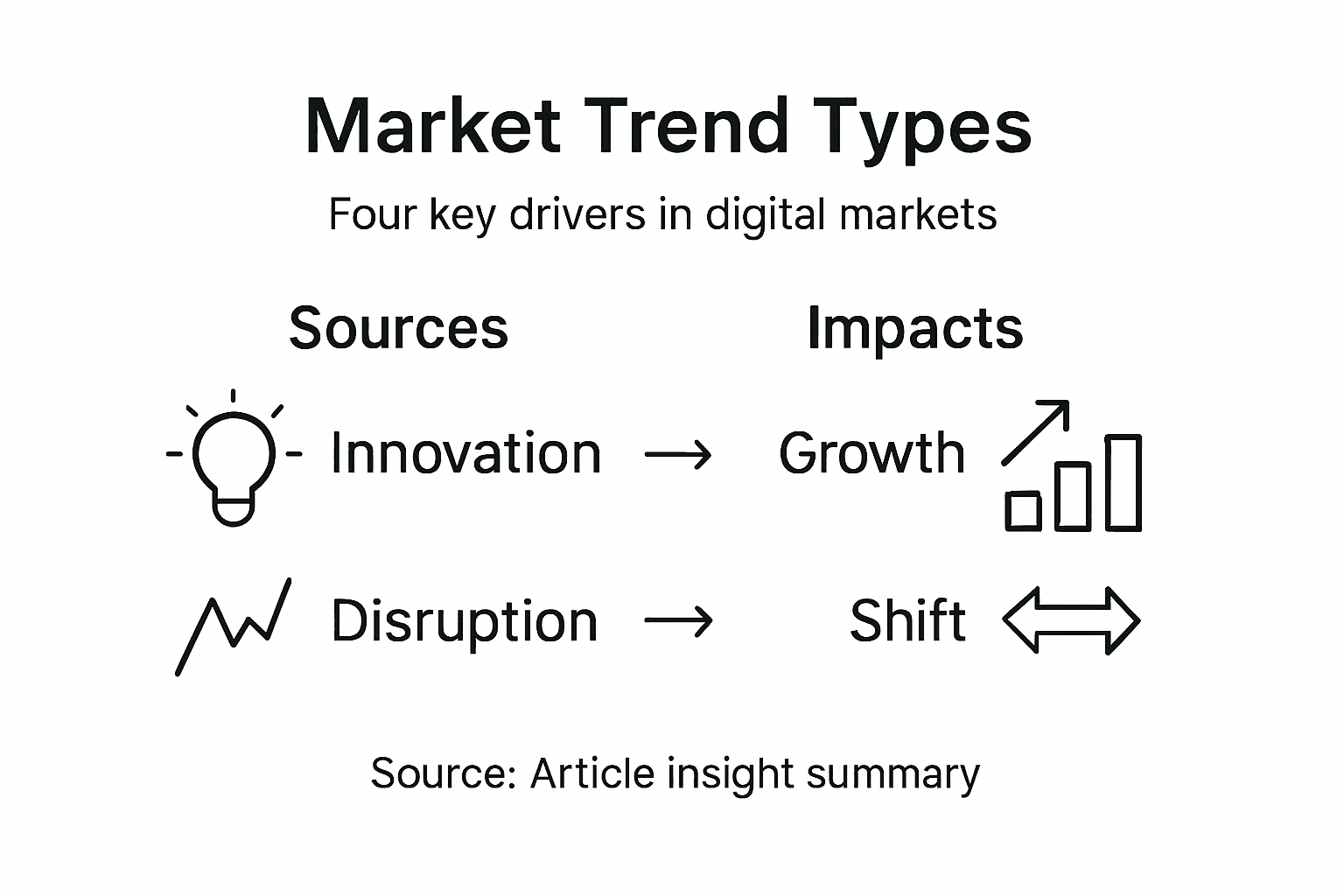
Here’s what makes this framework practical: you can map each trend type to specific marketing actions. When you identify an emerging technology trend, your content strategy responds by explaining implications. When you spot a behavioral shift, you test new channels and messaging frames. When regulatory changes arrive, you position your solution’s compliance capabilities as a core benefit. This categorization transforms trend analysis from overwhelming complexity into manageable strategic decisions.
Here’s a concise summary of the four types of market trends and how they impact SaaS marketing strategy:
| Trend Type | Description | Example Impact | Typical Marketing Response |
|---|---|---|---|
| Innovation-driven | New tech/features enter the market | Automation features | Update product messaging |
| Technological disruption | Major tech shifts reshape buying behavior | AI becomes essential | Create educational content |
| Consumer behavior shift | Changes in buyer priorities and actions | Mobile-first demand | Test new channels and adjust messaging |
| Regulatory evolution | New laws or compliance requirements | Data privacy rules | Emphasize compliance capabilities |
Pro tip: Create a simple tracking spreadsheet with these four trend categories and update it monthly with one or two trends you’re observing in your market—this forces you to categorize what’s actually happening versus noise, making resource allocation decisions much clearer.
Key Data Sources and Analytical Tools
You can’t analyze market trends effectively without reliable data and the right tools to process it. The challenge for most marketing managers isn’t finding data, it’s choosing which sources and tools actually matter for your business. Your analysis is only as good as the data feeding it, and your insights are only as actionable as your tools make them.
Start by understanding your two main data categories. Primary data comes directly from your market, captured through customer surveys, focus groups, sales conversations, and user feedback. This is data you control, and it reflects your actual customer reality rather than generalized industry patterns. Secondary data includes industry reports, competitor websites, social media conversations, and market intelligence platforms. While you don’t collect this yourself, primary data from customer surveys and focus groups combined with secondary sources creates a complete picture. Most effective trend analysis blends both. You might notice a pattern in industry reports suggesting behavioral shift toward mobile-first solutions, then validate it through customer interviews to confirm it’s actually impacting your prospect pool.

For tools, your stack depends on what trends you’re tracking. Web analytics tools like Google Analytics and Adobe Analytics show how digital behavior is shifting on your own properties and competitors’ sites. Social media analytics platforms track engagement patterns and emerging conversations in your market. SEO tools like Ahrefs and Semrush reveal search intent shifts, which often signal market trends before they become obvious. Competitor intelligence tools monitor pricing changes, feature releases, and positioning shifts. For SaaS specifically, product behavior analytics reveal how customers actually use solutions, not just whether they adopt them. Your monthly trend analysis should pull signals from multiple sources to cross validate. If Google Trends shows increased search volume for a topic, Ahrefs confirms keyword difficulty is rising, and your sales team reports more inbound conversations about that problem, you’ve got a legitimate trend worth acting on.
The practical reality is that no single tool gives you complete market visibility. Google Trends is powerful for macro search patterns but misses enterprise buying signals. Social listening catches emerging conversations but misses technical decision making. Competitor tracking shows what others are doing but not why buyers prefer them. Your job is assembling a small toolkit that covers the dimensions most relevant to your market, then checking signals across sources monthly. Start with two or three essential tools rather than trying to monitor ten simultaneously.
Use this quick comparison to select the best trend analysis data sources and tools for SaaS marketing:
| Source/Tool | Data Type | Unique Advantage | Limitation |
|---|---|---|---|
| Customer Surveys | Primary | Direct buyer insights | Limited sample size |
| Industry Reports | Secondary | Macro-level market view | May miss niche signals |
| Web Analytics | Secondary | Tracks real-time user behavior | Ignores competitor activity |
| Social Media Analytics | Secondary | Reveals emerging conversations | Subject to rapid shifts |
| Competitor Tracking | Secondary | Monitors competitor moves | Lacks buyer motivations |
Pro tip: Create a simple monthly “trend signal dashboard” pulling data from three sources you already subscribe to (analytics, competitor tracker, and one industry report service), then spend 30 minutes comparing what each source is telling you about your market—convergent signals across sources are the ones worth acting on.
Applying Trend Insights to Marketing Strategy
Having trend data sitting in a spreadsheet means nothing. The real value emerges when you translate those insights into concrete marketing decisions that drive revenue. This is where most marketing managers stumble. They collect data, recognize patterns, then struggle to connect those patterns to what they should actually do differently next week.
Start by aligning your marketing initiatives with what the trends are telling you about customer priorities. If your trend analysis reveals that enterprise buyers are increasingly concerned about AI-driven automation capabilities, your content strategy shifts immediately. You begin creating resources that address how automation impacts their workflows, what risks they should evaluate, and how your solution handles these new requirements. If SMB buyers suddenly prioritize implementation speed over feature completeness, your sales enablement materials emphasize fast deployment and quick time-to-value instead of comprehensive capabilities. Effective marketing strategy requires aligning organizational resources with evolving market demands, which means your product positioning, messaging, channel strategy, and campaign focus all shift together toward what buyers actually need right now.
Next, build flexibility into your marketing plans so you can respond quickly without major budget reallocations. When you spot a behavioral trend, you shouldn’t need approval to test a new content format, adjust messaging on existing campaigns, or shift paid advertising budget between channels. Developing flexible marketing plans incorporating real-time analytics and adaptive communication strategies drives measurable growth in fast-moving markets. This means treating your marketing engine like you’d treat your product roadmap. Some budget is reserved for innovation and experimentation, not locked into fixed annual plans. When you notice competitor activity shifting toward vertical-specific solutions, you can quickly test vertical-focused messaging without waiting for next quarter’s planning cycle. When search volume explodes for a particular problem category, you can rapidly expand content in that area.
The practical application involves three actions. First, quarterly review your trend analysis and ask what’s changed about your market since last quarter, which requires marketing response. Second, identify which messaging, channels, or audience segments need adjustment based on those changes. Third, allocate budget toward those adjustments immediately rather than queuing them for next planning period. Most organizations wait too long to act on trends because they’re locked into annual planning cycles. By the time next year arrives, the trend has matured and your competition has already captured the opportunity.
Pro tip: Create a simple quarterly trend-to-action worksheet with three columns (trend observed, marketing response needed, budget/resource required), then use it in your monthly team standup to ensure trends actually drive tactical changes rather than just staying documented in reports.
Avoiding Common Mistakes in Trend Analysis
Trend analysis sounds straightforward until you realize how many ways it can lead you in the wrong direction. The most dangerous mistakes aren’t obvious errors. They’re subtle biases that feel logical in the moment but distort your understanding of what’s actually happening in your market. Understanding these pitfalls protects your marketing budget from being wasted on trends that aren’t real or that don’t apply to your specific audience.
The first major mistake is relying on a single indicator or data source. When one metric suggests a trend exists, it feels compelling. You see search volume increasing for a keyword, and you assume demand is growing. But what if that spike came from a single viral article rather than genuine market interest? What if competitors launched similar campaigns simultaneously, inflating search volume artificially? Combining multiple indicators provides stronger confirmation than any single signal. If Google Trends shows volume increasing, but Ahrefs shows keyword difficulty dropping and your sales team reports no increase in inbound conversations about that topic, the trend might not be real. Cross validation takes more time, but it prevents costly mistakes.
Another critical error is neglecting macroeconomic context. A trend that looks promising in isolation might be completely misleading when you account for broader market conditions. Maybe search volume for a feature category is growing, but it’s growing because companies are actually consolidating tools and choosing alternatives. Maybe pricing sensitivity increased because of broader economic pressures, not because your market segment suddenly shifted preferences. Overlooking macroeconomic indicators and external influences leads to misinterpretation of market signals. You need to ask why the trend is happening, not just that it’s happening.
Subjective interpretation destroys objectivity faster than anything else. When you want a trend to exist because it aligns with a strategy you’ve already committed to, you’ll unconsciously interpret ambiguous signals as confirmation. You notice an article about a topic and assume it signals an emerging trend, even though it might just be one journalist’s opinion. You hear a customer mention a problem once and treat it as widespread market movement. The antidote is establishing decision rules before you analyze data. Decide upfront what constitutes sufficient evidence for a trend (multiple sources converging, sustained growth over time, actual customer conversations validating the signal) rather than interpreting evidence as you encounter it.
Finally, don’t assume past patterns predict future movement. Historical data is valuable context, but markets change, and what drove growth last year might not this year. Over reliance on historical data without validating insights against current market context leaves you building strategy around outdated assumptions. Your annual planning meeting shouldn’t rely primarily on last year’s performance. It should incorporate recent trend signals, current customer conversations, and what competitors are actually doing right now.
Pro tip: Before acting on any trend, write down your hypothesis about why it’s happening and what you’d expect to see if you were wrong—this forces intellectual honesty and prevents confirmation bias from distorting your interpretation.
Unlock Digital Growth with Data-Driven Market Trend Strategies
Understanding and leveraging market trends is essential to stay ahead in today’s fast-evolving digital landscape. The article emphasizes the importance of using market trend analysis to predict shifts in buyer behavior, technology disruptions, and innovation-driven changes. If you are struggling to translate these insights into actionable strategies that boost your SaaS company’s visibility and revenue you are not alone. Many digital marketing managers face challenges aligning messaging, optimizing channels, and prioritizing budget allocations based on real-time market signals.
At Web Spider Solutions we specialize in transforming complex trend data into clear marketing actions. Whether you need tailored paid advertising campaigns that respond to emerging buyer priorities or content marketing that educates prospects on cutting-edge technologies, our team delivers results that matter. Explore how our Paid Advertising Archives can help you capitalize on trending opportunities with precision. Learn from success stories in the Stories Archives to see how we have helped companies just like yours dominate competitive markets. Don’t let shifting trends leave you behind take control of your digital future with expert guidance today.
Ready to fuel your growth with trend-driven marketing strategies Request your free consultation now at Web Spider Solutions and start seeing measurable impact from insights that truly connect with your audience.
Frequently Asked Questions
What is market trend analysis for SaaS?
Market trend analysis for SaaS involves identifying shifts in cloud solution adoption, tracking customer demand patterns, and understanding emerging technologies. It helps inform marketing strategies by revealing where to invest resources effectively.
How can I conduct effective market trend analysis?
To conduct effective market trend analysis, combine primary data from customer surveys and feedback with secondary data from industry reports and competitor analysis. Use analytical tools such as web analytics, social media platforms, and competitor intelligence to validate trends.
What types of market trends should SaaS marketers be aware of?
SaaS marketers should be aware of four primary types of market trends: innovation-driven trends, technological disruptions, consumer behavior shifts, and regulatory evolutions. Each type requires tailored marketing responses to capitalize on market changes.
How can market trends impact my marketing strategy?
Market trends can significantly impact your marketing strategy by influencing product positioning, messaging, and channel selection. Understanding current trends allows you to align your marketing efforts with buyer priorities, ensuring more effective campaigns.
Recommended