







Over 80 percent of American SaaS companies admit their marketing funnels leak valuable leads. For digital marketing managers, understanding the real meaning behind funnel stages is crucial for driving engagement and genuine conversions. This guide breaks down the psychology, structure, and common mistakes in funnel tactics, giving you practical insights to help your team capture more qualified prospects and improve long-term customer loyalty.
Table of Contents
- What Marketing Funnel Stages Really Mean
- Types of Marketing Funnels for SaaS Teams
- How Each Stage Drives Lead Conversion
- Key Metrics and Tools for Funnel Analysis
- Common Pitfalls in SaaS Funnel Optimization
Key Takeaways
| Point | Details |
|---|---|
| Understanding Funnel Stages | Marketing funnels consist of four stages: Awareness, Consideration, Conversion, and Loyalty, each requiring targeted strategies for engagement. |
| Tailored Communication | Effective marketing strategies must adapt messaging for each funnel stage to maximize customer conversion and retention. |
| SaaS Funnel Variations | SaaS teams benefit from utilizing different funnel types, such as Product-Led and Sales-Led, to align with their unique objectives. |
| Key Performance Metrics | Essential metrics for funnel analysis include Conversion Rate, Customer Acquisition Cost, and Lifetime Value to inform optimization efforts. |
What Marketing Funnel Stages Really Mean
A marketing funnel represents the strategic pathway customers traverse from initial awareness to final purchase. Unlike simplistic linear models, this framework maps complex customer journeys that recognize prospects move through distinct psychological stages with unique informational needs.
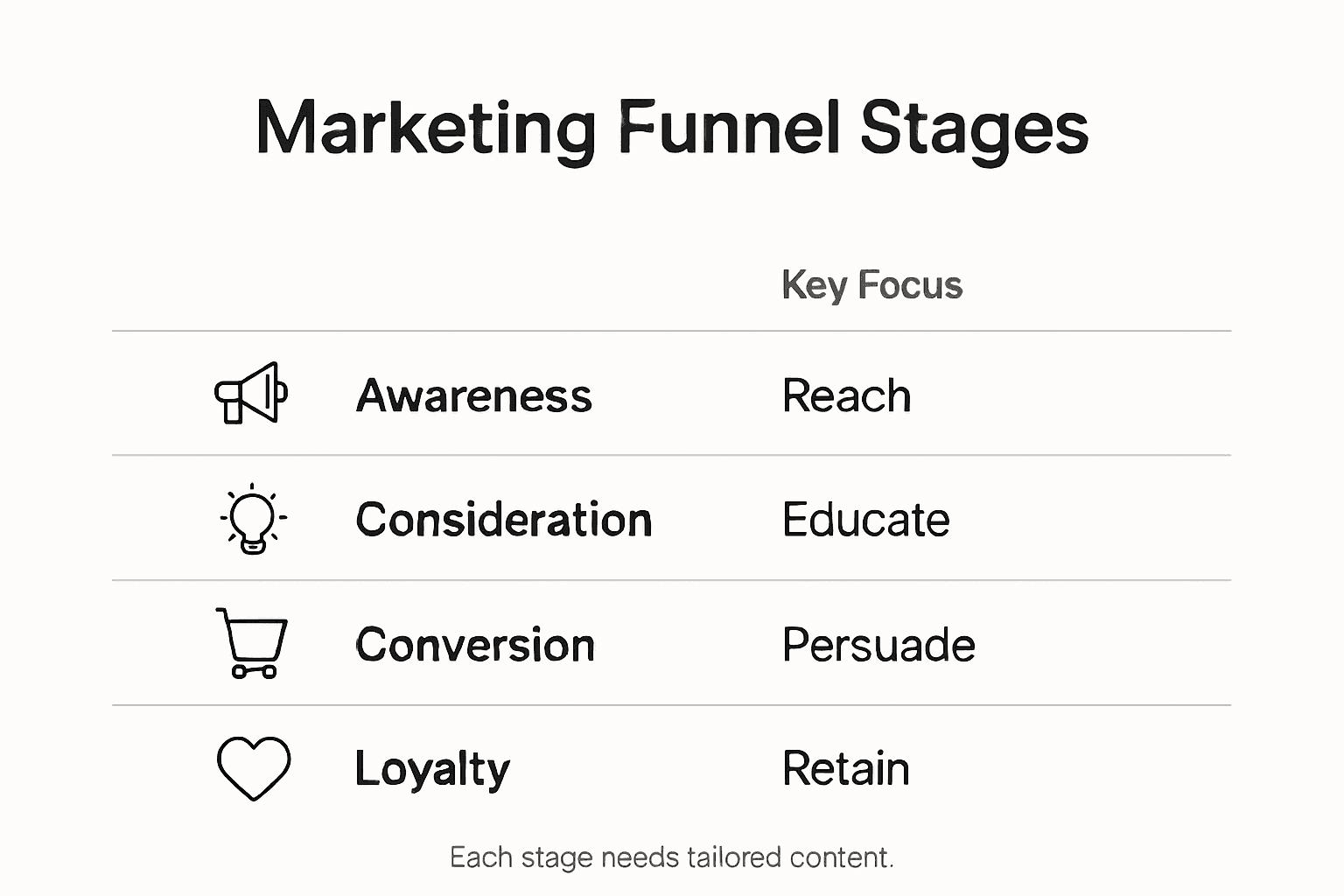
Typically, marketing funnels consist of four primary stages: Awareness, Consideration, Conversion, and Loyalty. In the Awareness stage, potential customers first encounter your brand through advertising, content marketing, or social media. Prospects are broad and numerous. During Consideration, interested individuals actively research solutions, comparing options and evaluating potential fit. The Conversion stage represents the critical moment when a prospect becomes a paying customer, transforming potential interest into tangible revenue. Finally, the Loyalty stage focuses on transforming one-time buyers into repeat customers and brand advocates.

Successful marketing funnel strategies require understanding that each stage demands specialized communication and targeted engagement. For instance, Awareness stage content should be educational and intriguing, while Conversion stage messaging needs to be direct and persuasive. Advanced marketers use sophisticated tracking and personalization techniques to guide prospects smoothly through these transitions, minimizing friction and maximizing conversion potential.
Pro tip: Create customized content assets specifically designed for each marketing funnel stage to dramatically improve prospect engagement and conversion rates.
Here’s how marketing funnel stages influence business outcomes:
| Funnel Stage | Primary Business Impact | Success Factor |
|---|---|---|
| Awareness | Builds brand recognition | Broad educational outreach |
| Consideration | Increases perceived value | Showcase differentiation |
| Conversion | Drives revenue growth | Persuasive direct offers |
| Loyalty | Enhances customer lifetime value | Consistent engagement |
Types of Marketing Funnels for SaaS Teams
SaaS marketing teams utilize multiple specialized funnel types designed to address unique business objectives and customer acquisition strategies. Marketing funnel structures vary significantly based on product complexity, target audience, and specific conversion goals, making customization crucial for success.
The primary marketing funnel types for SaaS teams include:
- Product-Led Funnel: Focuses on product features and user experience as primary conversion drivers
- Sales-Led Funnel: Emphasizes direct sales interactions and personalized engagement
- Content-Led Funnel: Relies on educational content and thought leadership to nurture prospects
- Freemium Funnel: Offers limited free product access to demonstrate value before paid conversion
Each funnel type requires precise targeting and strategic communication aligned with specific customer journey stages. For example, a product-led funnel might prioritize intuitive onboarding and self-service options, while a sales-led approach demands sophisticated lead qualification and personalized demonstrations. Successful SaaS teams often blend multiple funnel approaches, creating hybrid models that adapt to evolving customer preferences and market dynamics.
Pro tip: Regularly analyze your funnel performance metrics and be prepared to dynamically adjust your marketing strategy to optimize conversion rates and customer acquisition.
Below is a comparison of top SaaS funnel types by primary focus and key strengths:
| Funnel Type | Main Conversion Driver | Best Used For |
|---|---|---|
| Product-Led | In-app experience | Self-serve products |
| Sales-Led | Human interaction | Complex, high-value deals |
| Content-Led | Thought leadership | Nurturing researched buyers |
| Freemium | Free tier value | Rapid user base growth |
How Each Stage Drives Lead Conversion
The marketing funnel is a strategic framework where each stage plays a critical role in transforming potential prospects into committed customers. Conversion funnel dynamics demonstrate how targeted efforts at each phase can dramatically improve overall lead acquisition and retention.
Breakdown of lead conversion stages includes:
- Awareness Stage: Introduces the problem and potential solutions
- Goal: Generate initial interest and brand recognition
- Key tactics: Content marketing, social media engagement, targeted advertising
- Research Stage: Prospects actively investigate potential solutions
- Goal: Establish credibility and demonstrate expertise
- Key tactics: Detailed blog posts, whitepapers, webinars, comparison guides
- Decision Stage: Prospects evaluate specific offerings
- Goal: Differentiate from competitors and address specific pain points
- Key tactics: Case studies, product demos, free trials, personalized consultations
- Purchase Stage: Converting interested prospects into paying customers
- Goal: Streamline conversion process and reduce friction
- Key tactics: Transparent pricing, easy onboarding, compelling call-to-action
Successful lead conversion requires seamless integration between these stages, with marketing and sales teams collaboratively creating a smooth, engaging customer journey. Advanced teams continuously analyze conversion metrics, refining their approach to minimize drop-offs and maximize customer acquisition.
Pro tip: Implement cross-functional tracking systems that allow real-time monitoring of lead progression across all funnel stages, enabling rapid optimization and personalized engagement strategies.
Key Metrics and Tools for Funnel Analysis
Effective funnel analysis requires a comprehensive approach to tracking and interpreting key performance indicators across multiple stages of customer acquisition. Advanced funnel analysis tools provide critical insights into user behavior, helping teams identify and address potential conversion barriers.
Key metrics essential for robust funnel analysis include:
- Conversion Rate: Percentage of prospects moving between funnel stages
- Customer Acquisition Cost (CAC): Total expense of acquiring a new customer
- Lifetime Value (LTV): Total revenue generated by a customer over their entire relationship
- Drop-off Rates: Percentage of users abandoning the funnel at specific stages
- Engagement Metrics: Time spent, interactions, and depth of product exploration
Top analytical tools for comprehensive funnel monitoring include Google Analytics, Mixpanel, HubSpot, and Amplitude. These platforms offer advanced features like:
- Real-time funnel visualization
- Cohort analysis
- Session replay functionality
- Detailed user journey tracking
- Advanced segmentation and filtering
Pro tip: Implement a multi-tool approach that combines quantitative metrics with qualitative insights to gain a holistic understanding of your marketing funnel performance.
Common Pitfalls in SaaS Funnel Optimization
SaaS companies frequently encounter critical challenges when optimizing their marketing funnels, often stemming from fundamental misunderstandings about customer acquisition and retention. SaaS funnel optimization requires a nuanced approach that goes beyond traditional sales strategies.
Key pitfalls that undermine SaaS funnel performance include:
- Inconsistent Metrics: Different teams using conflicting measurement standards
- Acquisition Bias: Over-emphasizing top-of-funnel customer acquisition
- Neglecting Retention: Failing to prioritize customer activation and long-term engagement
- Generic Onboarding: Using one-size-fits-all approach instead of personalized experiences
- Misaligned Content: Creating content that doesn’t match specific funnel stage needs
Successful SaaS funnel optimization demands a holistic strategy that balances acquisition, activation, and retention. This means developing targeted approaches for each funnel stage, implementing robust tracking mechanisms, and creating personalized user experiences that address specific customer pain points. Teams must move beyond vanity metrics and focus on meaningful indicators of user engagement and potential lifetime value.
Pro tip: Conduct quarterly comprehensive funnel audits to identify friction points, realign measurement strategies, and continuously refine your customer acquisition approach.
Unlock Your Business Growth by Mastering Marketing Funnel Stages
Understanding the complexity behind marketing funnel stages is essential for converting leads into lasting growth. If you struggle with inconsistent metrics, low conversion rates, or misaligned messaging, it’s time to adopt a strategic and tailored approach that addresses each funnel stage with precision. From Awareness to Loyalty, every phase demands unique content and engagement techniques to minimize drop-offs and maximize customer lifetime value.
At Web Spider Solutions, we specialize in delivering comprehensive digital marketing services designed to elevate each stage of your funnel. Whether your challenge lies in boosting brand recognition through targeted paid campaigns or nurturing qualified B2B leads with compelling content, our proven strategies will help you overcome common SaaS funnel pitfalls. Explore how our expertise in Paid Advertising and B2B Marketing can transform your marketing efforts and deliver measurable results.
Ready to turn prospects into loyal customers? Visit Web Spider Solutions now and request a free consultation to start optimizing your marketing funnel for consistent growth today.
Frequently Asked Questions
What are the stages of a marketing funnel?
The marketing funnel typically consists of four primary stages: Awareness, Consideration, Conversion, and Loyalty. Each stage represents a distinct phase in the customer’s journey, from first discovering the brand to becoming a repeat customer.
How can I improve my marketing funnel’s conversion rates?
You can enhance conversion rates by creating customized content for each funnel stage, using analytical tools to monitor performance, and implementing targeted communication strategies that engage prospects effectively.
What is the difference between a product-led and a sales-led marketing funnel?
A product-led funnel focuses on the product’s features and user experience to drive conversions, making it ideal for self-serve models. In contrast, a sales-led funnel emphasizes direct sales interactions and personalized engagement, suitable for complex offers requiring human touchpoints.
Why is tracking metrics important in a marketing funnel?
Tracking metrics such as conversion rates, customer acquisition cost, and drop-off rates is crucial for identifying potential barriers to conversion, optimizing marketing strategies, and ultimately driving better customer acquisition and retention.