






Most american B2B SaaS companies struggle to drive consistent results from digital marketing efforts without automation. With nearly 80 percent of organizations reporting greater efficiency after automating core marketing processes, marketing managers see how manual workflows slow down lead generation and weaken engagement. This article unpacks how strategic marketing automation for B2B SaaS unlocks smarter campaigns, delivers stronger qualified leads, and maximizes team efficiency for sustainable growth.
Table of Contents
- Defining Marketing Automation For B2B SaaS
- Key Types And Popular Solution Platforms
- Core Features And Workflow Processes
- Use Cases And Campaign Strategies
- Potential Risks And Measuring ROI
Key Takeaways
| Point | Details |
|---|---|
| Marketing Automation Enhances Engagement | By streamlining repetitive tasks, marketing automation allows B2B SaaS companies to deliver personalized communication across multiple channels, resulting in better customer engagement. |
| Careful Platform Selection is Crucial | Selecting the right marketing automation platform requires consideration of factors like scalability, integration capabilities, and specific feature needs aligned with business objectives. |
| Effective Use of Core Features | Utilizing lead scoring and segmentation enhances marketing precision, enabling companies to focus on the most promising leads and deliver targeted messaging. |
| Awareness of Potential Risks | Companies should be mindful of risks like data privacy issues and over-automation, implementing robust measurement frameworks to track ROI effectively. |
Defining Marketing Automation for B2B SaaS
Marketing automation represents a strategic technological approach specifically designed to transform how B2B SaaS companies engage, nurture, and convert potential customers through intelligent, scalable digital processes. At its core, marketing automation streamlines repetitive tasks while delivering personalized communication across multiple channels.
In the B2B SaaS ecosystem, marketing automation goes beyond simple email scheduling. Real-time data collection and audience segmentation enable businesses to craft highly targeted messages that resonate with multiple stakeholders involved in complex purchasing decisions. These sophisticated systems track user interactions, analyze behavioral patterns, and automatically trigger relevant content based on specific customer journey stages.
The technological infrastructure of marketing automation typically includes several key components:
- Lead Capture Systems: Web forms, landing pages, and tracking mechanisms
- Customer Segmentation Tools: Advanced filtering based on demographics, behaviors, and engagement levels
- Campaign Management Platforms: Automated workflows that guide prospects through sales funnels
- Analytics and Reporting: Real-time performance tracking and insight generation
These integrated systems allow B2B SaaS companies to measure marketing tasks and workflows with unprecedented precision, ultimately enabling more efficient resource allocation and accelerated revenue growth.
Pro Tip: Start Small and Scale Strategically: Begin your marketing automation journey by automating 2-3 critical workflows, then progressively expand complexity as you gain insights and confidence in your system’s performance.
Key Types and Popular Solution Platforms
Marketing automation platforms for B2B SaaS companies range from comprehensive enterprise solutions to specialized tools designed for specific marketing functions. AI-powered marketing automation platforms like HubSpot, Marketo, Pardot, and ActiveCampaign offer increasingly sophisticated capabilities that enable businesses to streamline their digital marketing efforts.
The primary types of marketing automation platforms can be categorized into several key segments:
- All-in-One Enterprise Solutions: Comprehensive platforms covering multiple marketing functions
- Specialized Tactical Tools: Platforms focused on specific marketing activities like email marketing or lead scoring
- Customer Relationship Management (CRM) Integrated Systems: Platforms that seamlessly connect marketing and sales workflows
- Industry-Specific Automation Platforms: Solutions tailored to unique vertical market requirements
Each platform type offers distinct advantages depending on a company’s size, complexity, and specific marketing objectives. Enterprise-level solutions like HubSpot and Marketo provide extensive features including predictive analytics, advanced segmentation, and multi-channel campaign management. Smaller organizations might prefer more focused tools that offer targeted functionality at a lower cost point.
The selection of a marketing automation platform requires careful consideration of factors such as scalability, integration capabilities, user interface, pricing structure, and specific feature sets that align with your B2B SaaS company’s unique marketing strategy.
Here’s a comparison of key marketing automation platform types and when they are best suited for B2B SaaS companies:
| Platform Type | Ideal For | Typical Features |
|---|---|---|
| All-in-One Enterprise | Large, complex organizations | Advanced analytics, multi-channel campaigns |
| Specialized Tactical Tool | Small businesses or niche use | Focused functions like email or lead scoring |
| CRM-Integrated System | Teams needing sales-marketing alignment | Unified data, sales workflows connectivity |
| Industry-Specific Solution | Companies with unique compliance needs | Customizable to vertical industry processes |
Pro Tip: Platform Selection Strategy: Conduct a comprehensive audit of your current marketing workflows and future growth projections before selecting a marketing automation platform, ensuring the solution can expand alongside your business needs.
Core Features and Workflow Processes
Marketing automation platforms offer a sophisticated set of integrated features designed to transform how B2B SaaS companies engage potential customers throughout their complex buying journeys. At the heart of these systems lies an intricate network of interconnected processes that enable intelligent, data-driven marketing strategies.

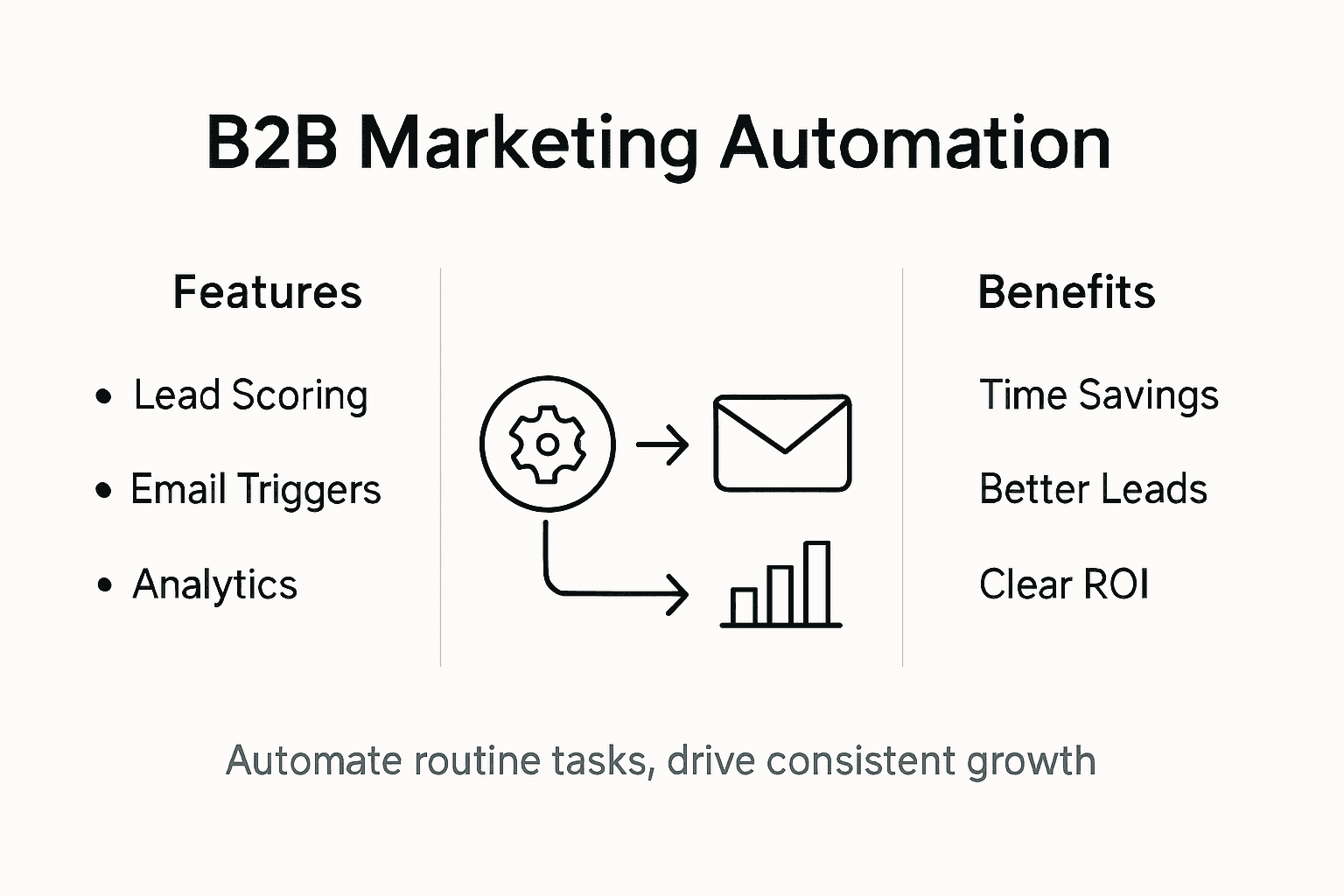
One of the most critical components is lead scoring, a powerful mechanism that systematically evaluates and prioritizes potential customers based on their demonstrated behaviors, interactions, and likelihood of converting. This strategic approach allows sales teams to focus their efforts on the most promising opportunities, dramatically improving overall conversion efficiency.
The core features of marketing automation platforms typically encompass several essential workflow processes:
- Lead Capture and Tracking: Comprehensive monitoring of user interactions across multiple digital touchpoints
- Segmentation and Personalization: Advanced audience categorization based on behavioral, demographic, and engagement data
- Multichannel Campaign Management: Synchronized communication strategies across email, social media, web, and mobile platforms
- Behavioral Triggered Workflows: Automated response sequences based on specific user actions and engagement levels
- Performance Analytics and Reporting: Real-time insights into campaign effectiveness, conversion rates, and ROI
These integrated features work synergistically to create a seamless, intelligent marketing ecosystem. By automating repetitive tasks and providing deep insights into customer behaviors, marketing automation platforms enable B2B SaaS companies to deliver highly personalized experiences at scale, transforming how businesses approach customer engagement and relationship management.
Below is a summary of core marketing automation features and their business impact for B2B SaaS:
| Feature | How It Works | Business Value |
|---|---|---|
| Lead Scoring | Prioritizes leads by behavior | Focuses sales on high-potential deals |
| Segmentation | Groups contacts by traits | Enables precise, relevant messaging |
| Behavioral Triggers | Automates actions by user activity | Delivers timely, personalized responses |
| Campaign Analytics | Tracks real-time results | Improves ROI through data-driven changes |
Pro Tip: Workflow Optimization Strategy: Regularly audit and refine your marketing automation workflows, focusing on continuous improvement and alignment with evolving customer interaction patterns and business objectives.
Use Cases and Campaign Strategies
Marketing automation has revolutionized how B2B SaaS companies approach customer engagement, offering sophisticated strategies that go far beyond traditional marketing techniques. At the core of these innovative approaches lies the ability to create highly targeted, personalized campaign experiences that speak directly to specific business needs and customer pain points.
Account-based marketing (ABM) represents a particularly powerful strategy where companies concentrate their resources on a carefully selected group of high-value target accounts. This approach transforms marketing from a broad-based broadcast model to a precision-targeted engagement mechanism, allowing businesses to craft extremely personalized communication strategies tailored to specific organizational decision-makers.
Key campaign strategies in B2B marketing automation typically include:
- Nurture Campaign Sequences: Multi-stage email workflows designed to guide prospects through complex buying journeys
- Targeted Account Engagement: Personalized outreach targeting specific roles and organizational challenges
- Behavioral Trigger Campaigns: Automated communication sequences based on specific user interactions and engagement signals
- Re-engagement Campaigns: Strategic outreach to dormant leads and past customers
- Cross-Channel Integrated Campaigns: Synchronized messaging across email, social media, web, and retargeting platforms
The integration of Customer Data Platforms (CDPs) further enhances these strategies by aggregating customer data from multiple touchpoints, enabling unprecedented levels of personalization and targeted communication. By creating unified customer profiles, B2B SaaS companies can deliver highly contextual messages that resonate with specific buyer personas and organizational needs.
Pro Tip: Campaign Precision Strategy: Develop granular buyer personas and map detailed customer journey stages before launching automated campaigns, ensuring each communication feels personally crafted and strategically targeted.
Potential Risks and Measuring ROI
Marketing automation represents a powerful strategy for B2B SaaS companies, but it also introduces complex challenges that require strategic management and continuous evaluation. Understanding the potential risks and implementing robust measurement frameworks are crucial for maximizing the return on investment and ensuring long-term success.
Implementing marketing automation systems presents significant challenges, including managing massive heterogeneous data sources, navigating complex multi-channel customer journeys, and operating within constrained marketing budgets. These intricacies demand sophisticated approaches to data integration, strategy optimization, and resource allocation.
Key potential risks in marketing automation include:
- Data Privacy Vulnerabilities: Potential breaches of customer information and compliance challenges
- Over-Automation Risks: Loss of personal touch and authenticity in customer communications
- Integration Complexity: Technical challenges in connecting disparate marketing and sales systems
- Skill Gap Limitations: Insufficient team expertise to fully leverage automation technologies
- Performance Measurement Difficulties: Challenges in accurately tracking and attributing marketing outcomes
AI-driven marketing automation frameworks require rigorous validation through real-world experiments and simulated scenarios to optimize strategies and ensure privacy compliance. Successful ROI measurement involves developing comprehensive metrics that go beyond traditional conversion tracking, incorporating advanced analytics that capture the nuanced impact of automated marketing efforts.
Pro Tip: ROI Validation Strategy: Establish a baseline measurement framework before implementing marketing automation, tracking key performance indicators across multiple dimensions including lead quality, conversion rates, customer acquisition costs, and long-term customer lifetime value.
Unlock the Power of Marketing Automation to Drive Your B2B Growth
Struggling to manage complex customer journeys while delivering personalized experiences at scale is a common challenge for B2B SaaS companies. This article highlights how marketing automation can transform your lead scoring, segmentation, and campaign management to focus your sales efforts on high-potential deals and increase conversion rates. If you want to overcome common pitfalls like over-automation or data integration difficulties, aligning your marketing technology with strategic execution is essential.
At Web Spider Solutions, we specialize in crafting tailored B2B marketing strategies that leverage automation alongside expert digital marketing services. Whether you need to refine your paid advertising campaigns or improve your targeted lead generation, our team helps you create seamless, data-driven workflows that deliver measurable ROI. Explore insights and success stories in our B2B Marketing Archives and take advantage of expert guidance on paid advertising in our Paid Advertising Archives.
Don’t let complex marketing automation overwhelm your growth potential. Visit Web Spider Solutions now for a personalized consultation and discover how to harness automation technologies for long-term B2B success.
Frequently Asked Questions
What is marketing automation in B2B SaaS?
Marketing automation in B2B SaaS refers to the use of technology to streamline, automate, and measure marketing tasks and workflows, enabling companies to engage with potential customers efficiently through personalized communication.
How does marketing automation improve lead nurturing?
Marketing automation enhances lead nurturing by utilizing real-time data collection and audience segmentation to deliver tailored content and follow-up communications based on individual customer behaviors and journey stages.
What are the key components of a marketing automation platform?
Key components of a marketing automation platform include lead capture systems, customer segmentation tools, campaign management platforms, and analytics and reporting features to measure effectiveness and optimize marketing efforts.
What are some common campaign strategies in B2B marketing automation?
Common campaign strategies include nurture campaign sequences to guide prospects, targeted account engagement for specific organizations, behavioral trigger campaigns based on user actions, re-engagement efforts for dormant leads, and cross-channel integrated campaigns that synchronize messaging across various platforms.
Recommended