






Meeting accessibility standards online no longer feels optional for growing SaaS businesses. As teams strive to create digital products that engage everyone, addressing web accessibility helps ensure your platform works for all users, from people with visual disabilities to those browsing on mobile devices. By prioritizing inclusive digital experiences, you not only reduce barriers for users but also gain a strategic edge in reach, brand perception, and long-term compliance.
Table of Contents
- Defining Web Accessibility And Key Concepts
- Types Of Disabilities And User Needs Online
- Global Standards And Common Accessibility Frameworks
- Legal Requirements And Compliance Challenges
- Business Risks And Benefits Of Accessibility
- Debunking Common Myths And Mistakes
Key Takeaways
| Point | Details |
|---|---|
| Web Accessibility Benefits | Prioritizing web accessibility enhances user engagement, improves brand reputation, and boosts SEO performance. |
| Understanding User Needs | Recognizing diverse user abilities and challenges is essential for creating inclusive digital experiences. |
| Legal and Compliance Imperatives | Adherence to accessibility standards like WCAG 2.1 Level AA is crucial for legal compliance and risk management. |
| Combatting Myths | Dispelling common accessibility myths can facilitate the implementation of effective inclusive design strategies. |
Defining Web Accessibility and Key Concepts
Web accessibility represents a critical approach to digital design that ensures online platforms are usable for everyone, regardless of their physical or cognitive capabilities. Web technologies designed for universal access fundamentally transform how people interact with digital content, breaking down barriers that traditionally marginalize certain user groups.
At its core, web accessibility means creating digital environments that accommodate diverse user needs, including individuals with auditory, cognitive, neurological, physical, speech, and visual disabilities. The concept extends far beyond compliance—it’s about crafting inclusive digital experiences that welcome all users, regardless of their personal challenges or technological constraints.
Key aspects of web accessibility include:
- Perceivable content that can be understood through multiple sensory channels
- Operable interfaces navigable through various input methods
- Understandable information presented in clear, logical formats
- Robust design compatible with current and future assistive technologies
Digital content accessibility is not just an ethical imperative but a strategic advantage. Businesses that prioritize inclusive design often experience improved user engagement, expanded audience reach, and enhanced search engine optimization (SEO) performance.
Benefits of Web Accessibility:
- Broader audience engagement
- Improved user experience for all visitors
- Enhanced brand reputation
- Better search engine rankings
- Compliance with legal standards
Pro tip: Start evaluating your website’s accessibility by running free online auditing tools that can identify potential barriers for users with disabilities.
Types of Disabilities and User Needs Online
Web accessibility requires understanding the diverse range of user abilities and challenges individuals encounter when interacting with digital platforms. Disabilities impact digital interactions in complex and nuanced ways, extending far beyond traditional assumptions about impairments.

Digital environments present unique challenges for users with different disabilities. These challenges can be categorized into several primary types:
Primary Disability Categories:
- Visual Disabilities: Including blindness, low vision, and color blindness
- Auditory Disabilities: Ranging from partial to complete hearing loss
- Cognitive Disabilities: Encompassing learning differences, memory challenges, and processing difficulties
- Physical Disabilities: Involving mobility limitations and motor control variations
- Speech Disabilities: Impacting communication and voice-based interactions
Digital access barriers often stem from technological design that fails to consider diverse user needs. These barriers can manifest through:
- Inaccessible website navigation
- Complex interface designs
- Non-adaptive content presentation
- Limited alternative input methods
Understanding these disability types is crucial for creating inclusive digital experiences that accommodate varied user capabilities and interaction preferences. Designers and developers must recognize that accessibility is not about creating separate experiences, but about developing flexible, adaptable digital environments that work seamlessly for everyone.
Pro tip: Conduct user testing with individuals representing different disability categories to gain authentic insights into potential accessibility challenges.
Global Standards and Common Accessibility Frameworks
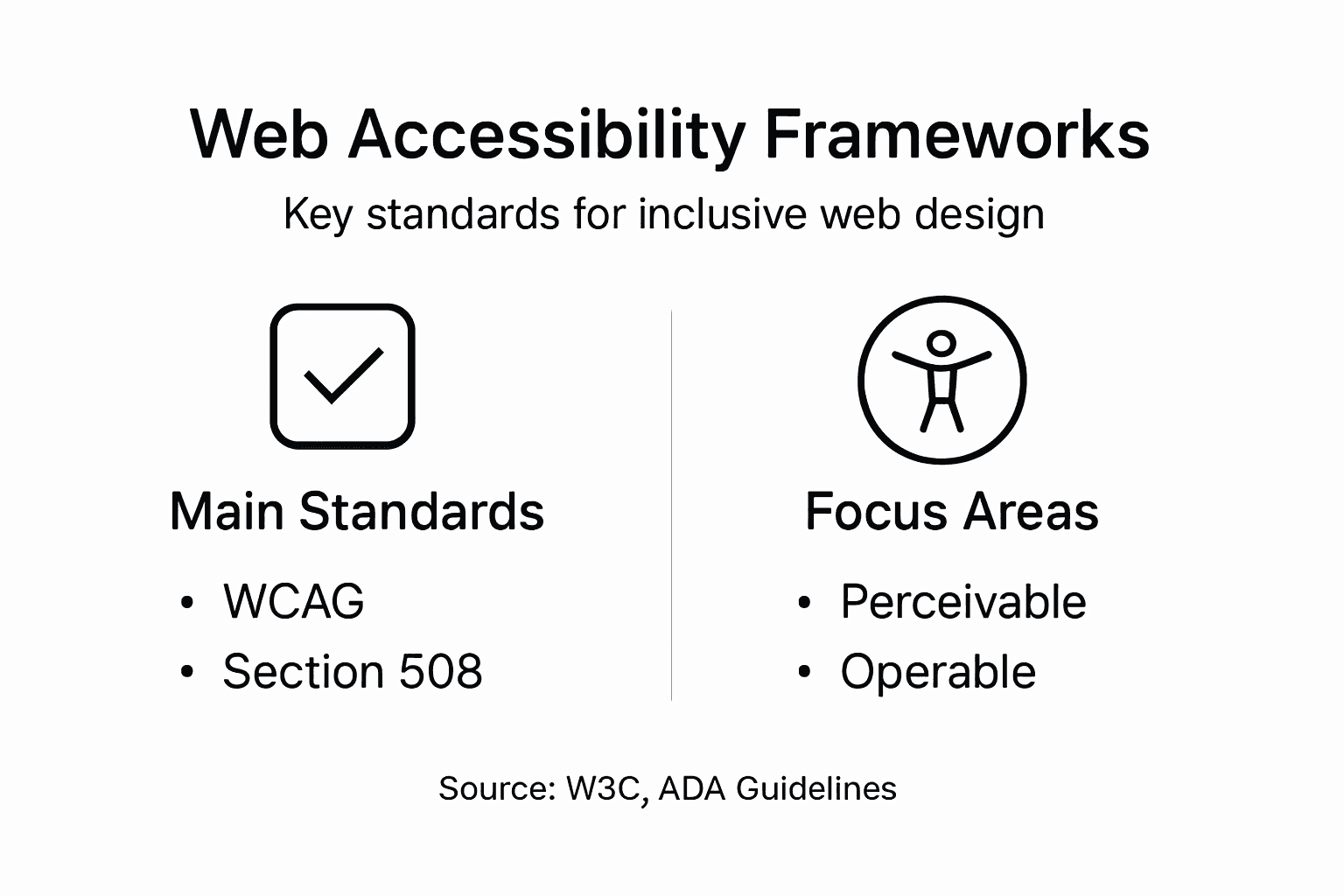
Web accessibility standards provide critical guidelines that ensure digital platforms remain inclusive and usable for all individuals. Web Content Accessibility Guidelines represent the most comprehensive international framework for creating accessible digital experiences, offering a robust set of recommendations that address diverse user needs.
The primary global accessibility frameworks include:
Compare the primary global accessibility frameworks and their regional roles:
| Accessibility Framework | Region | Purpose |
|---|---|---|
| WCAG | International | Detailed guidelines for web content |
| Section 508 | United States | Federal digital accessibility requirement |
| ADA | United States | Legal standard for digital inclusion |
| EN 301 549 | Europe | ICT accessibility requirements |
- WCAG (Web Content Accessibility Guidelines): The most widely recognized international standard
- Section 508: United States federal regulation for digital accessibility
- ADA (Americans with Disabilities Act): Legal standard for digital inclusion
- EN 301 549: European accessibility requirements for information and communication technology
U.S. Department of Justice web accessibility regulations now mandate specific compliance requirements for government websites and digital services. These regulations typically require adherence to WCAG 2.1 Level AA standards, which provide detailed criteria for creating accessible digital content.
Key Compliance Levels:
Here’s a summary illustrating how different accessibility compliance levels compare:
| Compliance Level | Coverage Scope | Typical Use Case |
|---|---|---|
| Level A | Basic accessibility requirements | Initial efforts or small sites |
| Level AA | Intermediate user needs addressed | Standard for organizations |
| Level AAA | Most comprehensive accessibility | Rarely achieved, specialized sites |
- Level A: Minimum accessibility requirements
- Level AA: Recommended standard for most organizations
- Level AAA: Highest level of accessibility (challenging to achieve completely)
Implementing these frameworks involves comprehensive strategies that go beyond technical compliance. Organizations must adopt a holistic approach that considers user experience, technological adaptability, and ongoing accessibility improvements.
Pro tip: Conduct regular accessibility audits and incorporate user feedback to continuously improve your digital platform’s inclusivity.
Legal Requirements and Compliance Challenges
Digital accessibility has become a critical legal consideration for organizations across various sectors. Department of Justice web accessibility rules are establishing increasingly stringent requirements that mandate comprehensive digital inclusion strategies for public and private entities.
Key Legal Compliance Requirements:
- Adherence to WCAG 2.1 Level AA standards
- Providing alternative text for images
- Ensuring keyboard navigation capabilities
- Implementing captions for multimedia content
- Creating screen reader compatible interfaces
Higher education accessibility regulations highlight the complex landscape of digital compliance. Different institutions face varied implementation timelines and specific challenges, including:
- Distributed content creation processes
- Legacy digital material adaptation
- Limited technological training resources
- Institutional capacity constraints
Potential Legal Consequences:
- Financial penalties
- Reputational damage
- Potential federal funding loss
- Civil rights violation claims
- Mandatory remediation costs
Organizations must adopt proactive accessibility strategies that go beyond mere technical compliance. This requires comprehensive planning, ongoing training, and a genuine commitment to creating inclusive digital environments that serve all users effectively.
Pro tip: Develop a cross-departmental accessibility task force to systematically address compliance challenges and create sustainable inclusion strategies.
Business Risks and Benefits of Accessibility
Web accessibility transcends ethical considerations, representing a strategic business imperative with profound financial and reputational implications. Web accessibility fundamentally impacts business performance by expanding market reach, enhancing user experience, and mitigating potential legal risks.
Key Business Benefits:
- Expanded market reach to 61 million disabled Americans
- Enhanced search engine optimization (SEO)
- Improved overall user experience
- Reduced legal vulnerability
- Stronger brand reputation
- Increased customer loyalty
Digital inclusion strategies reveal significant competitive advantages for organizations prioritizing accessibility. The potential risks of non-compliance are substantial and multifaceted:
Potential Business Risks:
- Legal litigation and potential financial penalties
- Reduced market share
- Negative brand perception
- Loss of potential customer segments
- Decreased digital platform effectiveness
Businesses that view accessibility as a cost rather than an investment fundamentally misunderstand its strategic value. Accessible digital platforms demonstrate organizational commitment to inclusivity, technological innovation, and social responsibility—qualities increasingly valued by modern consumers and stakeholders.
Pro tip: Conduct a comprehensive accessibility audit to identify potential gaps and prioritize implementation strategies that align with both legal requirements and user experience goals.
Debunking Common Myths and Mistakes
Web accessibility is frequently misunderstood, with numerous persistent myths preventing organizations from implementing effective inclusive design strategies. Digital accessibility myths often create unnecessary barriers that discourage meaningful progress in creating more inclusive digital environments.
Common Accessibility Myths:
- Accessibility only benefits people with permanent disabilities
- Making websites accessible is prohibitively expensive
- Accessibility is optional or a secondary consideration
- Compliance requires complex, disruptive redesigns
- Accessible websites are less aesthetically appealing
Accessibility misconceptions frequently overlook the broader impact of inclusive design. Accessibility actually benefits numerous user groups, including:
- Older adults experiencing age-related limitations
- Users with temporary injuries
- People in challenging environmental conditions
- Individuals using alternative devices
- Users with situational constraints
Realistic Accessibility Perspectives:
- Accessibility improves experience for ALL users
- Integrated design reduces long-term development costs
- Inclusive websites expand potential audience reach
- Early implementation prevents expensive retrofitting
- Accessible design demonstrates organizational sophistication
Businesses that recognize accessibility as a strategic opportunity rather than a compliance burden will develop more innovative, user-friendly digital platforms that serve broader audiences effectively.
Pro tip: Conduct periodic accessibility audits and integrate inclusive design principles throughout your development lifecycle, not just as a final checklist item.
Elevate Your Digital Presence with Inclusive Web Solutions
Understanding “What Is Web Accessibility and Why It Matters” reveals how crucial it is to create digital experiences that everyone can use easily. Many businesses struggle with complex navigation, limited alternative input methods, and compliance with legal standards like WCAG 2.1 Level AA. These challenges not only affect users with disabilities but also impact your overall SEO, brand reputation, and user engagement.
At Web Spider Solutions, we specialize in enhancing your website’s accessibility while boosting its search engine rankings and user experience. Our tailored digital marketing services integrate technical SEO and inclusive web design strategies to expand your market reach and reduce legal risks. Don’t let accessibility barriers limit your business growth.
Ready to transform your digital presence into an inclusive, high-performing platform? Discover how our expert team can help you overcome web accessibility challenges by visiting Web Spider Solutions today. Take the first step and request a free consultation to secure long-term growth and compliance.
Frequently Asked Questions
What is web accessibility?
Web accessibility refers to designing online platforms to ensure usability for everyone, including individuals with disabilities in areas such as vision, hearing, mobility, and cognition.
Why is web accessibility important for businesses?
Web accessibility is crucial as it helps expand audience reach, improve user experience, enhance brand reputation, and ensure compliance with legal standards, ultimately boosting overall business performance.
What are the key principles of web accessibility?
The key principles include perceivable content, operable interfaces, understandable information, and robust design that works with assistive technologies, ensuring all users can access and engage with digital content effectively.
How can organizations improve their web accessibility?
Organizations can improve web accessibility by conducting regular audits, implementing the Web Content Accessibility Guidelines (WCAG), providing alternative text for images, ensuring keyboard navigation, and continuously seeking user feedback to enhance the digital experience.