






Trying to secure your startup’s spot on the first page of Google can feel like shooting at a moving target. The search giant’s complex algorithm evaluates hundreds of signals while evolving with thousands of tweaks every year, and major updates like Panda, Penguin, and Hummingbird often force dramatic shifts in strategy. For marketing managers aiming for real results, knowing how the algorithm prioritizes relevance, quality, and user intent satisfaction is now key to building organic visibility that actually lasts.
Table of Contents
- What Is The Google Algorithm? Core Functions Defined
- Key Types Of Google Algorithm Updates Explained
- How Google Ranks Websites: Signals And Factors
- Recent Update Impacts On SEO And Traffic
- Common SEO Mistakes And Penalties To Avoid
Key Takeaways
| Point | Details |
|---|---|
| Understanding the Google Algorithm is Crucial | The algorithm evaluates content relevance, quality, and user intent, requiring startups to focus on genuine value creation. |
| Core Updates Impact Rankings Significantly | Major updates like Panda, Penguin, and Hummingbird reshape SEO strategies, demanding adaptation to align with Google’s shifting priorities. |
| User Experience is Paramount | Ranking factors include site speed, mobile-friendliness, and content engagement, highlighting the need to enhance user experience for better visibility. |
| Avoid Common SEO Mistakes | Technical errors, duplicate content, and ignoring user intent can severely impact rankings; regular audits and targeted strategies are essential for success. |
What Is the Google Algorithm? Core Functions Defined
The Google algorithm isn’t a single tool or decision maker. It’s a complex mathematical formula that evaluates hundreds of factors to determine which web pages deserve to appear for a given search query. Think of it as a massive filtering system that processes billions of pages and ranks them by relevance, quality, and how well they answer what someone is actually searching for. For your startup, this means Google constantly analyzes whether your content genuinely solves problems for your target audience or just stuffs keywords into paragraphs.
What makes this system so powerful is that it never stays still. Google tweaks its algorithm thousands of times each year, but some changes are far more significant than others. The major core updates—like Panda, Penguin, and Hummingbird—reshaped how search works by targeting specific problems. Panda tackled low-quality content, Penguin cracked down on spam and unnatural link patterns, and Hummingbird fundamentally improved Google’s ability to understand what people actually mean when they search, not just the keywords they type. Each update forced websites to think differently about their strategy. If you’re building content for a tech startup, you need to understand that Google’s March 2024 core update reduced unhelpful content by 40%—that tells you exactly where the algorithm’s priorities are right now.
At its core, the algorithm does three things for your business. First, it crawls and indexes your pages to understand what they’re about. Second, it ranks those pages against countless competitors based on relevance and trustworthiness signals. Third, it serves the best match to the person searching. The ranking part is where most startups get confused. Google looks at factors like your site’s overall authority, the freshness of your content, how fast your pages load, whether your content actually matches user intent, and whether other credible sites link to you. But here’s what trips up many marketing managers: the algorithm doesn’t care about your intentions. It cares about user experience. A beautifully written article that nobody clicks on ranks lower than a straightforward, helpful piece that keeps people engaged.
Pro tip: Focus your SEO efforts on understanding what your target audience actually searches for and what results they click on most, then create content that does those things better than what currently ranks—this alignment with user intent is what the algorithm rewards most consistently.
Key Types of Google Algorithm Updates Explained
Google doesn’t drop a single massive update once a year and call it done. Instead, the company continuously refines its algorithm through thousands of minor tweaks annually, but what really matters for your startup’s visibility are the major core updates that reshape how search rankings work across the entire web. These significant updates happen several times a year and can shift your organic traffic dramatically, either rewarding websites that align with Google’s new priorities or penalizing those that don’t. Understanding these major updates isn’t optional for marketing managers trying to keep their startups competitive. It’s the difference between staying ahead and watching competitors climb past you in search results.
Let’s break down the updates that fundamentally changed SEO strategy. Panda arrived in 2011 and targeted low quality content, thin pages, and duplicate material by introducing quality scores that evaluated whether content actually provided value. Penguin launched in 2012 and cracked down on manipulative linking practices, penalizing websites that bought links or engaged in unnatural link schemes. Hummingbird rolled out in 2013 and represented a shift toward understanding search context and user intent rather than just matching keywords. If someone searches “best running shoes for flat feet,” Hummingbird understood they wanted product recommendations, not a dictionary definition of “shoes.” These three updates alone forced the entire SEO industry to rethink strategy from keyword stuffing to actual value creation.
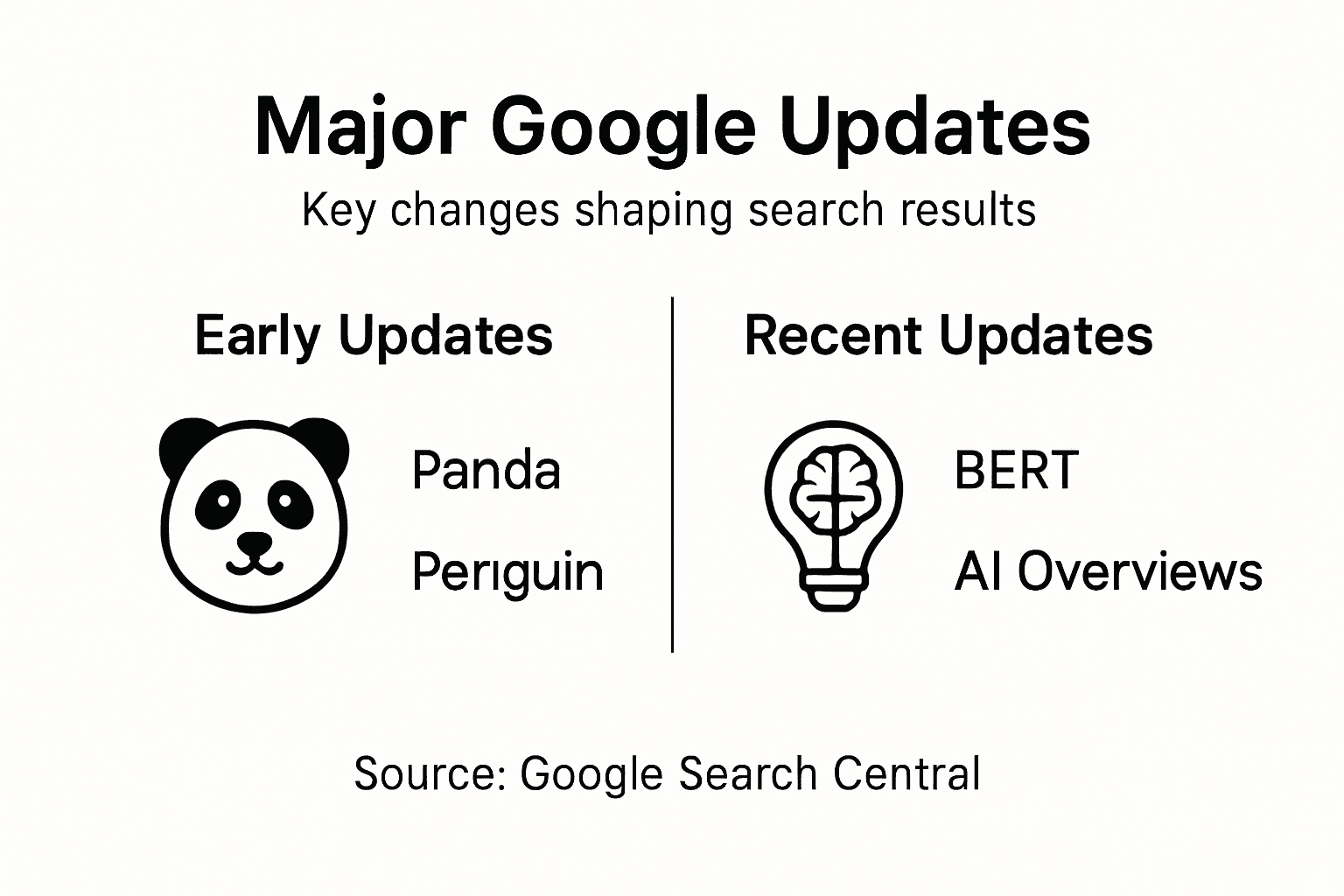
More recent updates have targeted specific problems that plague modern search results. Google released updates focused on reducing spam, combating AI-generated content that provides no real value, and improving page experience metrics like load speed and mobile usability. The E-E-A-T framework (Experience, Expertise, Authoritativeness, Trustworthiness) became central to ranking, especially for health, finance, and legal content where credibility matters most. For your tech startup, this means simply having a fast website with keyword-rich content isn’t enough anymore. Google wants to see that real people with real expertise created your content and that your website is a trusted source in your industry.
The pattern is clear. Each major update narrows the gap between what Google rewards and what users actually need. Your content needs to solve real problems for real people, your website authority needs to grow through legitimate means, and user experience signals need to improve. Core updates happen multiple times yearly, so you’re always in a state of needing to adapt rather than achieving permanent rankings.
Here’s a summary of key Google algorithm updates and their business implications:
| Update Name | Core Focus | Main Impact on Startups |
|---|---|---|
| Panda | Reducing low-quality content | Forces creation of valuable, original articles |
| Penguin | Penalizing manipulative links | Requires natural backlink strategies |
| Hummingbird | Understanding searcher intent | Rewards intent-focused, comprehensive answers |
| E-E-A-T | Emphasizing expertise/trust | Demands recognized authors, real-world authority |
| Core Updates | Prioritizing user experience | Rewards fast, problem-solving, user-centric sites |
Pro tip: Monitor Google Search Console and SEO ranking tools weekly after any major update announcement, because drops often appear within 48 hours and understanding which pages lost visibility tells you exactly what to fix first.
How Google Ranks Websites: Signals and Factors
Google’s ranking system doesn’t look at your website in isolation. Instead, it evaluates hundreds of billions of web pages using both page-level and site-wide signals to determine which results deserve the top positions for any given search query. Think of it as a massive comparison engine. When someone searches for “SEO strategies for startups,” Google doesn’t just check if your page mentions those words. It analyzes thousands of competing pages, measures dozens of quality indicators, and decides which one best serves that searcher. The algorithm incorporates AI models like BERT to understand what people actually mean when they type their queries, not just the literal keywords they use. For your startup, this means ranking depends on how well your entire website performs across multiple dimensions, not just optimizing individual pages.
The ranking factors break down into three main categories. Content quality and relevance matter first. Google looks for original, comprehensive content that thoroughly answers the query. A 10,000-word guide on technical SEO that covers every angle ranks higher than a 500-word article that skims the surface. Backlinks and authority come next. When other credible websites link to you, Google sees that as a vote of confidence. But not all backlinks carry equal weight. A link from a major industry publication matters far more than links from low-quality directories. Finally, technical performance and user experience signals include site speed, mobile-friendliness, how easy your pages are to navigate, and whether people actually stay on your site or bounce immediately. Google has confirmed that over 200 factors influence rankings, but these three categories capture most of what moves the needle for visibility.

What’s changed recently is how Google weighs these factors. The algorithm now prioritizes user satisfaction signals more heavily than ever before. Experience, expertise, authoritativeness, and trustworthiness determine whether Google believes your content should rank at all, especially in competitive niches. If you’re writing health or finance content without clear credentials, you’ll struggle to rank regardless of how well optimized your pages are. The algorithm also penalizes websites that prioritize ad revenue or clickbait over actual user value. Your startup’s success depends on genuinely solving problems for your audience, building real authority in your industry, and making your website fast and easy to use. These aren’t just nice-to-have extras anymore. They’re the foundation that separates websites that rank from those that disappear into page three.
Pro tip: Start by auditing your top five competitor websites to see which ranking signals they dominate—whether it’s backlink authority, content depth, technical speed, or user engagement—then focus your efforts on beating them in the areas where you’re currently weakest.
Recent Update Impacts on SEO and Traffic
Google’s 2025 updates have fundamentally shifted the playing field, and if your startup hasn’t adapted yet, you’re likely feeling the pain in your analytics. The latest core updates prioritize experience-based, trustworthy content over generic or AI-generated material, meaning websites that once ranked well by churning out keyword-optimized articles are now losing significant traffic. Meanwhile, competitors who focus on genuine expertise and original insights are climbing the rankings. Recent core updates have caused traffic shifts where some sites lose 30 to 50 percent of their organic visitors while others gain proportionally. The disparity isn’t random. Google’s algorithm now distinguishes between content created to genuinely help people and content created primarily to rank in search results. For marketing managers managing tech startups, this distinction matters because it forces a real strategic pivot away from volume and toward value.
The introduction of AI Overviews has changed search behavior in ways that directly impact your traffic potential. When Google provides direct answers to user questions within the search results themselves, people click through to websites less frequently than before. This doesn’t mean SEO is dead. Rather, it means your content needs to serve a purpose beyond just answering basic questions. You need to provide context, original research, case studies, expert analysis, or solutions that Google’s AI can’t simply extract and display. A startup that publishes a generic overview of “how to optimize landing pages” might see clicks drop. But a startup that publishes a detailed case study showing exactly how they increased conversion rates by 247 percent for a specific customer type will still attract engaged visitors. The algorithm rewards depth and authenticity because those traits signal that a human expert created the content.
What’s crucial to understand is that volatility continues. Core updates in 2025 emphasize user experience and content quality, but the specific winners and losers shift based on your industry and audience. Sites demonstrating originality and trustworthiness gain visibility while those relying on thin, programmatic content lose rankings. Technical performance remains critical. A beautifully researched article that loads in 7 seconds will rank lower than a slightly less detailed article that loads in 1.5 seconds. Mobile usability, Core Web Vitals, and proper site structure all influence whether Google even shows your content to searchers. For your startup, this means you cannot focus on just one aspect of SEO. Content quality matters. Technical performance matters. Authority building matters. User experience matters. Neglecting any one of these creates a ceiling on your potential rankings and traffic.
Pro tip: Audit your top 20 traffic-generating pages weekly for the next 30 days to identify which ones gained or lost visibility after the latest updates, then reverse engineer what those winning pages do differently in terms of depth, original data, technical speed, and user engagement—that’s your playbook for new content.
Common SEO Mistakes and Penalties to Avoid
Most startups aren’t intentionally sabotaging their SEO. But they’re making preventable mistakes that cost them thousands in lost traffic every month. The most damaging errors happen before you even publish content. Common SEO mistakes include blocking Google from crawling or indexing content, which literally prevents your pages from appearing in search results. This sounds obvious, but it happens constantly. A developer accidentally leaves noindex tags on production pages, or robots.txt is configured to block entire sections of the site. Your website could have perfect content and flawless technical setup, but if Google can’t access it, no one will find you. Another foundational mistake is skipping keyword research entirely. Many startups create content based on assumptions about what their audience searches for, then wonder why the pages get zero traffic. You might write a beautiful article about your product features when your actual customers are searching for solutions to specific problems. The gap between what you think people want and what they actually search for is where rankings disappear.
Technical mistakes create another major penalty zone. Duplicate content across multiple pages signals to Google that you’re either poorly organized or trying to game the rankings, neither of which Google rewards. Under-optimized meta tags and descriptions mean your page titles and snippets don’t accurately represent your content or appeal to searchers, so they skip your result even if you rank. Poor mobile usability is an automatic ranking killer in 2025. Google crawls pages from mobile devices first, so if your website is slow or clunky on phones, you’ll lose rankings and traffic. Keyword stuffing, where you cram target keywords into content unnaturally, doesn’t work anymore and often gets penalized. A sentence that reads “Best SEO services for best SEO results using best SEO techniques” isn’t fooling anyone. Google’s AI understands that real writing doesn’t work that way. The algorithm now distinguishes between content written for people and content written for search engines. Technical issues like duplicate content and poor mobile usability degrade rankings and require fixing through site audits and optimization efforts.
The most dangerous mistake is ignoring user intent. You can rank for “best project management tools” but if your content is just a list of generic feature comparisons, users will bounce instantly. Google tracks this behavior and interprets it as a signal that your page didn’t satisfy the searcher. Pages with high bounce rates rank lower over time. Meanwhile, a competitor who created a detailed comparison showing specifically how to choose between tools for small teams versus agencies will keep visitors engaged. Building authority takes time, but undoing penalties takes even longer. If Google penalizes your site for manipulative tactics or low-quality content, recovery can take months. Prevention is infinitely easier than recovery. Run regular site audits to catch technical issues, verify your robots.txt configuration, audit for duplicate content, and most importantly, ensure every piece of content solves a real problem for your specific audience better than existing options.
Common SEO mistakes and their long-term consequences:
| Mistake Type | Typical Example | Potential Penalty |
|---|---|---|
| Technical Blocking | Noindex tags on key pages | Content never indexed by Google |
| Duplicate Content | Repeating articles across URLs | Reduced rankings sitewide |
| Poor Mobile Design | Slow/clunky mobile layout | Lower rankings, less traffic |
| Ignoring Intent | Generic topics, not user questions | High bounce rate, lost visibility |
| Keyword Stuffing | Overusing keywords unnaturally | Algorithm penalties, trust erosion |
Pro tip: Set up monthly automated site audits to catch technical SEO issues before they impact rankings, and track your bounce rates by page in Google Analytics to identify content that fails to match user intent so you can revise or remove it.
Elevate Your Online Visibility with Expert SEO and AI-Driven Strategies
Understanding how the Google Algorithm shapes search rankings can feel overwhelming. You know that focusing on content quality, user intent, and technical performance is key. Yet, keeping pace with constant updates like Panda, Penguin, and the evolving E-E-A-T framework demands specialized knowledge and proactive actions. These complexities can stall your startup’s growth if you miss critical signals or fail to optimize fully for user experience and authority.
At Web Spider Solutions, we solve these challenges by delivering tailored SEO and digital marketing solutions that align perfectly with Google’s priorities. Our team blends proven optimization techniques with cutting-edge insights from the Artificial Intelligence Archives – Web Spider Solutions to ensure your content not only meets but exceeds user intent and trustworthiness standards. We help startups boost organic rankings, increase targeted traffic, and develop sustainable authority in highly competitive markets. Ready to turn complex algorithm changes into a growth opportunity Visit https://webspidersolutions.com/ for a complimentary SEO audit and start transforming your digital presence today.
Frequently Asked Questions
What is the Google Algorithm and how does it impact online visibility?
The Google Algorithm is a complex mathematical formula that evaluates various factors to determine the ranking of web pages for specific search queries. It impacts online visibility by filtering billions of pages, ensuring that the most relevant and high-quality content appears at the top of search results.
How often does the Google Algorithm change and why should I care?
Google updates its algorithm thousands of times annually. Major core updates can significantly affect your website’s ranking and traffic, either rewarding high-quality content or penalizing low-value pages. For businesses, staying informed about these changes is crucial for maintaining competitive online visibility.
What are some major Google Algorithm updates that have influenced SEO strategies?
Key updates include Panda, which targets low-quality content; Penguin, which penalizes manipulative linking practices; and Hummingbird, which improves understanding of user intent. Understanding these updates helps businesses adapt their SEO strategies to align with Google’s priorities.
How can I optimize my website for Google’s ranking system?
To optimize your website, focus on creating high-quality, original content that meets user intent, boosts site authority with legitimate backlinks, and enhances technical performance like page speed and mobile usability. Regularly audit your website for SEO issues and adjust your strategy based on performance metrics.
Recommended