








Most American businesses underestimate just how powerful a consistent brand voice can be in building audience trust. With over 80 percent of consumers saying brand authenticity influences their buying decisions, the right voice becomes a true competitive asset. In a world crowded with choices, understanding how a distinct voice shapes perception will help your business cut through noise and forge genuine connections.
Table of Contents
- Defining Brand Voice In Modern Marketing
- Key Elements That Shape Brand Voice
- Types And Variations Across Industries
- Benefits Of A Distinctive Brand Voice
- Common Pitfalls And How To Avoid Them
Key Takeaways
| Point | Details |
|---|---|
| Importance of Brand Voice | A distinct brand voice establishes emotional connections with audiences and builds loyalty. This voice should reflect the company’s core values and maintain consistency across all communication channels. |
| Components of Brand Voice | Brand voice is shaped by tone, style, and vocabulary, which help define an organization’s communication identity. Regular audits and a style guide are vital for maintaining alignment and clarity. |
| Industry Variations | Different industries require tailored brand voices that resonate with their target audience; awareness of these differences enhances communication effectiveness. |
| Common Pitfalls | Avoid inconsistencies, forced authenticity, and over-complication to ensure clear and relatable communication that aligns with organizational values. |
Defining Brand Voice in Modern Marketing
Brand voice represents the distinct personality and communication style a company uses to connect with its audience. It transcends mere words, encompassing the emotional resonance and consistent messaging that distinguishes an organization from its competitors. In the digital age, verbal identity has become increasingly critical as businesses seek to create meaningful two-way conversations with consumers.
At its core, brand voice includes the language, tone, vocabulary, and emotional undertones that reflect a company’s core values and personality. Think of it as the verbal equivalent of visual branding – just as a logo communicates identity visually, brand voice communicates identity through language. Some brands sound professional and authoritative, while others are playful, witty, or empathetic. The key is maintaining consistency across all communication channels, from social media posts to customer service interactions.
Conversational capital plays a significant role in modern brand voice strategies. Brands can engineer word-of-mouth by creating experiences that become part of consumers’ personal narratives, which means developing a voice that resonates authentically with target audiences. This approach transforms communication from a one-way broadcast into an engaging dialogue that builds trust and emotional connection.
Pro Tip for Success: Conduct a comprehensive brand voice audit every six months, analyzing your current communications across platforms to ensure consistency and alignment with your core brand identity and messaging strategy.
Key Elements That Shape Brand Voice
Brand voice is a complex framework built on several critical elements that collectively define an organization’s communication style. Key components include tone, style characteristics, and core values that guide communication strategies, transforming abstract concepts into tangible communication guidelines.

Word choice plays a pivotal role in establishing brand personality. Vocabulary selection signals a brand’s intent and identity, with clear guidelines specifying preferred words, prohibited terms, and contextual examples across different communication channels. For instance, a technology startup might use dynamic, innovative language, while a financial services firm would likely adopt a more measured, authoritative tone.
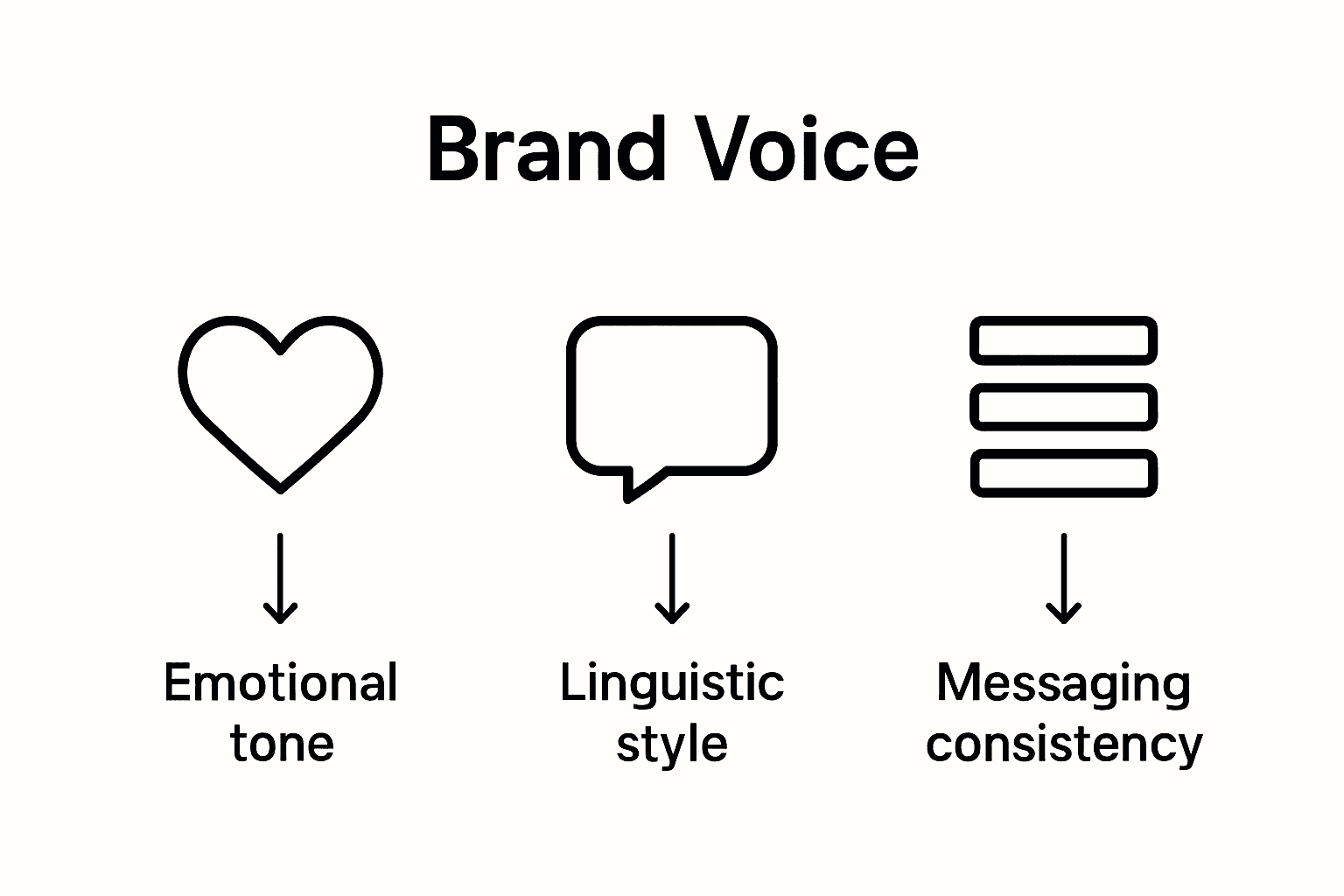
The fundamental elements shaping brand voice can be categorized into three primary dimensions: emotional tone, linguistic style, and value-driven messaging. Emotional tone reflects the underlying sentiment – whether playful, serious, empathetic, or inspirational. Linguistic style encompasses sentence structure, vocabulary complexity, and communication rhythm. Value-driven messaging ensures that every communication reinforces the brand’s core principles and strategic objectives.
Pro Tip for Precision: Develop a comprehensive brand voice style guide that documents specific language preferences, prohibited terms, and contextual communication examples to maintain consistent messaging across all platforms.
Types and Variations Across Industries
Brand voice demonstrates remarkable diversity across different industries, with each sector developing unique communication strategies tailored to its specific audience and professional context. Sound symbolism plays a critical role in how companies create meaningful relationships between their brand names and visual identities, influencing how audiences perceive and interact with different brands.
Technology and startup environments typically adopt an innovative, dynamic voice characterized by energetic language, forward-thinking terminology, and a sense of disruption. In contrast, financial services firms employ a more conservative, authoritative tone that emphasizes reliability, expertise, and trust. Healthcare brands prioritize compassionate, informative communication that balances technical accuracy with empathetic messaging. Retail and consumer brands often leverage conversational, engaging voices that create emotional connections and reflect contemporary social trends.
Sound branding techniques, including audio mnemonics and sonic logos, offer powerful tools for differentiating products across various industries. These auditory elements help enhance brand recall, build consumer trust, and create memorable brand experiences that extend beyond traditional visual communication. For instance, technology companies might use crisp, clean language with technical precision, while hospitality brands focus on warm, welcoming communication that suggests comfort and exceptional service.
The following table summarizes how brand voice differs across key industries:
| Industry | Typical Brand Voice Characteristics | Key Audience Expectation |
|---|---|---|
| Technology | Energetic, innovative, dynamic | Cutting-edge, updated information |
| Financial Services | Authoritative, measured, trustworthy | Clarity, reliability, professionalism |
| Healthcare | Compassionate, informative, empathetic | Accurate, clear, reassuring |
| Retail/Consumer | Conversational, engaging, trend-aware | Relatable, friendly, accessible |
| Hospitality | Warm, welcoming, service-oriented | Comfort, personal attention |
Pro Tip for Strategic Adaptation: Conduct periodic audience research to ensure your brand voice remains aligned with evolving industry communication trends and target demographic expectations.
Benefits of a Distinctive Brand Voice
A well-defined brand voice provides strategic advantages that extend far beyond simple communication, transforming how audiences perceive and interact with an organization. By establishing a consistent and unique communication style, businesses can differentiate themselves in increasingly crowded marketplaces, creating memorable connections that transcend traditional marketing approaches.
One of the most significant benefits is enhanced brand recognition and customer loyalty. When a brand communicates with a distinctive, authentic voice, it builds trust and emotional resonance. Customers begin to recognize and anticipate the brand’s communication style, which creates a sense of familiarity and reliability. This consistency helps transform casual consumers into dedicated brand advocates who feel a genuine connection to the company’s personality and values.
A distinctive brand voice also enables more effective storytelling and messaging across multiple platforms. Whether communicating through social media, website content, customer service interactions, or marketing materials, a well-crafted brand voice ensures a unified narrative. This coherence helps reinforce the brand’s core message, making communication more impactful and memorable. Companies can strategically leverage their unique voice to cut through the noise of digital communication, capturing audience attention and creating meaningful engagement.
Pro Tip for Voice Development: Conduct regular audience surveys and communication audits to ensure your brand voice remains authentic, relevant, and aligned with your evolving customer expectations.
Common Pitfalls and How to Avoid Them
Developing a consistent brand voice requires careful navigation of several potential challenges that can undermine communication effectiveness. One of the most significant pitfalls is inconsistency across different communication channels, which can create confusion and erode brand credibility. Companies often struggle to maintain a unified voice when multiple team members or departments are responsible for creating content.
Another critical mistake is forcing an artificial or inauthentic brand voice that does not genuinely reflect the organization’s core values and personality. Audiences are remarkably perceptive and can quickly detect when communication feels manufactured or disingenuous. This disconnect can lead to decreased trust and reduced engagement. Brands must strike a delicate balance between professional communication and authentic expression, ensuring that their voice sounds natural and aligned with their true organizational identity.
Over-complication represents another common challenge in brand voice development. Some organizations attempt to sound too sophisticated or technical, alienating their target audience and obscuring key messages. Effective brand communication requires clarity, simplicity, and accessibility. Complex jargon and unnecessarily elaborate language can create barriers to understanding, ultimately undermining the intended communication goals. Successful brands learn to communicate complex ideas in straightforward, engaging language that resonates with their specific audience demographics.
Pro Tip for Consistency: Create a comprehensive brand voice style guide that includes specific examples of acceptable and unacceptable language, complete with context-specific communication scenarios to guide team members in maintaining a unified voice.
Here is a quick reference for building a successful brand voice:
| Step | Purpose | Business Impact |
|---|---|---|
| Brand Voice Audit | Identify inconsistencies or misalignments | Ensures unified communication |
| Style Guide Creation | Document tone, vocabulary, and examples | Enables team-wide consistency |
| Regular Audience Check | Measure relevance and authenticity | Builds trust and loyalty |
| Training Staff | Align team with desired voice style | Reduces errors and confusion |
Strengthen Your Brand Voice with Targeted Digital Marketing Solutions
Creating a consistent and authentic brand voice is essential for standing out in today’s crowded digital marketplace. This article highlights the challenge many businesses face when their communication lacks unity or emotional connection. If you want to avoid pitfalls like inauthentic messaging or inconsistent tone across platforms, it is crucial to implement a strategic approach that integrates your brand personality into every touchpoint.
At Web Spider Solutions we specialize in crafting tailored digital marketing strategies that enhance your brand voice while driving real business growth. From creative content marketing to SEO and social media management we help you develop clear consistent messaging that resonates with your target audience. Discover how our comprehensive services support your goal to build trust loyalty and a memorable identity by exploring our Stories Archives – Web Spider Solutions. Ready to elevate your brand voice and dominate your industry? Take the next step with a free consultation visit Web Spider Solutions today and start transforming your digital presence.
Frequently Asked Questions
What is brand voice?
Brand voice is the unique personality and communication style a company uses to connect with its audience. It includes language, tone, vocabulary, and emotional undertones that reflect the organization’s core values and distinguish it from competitors.
Why is brand voice important in marketing?
Brand voice is crucial because it helps create meaningful conversations with consumers, builds trust, and fosters emotional connections. A consistent brand voice enhances recognition and loyalty among customers, helping to differentiate a business in a crowded marketplace.
How can I develop a strong brand voice?
To develop a strong brand voice, conduct a brand voice audit to identify your current communication style, create a comprehensive brand voice style guide, and ensure consistency across all platforms. Regularly check in with your audience to align your voice with their expectations.
What are common pitfalls in maintaining brand voice?
Common pitfalls include inconsistency across communication channels, forcing an inauthentic voice that doesn’t reflect the brand’s core values, and over-complicating language, which can alienate audiences. It’s important to ensure your communication is clear, relatable, and aligned with your brand identity.
Recommended