






Every B2B marketing team has witnessed the frustration of leads going quiet right when they should convert. The challenge grows when your prospects navigate countless options and complex decision-making paths before saying yes. Understanding the core sales funnel concepts not only brings clarity to this process but also gives your team the structure to map real customer journeys, deliver relevant messaging, and move qualified leads toward lasting partnerships.
Table of Contents
- Core Sales Funnel Concepts For B2B Marketing
- Key Sales Funnel Stages And Customer Journey
- Types Of Sales Funnels For Digital Campaigns
- Essential Metrics And Optimization Strategies
- Common Sales Funnel Mistakes And How To Avoid
Key Takeaways
| Point | Details |
|---|---|
| Understanding Funnel Stages | Mapping each stage of the sales funnel is essential for effective marketing and sales alignment. It helps tailor messaging to meet prospects’ needs at each phase. |
| Customer Journey Focus | The customer journey extends beyond the sale; recognize the importance of educating prospects at the awareness stage and nurturing them through to loyalty. |
| Tailored Content is Crucial | Each sales funnel stage requires specific content that addresses the varying needs of prospects to avoid drop-offs and enhance conversions. |
| Continuous Optimization | Regularly measure and refine your sales funnel based on actual performance data, focusing on key metrics to improve conversion rates systematically. |
Core Sales Funnel Concepts for B2B Marketing
A sales funnel is the path your prospects travel from first hearing about your company to becoming paying customers. Think of it as a filtering system where each stage narrows down the audience while moving the most qualified leads toward a purchase decision.
Understanding how funnel marketing guides potential customers through awareness to purchase is foundational for B2B growth. Your funnel isn’t just a theoretical model—it’s the actual journey your prospects experience, and mapping it correctly changes everything about how you market and sell.
The Four Core Stages
Every B2B sales funnel has distinct stages where prospects need different messaging, information, and support:
- Awareness: Prospects recognize they have a problem or need. Your job is visibility and education.
- Consideration: Prospects actively research solutions. They’re comparing options and evaluating vendors.
- Decision: Prospects are ready to buy. They need clear pricing, terms, and reasons to choose you over competitors.
- Retention: Customers become advocates who generate referrals and repeat business.
Each stage requires completely different tactics. A prospect in the awareness stage doesn’t need a sales call—they need helpful content that addresses their pain point. Someone in the decision stage needs pricing details and proof of results.
The most common B2B mistake is treating all prospects the same regardless of where they sit in the funnel. Different stages require different messages.
B2B sales cycles are longer and more complex than B2C, with multiple decision-makers involved. You’re not just selling to one person—you’re managing relationships across departments and approval hierarchies. This means your funnel must support extended nurturing periods and account-based approaches.

Why Funnel Stages Matter for Your Team
Without clear funnel stages, your marketing and sales teams operate in different worlds. Marketing generates leads. Sales complains they’re not qualified. Nobody wins.
When you define each stage, you create alignment:
- Marketing knows exactly what content moves prospects from one stage to the next.
- Sales understands which prospects are actually ready for outreach.
- Leadership can track conversion rates at each stage and spot bottlenecks.
- You can measure ROI on individual marketing activities.
B2B success depends on understanding customer needs, building relationships, and adapting your approach as markets change. The funnel gives you the structure to do all three systematically.
Pro tip: Map your actual sales process before building your funnel model—measure where deals stall, how long stages take, and what messaging gets responses. Use real data, not assumptions.
Key Sales Funnel Stages and Customer Journey
Your customer journey doesn’t start at the sale—it starts when someone first becomes aware of a problem they need to solve. The sales funnel maps this entire journey, showing how prospects move from strangers to loyal customers who refer others.
The journey typically flows through distinct stages where prospects have different needs and require different messaging. Understanding how the customer journey moves through awareness, consideration, conversion, and loyalty helps you design marketing efforts that actually match where prospects are in their buying process.
The Five Critical Stages
Most B2B sales funnels follow this progression, though your specific stages may vary slightly based on your industry and sales cycle:
- Awareness: A prospect recognizes they have a problem. They’re searching for information, reading blog posts, and trying to understand their situation.
- Interest: The prospect actively learns about potential solutions. They’re comparing approaches and evaluating different vendors in the space.
- Consideration: The prospect narrows their focus to specific solutions. They’re requesting demos, downloading case studies, and talking to sales teams.
- Decision: The prospect is ready to buy from someone. They’re negotiating terms, finalizing pricing, and preparing for implementation.
- Loyalty: The customer is onboarded and engaged. They’re gaining results and becoming advocates who refer other prospects.
Each stage requires completely different content, channels, and interactions. A prospect in awareness needs educational content about their problem. Someone in consideration needs competitive comparisons and social proof.
Here’s a quick comparison of the five critical customer journey stages and recommended content focus for each:
| Stage | Customer Goal | Content Focus | Channel Example |
|---|---|---|---|
| Awareness | Identify a problem | Educational guides | Blog posts, social media |
| Interest | Explore solutions | Solution overviews | Webinars, expert interviews |
| Consideration | Evaluate options | Vendor comparisons, case studies | Product demos, sales calls |
| Decision | Choose a provider | Pricing, proof of success | Proposals, contract reviews |
| Loyalty | Gain ongoing value, refer others | Onboarding, advocacy programs | Success check-ins, referrals |
The funnel narrows because not every prospect moves forward—some drop out, some go silent, some choose competitors. That’s normal and expected.
Aligning Your Channels and Messages
Different digital channels work better at different stages of the journey. Marketing funnels use channels like SEO, social media, and PPC to move prospects through each stage based on their intent and readiness.
Here’s how channels align with stages:
- Awareness stage: organic search, social media content, industry publications
- Interest stage: webinars, comparison guides, expert interviews
- Consideration stage: product demos, case studies, sales conversations
- Decision stage: custom proposals, security reviews, contract negotiation
- Loyalty stage: onboarding training, success check-ins, referral programs
When your messaging and channels misalign with where prospects actually are in the journey, they either ignore you or drop out. You waste budget pushing decision-stage messaging to awareness-stage prospects who aren’t ready.
The key is mapping how long your actual prospects spend in each stage, what content moves them forward, and where most deals stall. This reveals your real bottlenecks.
Pro tip: Track conversion rates between each stage for the last 90 days—identify which transition loses the most prospects, then focus your optimization efforts there first.
Types of Sales Funnels for Digital Campaigns
Not all sales funnels work the same way. Your B2B company might need a lead generation funnel, while a competitor runs a webinar funnel. The type you choose depends entirely on your business goal and how your prospects prefer to buy.
Choosing the right funnel type is critical because each one guides prospects through different stages and interactions. Different types of sales funnels serve specific purposes such as lead capture, product sales, webinars, and applications—each suited to unique business goals and marketing strategies.
The Main Funnel Types for B2B
Here are the funnel types most B2B companies use in their digital campaigns:
- Lead Generation Funnels: Designed to capture contact information from prospects early in their awareness stage. You offer something valuable—a guide, checklist, or assessment—in exchange for their email.
- Buyer/Product Funnels: Move qualified prospects toward a purchase decision. These work best when prospects already know they need a solution and are comparing options.
- Webinar Funnels: Use live or recorded presentations to educate prospects and build credibility. Ideal for complex solutions that need explanation and expert positioning.
- Event Funnels: Drive attendance and engagement for conferences, demos, or training sessions. These build relationships and allow face-to-face interactions.
- Follow-up Funnels: Re-engage prospects who went silent or didn’t convert. These use email sequences and targeted content to revive stalled opportunities.
Each funnel type requires different content, messaging, and timing. A lead generation funnel might take 7 days from opt-in to first sales contact. A buyer funnel might stretch 30-60 days with multiple touchpoints.
The table below summarizes key funnel types, their main business goals, and typical timeframes:
| Funnel Type | Main Goal | Best Audience | Typical Timeframe |
|---|---|---|---|
| Lead Generation | Collect qualified leads | Early-stage, information seekers | 1-7 days |
| Buyer/Product | Drive product purchase | Solution-aware, high intent | 30-60 days |
| Webinar | Educate and build credibility | Mid-stage, complex needs | 1-2 weeks before event |
| Event | Increase engagement | Networking and learning seekers | 1-4 weeks prior |
| Follow-up | Re-engage dormant prospects | Stalled, lost opportunities | Varies by campaign |
The wrong funnel type wastes budget and frustrates your sales team. Pick the funnel that matches where your prospects actually are in their buying journey.
Matching Funnels to Your Digital Channels
Your digital campaigns across SEO, paid advertising, and content marketing all feed into one or more of these funnel types. When you manage digital campaigns effectively, you’re strategically routing prospects into the right funnel based on their intent and readiness.
Consider how prospects enter each funnel:
- Lead generation: organic search traffic, social media ads, content downloads
- Buyer funnels: high-intent search traffic, remarketing campaigns, referrals
- Webinar funnels: email lists, LinkedIn ads, industry communities
- Event funnels: targeted outreach, partner promotions, direct invitations
- Follow-up funnels: abandoned cart emails, website behavior tracking, past inquiries
The mistake most B2B companies make is running the same funnel for everyone. Your awareness-stage prospects need different nurturing than decision-stage prospects. Different funnels solve this problem.
Pro tip: Start with one funnel type and optimize it to 20+ percent conversion before building a second. Most teams spread too thin across all funnel types instead of mastering one.
Essential Metrics and Optimization Strategies
Your sales funnel only improves when you measure it. Without data, you’re guessing where prospects drop off and why they choose competitors. The right metrics tell you exactly which stages leak opportunities and where to focus your optimization efforts.
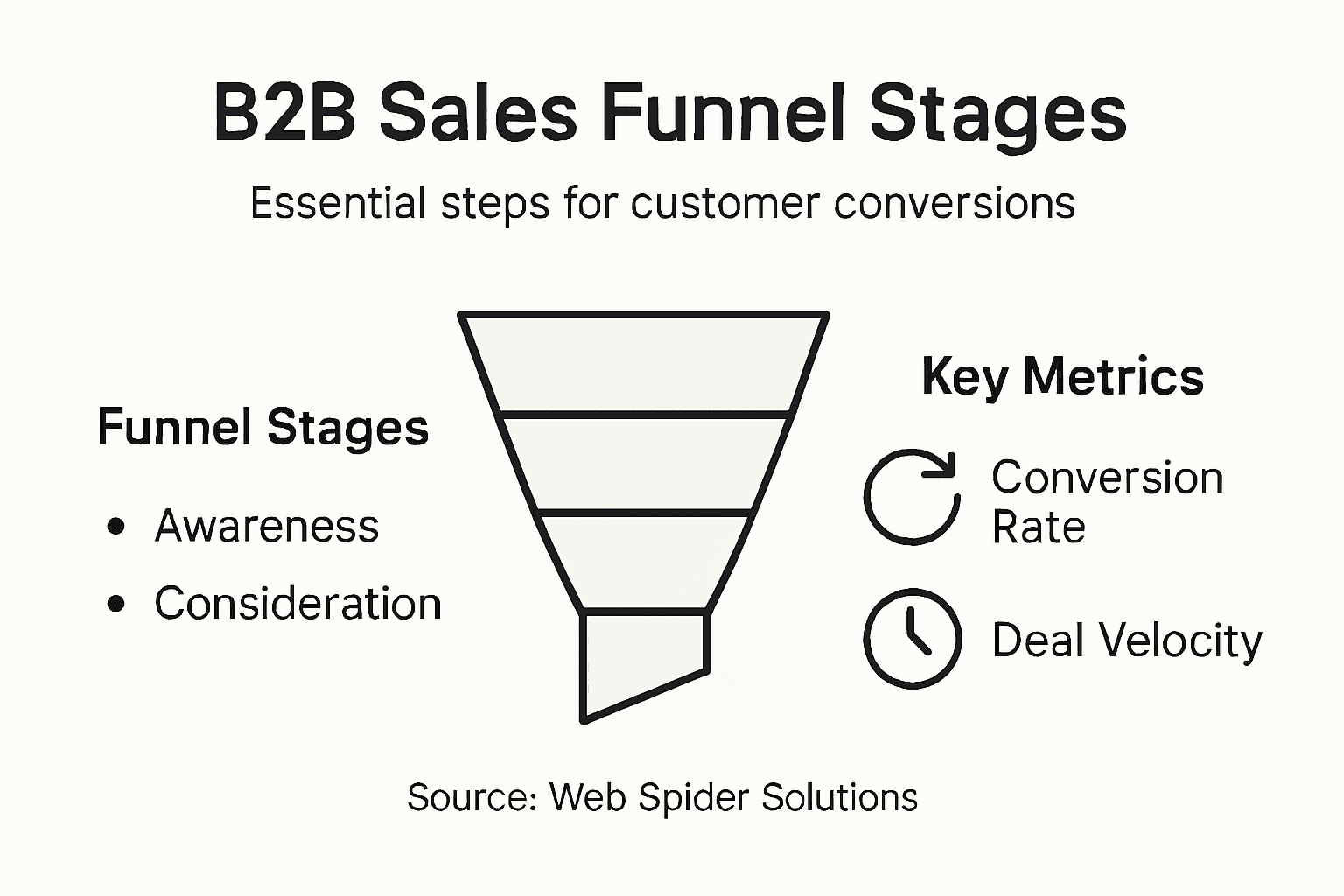
Most B2B companies track vanity metrics like total traffic or email subscribers. That misses the point entirely. You need to measure conversion funnel optimization by analyzing where potential customers drop off and making data-driven improvements at each stage.
Critical Metrics to Track
Focus on these metrics that actually predict revenue and growth:
- Stage Conversion Rate: Percentage of prospects moving from one stage to the next. A 20% drop between consideration and decision signals a messaging or credibility problem.
- Cost Per Lead: Total marketing spend divided by leads generated. Track by channel to identify which sources deliver quality prospects.
- Sales Cycle Length: Days from first contact to closed deal. If your average is 90 days, prospects spending 120+ days signal friction or low priority status.
- Lead Quality Score: Percentage of marketing leads that sales actually qualifies. A low score means marketing and sales have misaligned definitions.
- Customer Lifetime Value: Total revenue from a customer minus acquisition cost. This determines how much you can spend to acquire them.
These five metrics reveal your funnel’s actual health far better than vanity numbers.
Track what moves the needle on revenue, not what looks impressive in a boardroom. One conversion metric beats ten traffic metrics.
Three Optimization Moves That Work
Once you’re measuring, optimize these areas where most B2B funnels leak opportunities:
- Reduce friction at decision stage: Add testimonials, case studies, and security certifications. Decision-stage prospects need confidence, not more information.
- Improve consideration stage nurturing: Use conversion rate optimization strategies to test clearer value propositions, comparison tables, and competitive positioning that moves prospects toward buying confidence.
- Tailor content to each stage: Awareness prospects need education about their problem. Consideration prospects need vendor comparison. Decision prospects need implementation details. Mismatched content stops conversion cold.
Start by identifying your biggest leak—the transition where most prospects disappear. Optimize that stage first. Once you’re converting 40+ percent through that transition, move to the next bottleneck.
Pro tip: Set up automated alerts when conversion rates between any two stages drop more than 5 percent week-over-week—early warning signs often mean messaging or technical problems need immediate attention.
Common Sales Funnel Mistakes and How to Avoid
Most B2B companies build their first sales funnel and then stop improving it. They treat the funnel as a static blueprint instead of a living system that needs constant refinement. This single mistake costs thousands in lost revenue every quarter.
The funnel is not a one-time strategy. It’s a continuous cycle of measurement, testing, and optimization. Companies that avoid the biggest mistakes see 30-50% improvements in conversion rates within six months.
The Five Biggest Mistakes
Here are the errors that derail most B2B funnels:
- Assuming a linear path: Customers rarely move straight through awareness, consideration, and decision. They loop back, research competitors, and take detours. Focusing rigidly on sequential funnel stages misses how customers actually behave across multiple touchpoints and channels.
- Chasing volume over quality: Generating 1,000 unqualified leads wastes time and budget. One qualified prospect worth $50,000 beats 100 tire-kickers every time.
- Using one-size-fits-all messaging: A prospect in awareness needs education. Someone in decision needs negotiation terms. Using the same message for both kills conversions.
- Ignoring where prospects drop off: Most teams track inputs (traffic, emails sent) but ignore outputs (where deals stall). Find your biggest leak and fix it first.
- Misalignment between marketing and sales: Marketing delivers leads. Sales says they’re worthless. Without a shared definition of “qualified,” both teams fail.
Fix your biggest leak before building new campaigns. One 5% improvement in conversion beats launching five new channels.
How to Fix Each Mistake
Address these problems systematically:
- Map the actual customer journey: Stop assuming prospects move sequentially. Track how real customers behave—where they research, what content they consume, which emails they open, how long decisions take.
- Define lead quality together: Marketing and sales must agree on what “qualified” means. Use qualification criteria like budget, authority, need, and timeline. Disqualify prospects who don’t fit, even if they came from marketing.
- Create stage-specific content: Awareness prospects need problem education. Consideration prospects need solution comparison. Decision prospects need implementation details and pricing. Match content to stage.
- Measure the transitions, not the volume: Focus on continuously improving data and fine-tuning communications rather than vanity metrics. Track conversion rates between stages and identify where prospects abandon you.
- Test and refine constantly: Change one element at a time—headline, offer, email subject line—and measure the impact. Small improvements compound into massive results.
Pro tip: Audit your funnel quarterly by reviewing where deals stall longest and which stage has the lowest conversion rate—tackle that bottleneck first before expanding to other stages.
Unlock B2B Growth by Mastering Your Sales Funnel Stages
Are you struggling to align your marketing and sales teams around a clear, effective sales funnel? The article highlights the critical pain points of treating all prospects the same and ignoring where deals stall in the funnel. These challenges often lead to wasted budget, lost leads, and stalled growth. Your prospects need stage-specific messaging and tailored nurturing to move confidently from awareness to decision and beyond.
At Web Spider Solutions we specialize in designing comprehensive digital marketing strategies that precisely target each funnel stage. Our expertise in SEO, paid advertising, and content marketing helps you attract the right prospects at the awareness and interest stages while advanced funnel optimization techniques improve conversion rates during consideration and decision stages. Take control of your sales process today and stop losing valuable leads due to mismatched messaging or unqualified traffic.
Ready to transform your B2B sales funnel into a powerful revenue engine? Explore how our tailored solutions can provide the clarity your team needs at Web Spider Solutions. Contact us for a free SEO audit and personalized consultation to identify your biggest funnel leaks and unlock real growth now.
Frequently Asked Questions
What is a sales funnel?
A sales funnel is a visual representation of the journey that potential customers take from first becoming aware of a problem or need to ultimately making a purchase. It illustrates how prospects are filtered through various stages until they become paying customers.
What are the main stages of a B2B sales funnel?
The main stages of a B2B sales funnel typically include Awareness, Consideration, Decision, and Retention. Each stage requires different content and messaging to effectively guide prospects toward making a purchase decision.
Why is it important to align marketing and sales teams in a sales funnel?
Aligning marketing and sales teams is crucial because it ensures that both teams work toward common goals and have a shared understanding of what defines a qualified lead. This alignment helps optimize the funnel, improve lead quality, and ultimately increase conversion rates.
How can I optimize each stage of my sales funnel?
You can optimize each stage of your sales funnel by measuring key metrics such as conversion rates and lead quality, implementing specific content tailored to each stage, and identifying bottlenecks. Regularly testing and refining your messaging and strategies can enhance performance throughout the funnel.