





A single vulnerability can threaten not just your SaaS platform, but also the hard-earned trust of every customer who relies on you. For digital marketing managers, protecting sensitive client data goes beyond compliance—it is about building and maintaining confidence with every interaction. By understanding the core elements of website security, you create a solid foundation that protects your company’s reputation, reduces risk, and strengthens your competitive position among SaaS providers.
Table of Contents
- Defining Website Security and Its Role
- Common Website Vulnerabilities and Threats
- Key Security Measures for SaaS Companies
- Legal Obligations and Data Protection Laws
- Impact of Website Security on Business Trust
Key Takeaways
| Point | Details |
|---|---|
| Website Security Is Essential | Protecting customer data and maintaining trust is critical for your SaaS business. Strong security measures are foundational from the start. |
| Compliance Is Mandatory | Understanding and adhering to legal data protection regulations is crucial for avoiding penalties and maintaining business operations. |
| Transparency Builds Trust | Clearly document and communicate your security practices and compliance efforts to instill confidence in potential customers. |
| Investing in Security Saves Money | Prioritizing security measures can prevent costly breaches and reputation damage that may arise from cyber attacks. |
Defining Website Security and Its Role
Website security means protecting your SaaS platform, customer data, and business operations from cyber threats. It’s not just about keeping hackers out—it’s about maintaining trust with the companies relying on you.
Your customers expect their information to be safe. When you store client credentials, payment details, or proprietary business data on your servers, you’re responsible for keeping that information secure from unauthorized access and theft.
What Website Security Actually Covers
Website security involves multiple layers of defense working together. Think of it like protecting a physical office: you need locks on doors, security cameras, and staff trained to spot suspicious behavior.
Core elements include:
- Data encryption – scrambling sensitive information so only authorized users can read it
- Access controls – ensuring only the right people can access specific data or features
- Threat detection – identifying attacks and suspicious activity in real-time
- Compliance standards – meeting legal requirements for data protection in your industry
- Regular security updates – patching vulnerabilities before attackers exploit them
Website security frameworks include strategies like HTTPS encryption, same-origin policies, and secure coding practices that prevent common vulnerabilities.
Why This Matters for Your SaaS Business
A single security breach can damage your reputation permanently. Customers will leave. You’ll face legal liability. Recovery costs money and time you don’t have.
Beyond the damage control, strong security gives you a competitive advantage. When prospects evaluate SaaS solutions, they check your security credentials and certifications. Being able to prove you take data protection seriously wins deals.
Security isn’t a feature you add later—it’s a foundation you build from day one of your platform.
The Real-World Impact on Marketing
As a digital marketing manager at a SaaS company, you know how hard you work to build brand trust. Security breaches destroy that trust instantly. One headline about stolen customer data undoes months of trust-building efforts.
Conversely, strong security becomes a marketing asset. You can highlight certifications, compliance standards, and security practices in your messaging. It addresses buyer concerns and accelerates sales cycles.
Website security also protects your business operations. Attacks can take your platform offline, preventing customers from accessing their accounts. Downtime means lost revenue and frustrated clients.
Security’s Role in Compliance
Depending on your industry and customer base, you might need to comply with regulations like GDPR, HIPAA, or SOC 2. Information security frameworks establish policies and controls to meet these requirements.
Compliance isn’t optional. Non-compliance results in fines, legal action, and business restrictions. Many enterprise customers won’t work with you unless you meet specific security standards.
You can’t market your SaaS product effectively without proving you handle customer data responsibly. Security compliance removes a major objection from the sales process.
Pro tip: Document your security practices and compliance certifications clearly on your website—potential customers want to see this before they even schedule a demo.
Common Website Vulnerabilities and Threats
Your SaaS platform faces constant attacks from hackers looking for weaknesses to exploit. These aren’t theoretical risks—they’re actively being targeted right now across thousands of websites.

Understanding what attackers target helps you prioritize your security budget. You can’t protect everything equally, so focus on the vulnerabilities that cause the most damage.
The Most Exploited Vulnerabilities
Certain security flaws appear in nearly every breach. OWASP identifies critical web application security risks that should top your security checklist.
The most dangerous vulnerabilities include:
- Broken access control – users accessing data or features they shouldn’t
- SQL injection attacks – attackers inserting malicious code into your database queries
- Security misconfiguration – default settings left unchanged or features exposed unintentionally
- Cryptographic failures – weak encryption or improper data handling
- Insecure design patterns – fundamental flaws in how your platform was built
Each of these opens a direct path for attackers to steal customer data or take your platform offline.
Real-World Attack Methods
Attackers don’t wait for you to fix problems. Unpatched software flaws and zero-day exploits represent the fastest attack vectors used by malicious actors today.
Common attack methods your team should know about:
- Credential abuse – stolen login credentials used to access accounts
- Supply chain attacks – compromising software you rely on to attack your platform
- Phishing campaigns – tricking employees into revealing passwords or access
- Brute force attacks – repeatedly trying login combinations until one works
- Malware injection – embedding harmful code into your application
Most breaches exploit vulnerabilities that have been publicly known for months. Patching promptly matters more than detecting new threats.
Why Your SaaS Business Is a Target
SaaS platforms hold valuable data. Customer lists, billing information, and business secrets make you an attractive target for cybercriminals and competitors alike.
Your platform also controls access to customer operations. Taking it offline disrupts their business, which means they’ll pressure you to fix the problem quickly—sometimes paying ransom.
As a digital marketing manager, understand that attackers specifically research companies to find weaknesses. They read your LinkedIn profiles, monitor your job postings, and analyze your technology stack to identify targets.
The Cost of Inaction
Ignoring vulnerabilities costs money fast. A single breach exposes you to fines under GDPR and state privacy laws, legal liability from customers, and the operational expense of incident response and notification.
Your reputation damage is impossible to quantify but easy to measure—customers leave, prospects decline demos, and trust disappears.
Delaying patches or skipping security audits might save money today, but the cost of a breach will dwarf those savings.
Pro tip: Maintain a public security page showing your certifications, last penetration test date, and incident response process—transparency builds customer confidence and differentiates you from competitors.
Key Security Measures for SaaS Companies
Protecting your SaaS platform requires a layered approach. No single solution stops all attacks, so you need multiple defenses working together to catch what others might miss.
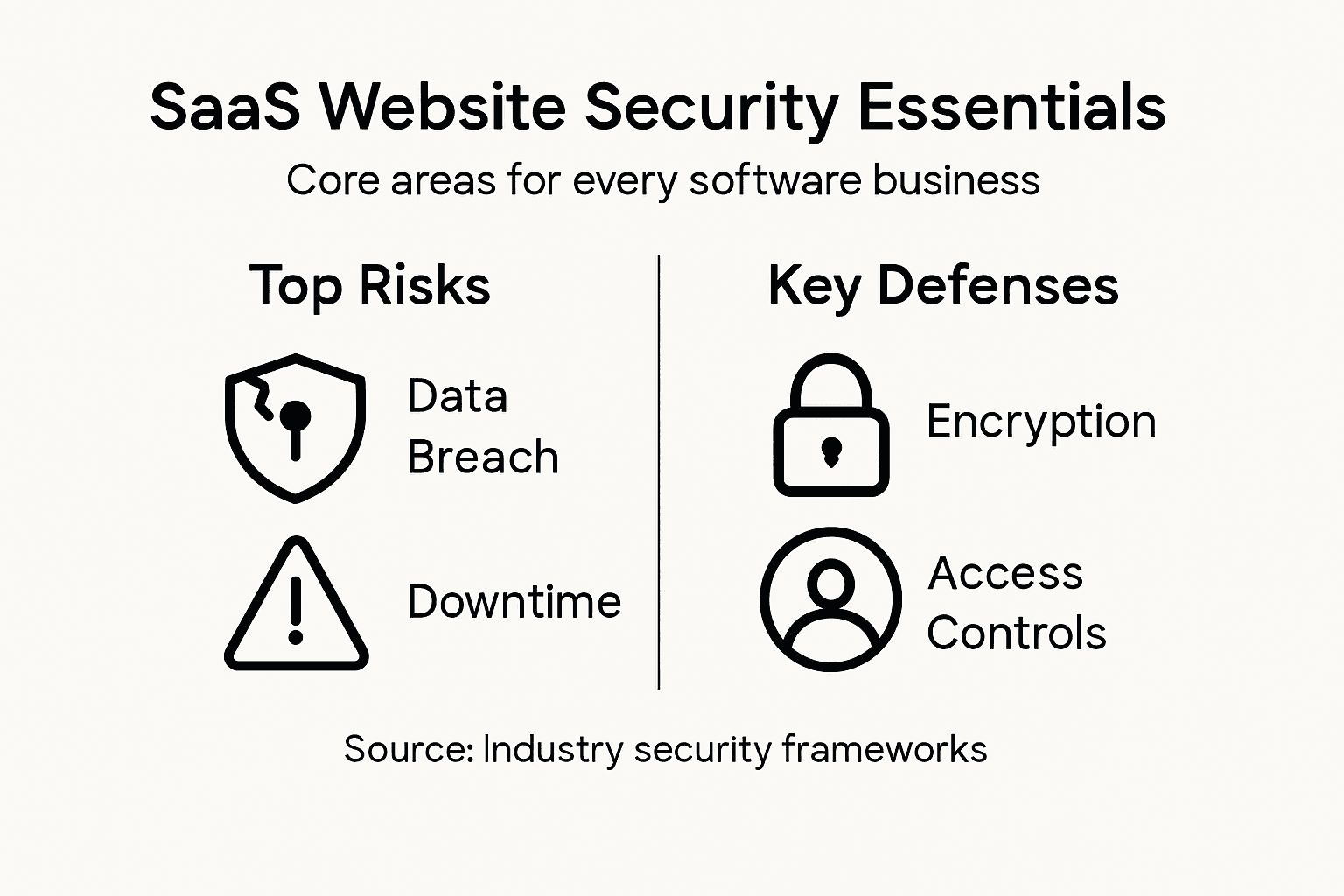
The good news? You don’t need to invent security from scratch. Industry frameworks give you proven strategies that work across thousands of companies.
Core Security Controls
Start with the fundamentals. Identity and access management systems prevent unauthorized users from accessing your platform and customer data.
Core controls your team should implement:
- Data encryption – both when data sits at rest and when it travels across networks
- Access controls – limiting who can view or modify sensitive information
- Network firewalls – blocking unauthorized traffic before it reaches your servers
- Continuous threat monitoring – detecting suspicious activity in real-time
- Vulnerability scanning – regularly testing your code for security flaws
These form your foundation. Without them, you’re vulnerable to basic attacks that exploit well-known weaknesses.
Following Industry Frameworks
Building security from scratch wastes time and money. CIS Critical Security Controls provide a prioritized framework proven to reduce cyber risk across industries.
Key CIS controls to prioritize:
- Inventory all hardware and software assets on your network
- Protect sensitive data with encryption and access restrictions
- Configure all systems securely, disabling unnecessary features
- Control application access based on user roles and permissions
- Continuously scan for and patch system vulnerabilities
- Log all activity for audit trails and incident investigation
- Protect email and web browsers against malware and phishing
You don’t need to implement everything at once. Start with controls that address your highest risks.
The Shared Responsibility Model
SaaS security isn’t just your responsibility. Your customers must also implement controls on their side—managing their passwords, enabling two-factor authentication, and training their employees.
Clearly document which security measures you provide and which ones customers must manage themselves. This transparency prevents misunderstandings and reduces breach risk.
Security is a continuous process, not a one-time project. Threats evolve constantly, so your defenses must evolve too.
Making Security Practical
Over-complicated security programs fail because employees bypass them. You need security that protects effectively without crushing productivity.
Focus on automation. Let tools handle threat detection, patch management, and log analysis instead of requiring manual review. Your team can then focus on strategic security decisions.
Budget realistically. A breach costs far more than preventive security measures. Spending 5% of revenue on security saves 20% when a breach is prevented.
Pro tip: Conduct a security audit of your current systems and identify your top three vulnerabilities—focus your budget there first before expanding to comprehensive controls across the platform.
Legal Obligations and Data Protection Laws
Ignoring data protection laws isn’t just risky—it’s illegal. If you process customer data, laws in your country and theirs apply to you, and violations carry serious penalties.
As a digital marketing manager, you need to understand what legal obligations your SaaS company faces. This knowledge directly impacts your marketing messaging, website compliance, and customer trust.
The Global Legal Landscape
Data protection laws exist in over 140 countries worldwide, creating a complex patchwork of requirements. If your customers span multiple regions, you likely must comply with multiple jurisdictions’ rules.
This isn’t optional compliance. Violating these laws results in:
- Heavy financial penalties and fines
- Legal liability from affected customers
- Mandatory breach notifications
- Reputational damage that impacts sales
- Potential business restrictions in certain regions
Your marketing claims about security and data handling must align with these legal requirements. Making false security promises violates both marketing regulations and data protection laws.
Key Regulations You Need to Know
Data protection laws regulate how organizations collect, use, store, and share personal data at federal, state, and international levels. The specific laws applying to you depend on your customer base.
Critical regulations include:
- GDPR – applies to any company processing data of European residents, regardless of where your company operates
- HIPAA – required for companies handling health information in the United States
- CCPA and state privacy laws – apply to California and other US states
- PIPEDA – Canada’s federal privacy law for private sector organizations
If you’re unsure which laws apply, consult with a legal professional. The cost of guidance is minimal compared to breach penalties.
Here is a comparison of legal data protection regulations relevant to SaaS businesses:
| Regulation | Jurisdiction | Main Focus | Key Business Impact |
|---|---|---|---|
| GDPR | European Union | Personal data rights | Requires consent, breach notification |
| HIPAA | United States | Health data protection | Demands strict access controls |
| CCPA | California, US | Consumer privacy | Opt-out mechanisms for data sales |
| PIPEDA | Canada | Data collection transparency | Requires clear privacy policies |
What Compliance Actually Requires
Compliance means more than having a privacy policy. You must demonstrate active practices protecting customer data and respecting individual rights.
Requirements typically include:
- Written privacy policies explaining data handling
- Consent mechanisms before collecting data
- Breach notification procedures within specified timeframes
- Data access and deletion capabilities for customers
- Regular security audits and assessments
- Employee training on data protection
Most breaches don’t happen because companies lack security—they happen because companies don’t follow their own procedures consistently.
Compliance as a Marketing Advantage
Compliance isn’t just defensive. It’s a competitive differentiator. Customers increasingly ask about data protection before signing contracts.
Your marketing should highlight your compliance certifications, regular audits, and transparent data practices. This addresses buyer concerns and accelerates deal closure with security-conscious prospects.
Document your compliance efforts. When marketing to enterprise customers, proof of compliance becomes part of your sales advantage.
Pro tip: Create a compliance page on your website listing the regulations you follow, your certifications, and when your last audit occurred—this builds trust and speeds up enterprise sales cycles.
Impact of Website Security on Business Trust
Security isn’t just a technical problem—it’s a business problem. Customers choose SaaS platforms based on trust, and security is foundational to that trust.
When prospects evaluate your platform, they’re asking themselves: Can I trust this company with my data? A strong security posture answers that question affirmatively and accelerates sales cycles.
How Security Builds Customer Loyalty
Effective cybersecurity demonstrates commitment to protecting customer data, which directly supports customer loyalty and business growth. Customers who feel their information is safe become repeat customers.
Conversely, a single breach destroys years of trust building. One headline about stolen data causes customers to leave for competitors, even if you recover technically.
This is why security belongs in your marketing conversation. It’s not just compliance—it’s competitive advantage.
The Trust-Security Connection in Sales
Enterprise buyers won’t sign contracts without confidence in your security practices. They ask for certifications, audit results, and penetration testing reports before committing.
Your sales team needs to address security concerns directly:
- Highlight your certifications and compliance standards
- Share your incident response procedures
- Provide documentation of security audits
- Explain your data encryption methods
- Demonstrate your vulnerability management processes
Not having these answers kills deals. Having them accelerates them.
Here is a summary of how website security supports business trust and growth:
| Security Priority | Trust Outcome | Impact on Sales |
|---|---|---|
| Certifications displayed | Builds buyer confidence | Shortens sales cycles |
| Proactive communication | Increases loyalty | Reduces lost customers |
| Transparent incident response | Retains customer trust | Limits reputation damage |
| Documented audits & tests | Reveals security maturity | Wins enterprise contracts |
Transparency as a Trust Tool
Transparency in cybersecurity communication enables customers to have confidence in your commitment to protecting their data. Open dialogue about security practices builds accountability.
This means being honest about:
- What security measures you provide
- What customers must implement themselves
- How you handle security incidents
- When you discover and patch vulnerabilities
- Your breach notification timeline
Customers appreciate honesty more than perfection. They expect problems—they want to know you’ll handle them responsibly.
Trust is built slowly through consistent security practices and destroyed instantly by a single breach. The math is unforgiving.
Security as Marketing Differentiation
Most SaaS companies claim to be secure. Few prove it with concrete evidence. Documentation becomes your competitive advantage.
Featuring your security practices prominently on your website addresses buyer concerns before they even contact sales. This removes friction from the buying process.
When marketing to security-conscious industries like healthcare, finance, or legal services, your security story becomes part of your value proposition.
The Reputation Impact
A breach makes headlines. Recovery takes months or years. Customer acquisition costs spike because prospects become skeptical.
Investing in security prevents this scenario entirely. That prevention is worth far more than the investment cost.
Pro tip: Add a “Security” section to your main navigation showing certifications, audit dates, and your incident response commitment—this builds buyer confidence and reduces sales cycle length.
Strengthen Your SaaS Security with Proven Digital Strategies
Protecting your SaaS business from cyber threats requires more than technical fixes. As the article “Website Security: Safeguarding SaaS Businesses Online” highlights, building trust through transparent security measures is vital to winning and retaining clients. You face challenges such as preventing unauthorized access, maintaining compliance with laws like GDPR, and defending against costly breaches that damage reputation and revenue. Your goal is clear. Secure your platform and showcase that security as a competitive advantage.
At Web Spider Solutions, we understand how essential website security is to your brand trust and growth. Our expert digital marketing services focus on communicating your security certifications, compliance efforts, and transparent incident response clearly and confidently. From search engine optimization to tailored content marketing campaigns, we help your SaaS company highlight your commitment to protecting customer data. This builds customer loyalty, accelerates sales cycles, and differentiates your brand in competitive markets.
Ready to turn your website security into a powerful marketing asset? Discover how our comprehensive digital strategies can amplify your business credibility and attract the right customers now. Visit Web Spider Solutions to request a free consultation and start building trust that lasts.
Frequently Asked Questions
What is website security and why is it important for SaaS businesses?
Website security involves protecting your SaaS platform and customer data from cyber threats. It’s crucial because a single breach can severely damage your reputation and result in legal liabilities, while strong security measures can enhance customer trust and provide a competitive advantage.
What are common vulnerabilities that SaaS platforms face?
SaaS platforms commonly face vulnerabilities such as broken access controls, SQL injection attacks, security misconfiguration, cryptographic failures, and insecure design patterns. These weaknesses provide attack vectors for cybercriminals seeking to exploit your systems.
How can I improve the security of my SaaS application?
To improve security, implement core security controls such as data encryption, access controls, network firewalls, continuous threat monitoring, and regular vulnerability scanning. Following established industry frameworks can also guide your security strategy.
What role does compliance play in website security for SaaS businesses?
Compliance with data protection regulations like GDPR and HIPAA is essential for SaaS businesses. It requires implementing specific security measures and practices to protect customer data. Non-compliance can lead to significant fines and reputational damage.