







Up to 83% of U.S. SMBs have a website, yet a striking number of those sites quietly drain marketing budgets instead of fueling growth. The problem is rarely the product or the service. It is almost always the design. Poor structure, slow load times, and unclear calls-to-action (CTAs) turn potential customers away before they ever read a single word about what you offer. This guide breaks down exactly how design choices shape your marketing results, which elements matter most, and how to start making your website work as hard as your team does.
Table of Contents
- Why website design matters in modern marketing
- Core elements of high-performance marketing websites
- How design decisions impact lead generation and SEO
- Evaluating and optimizing your website for better marketing ROI
- Why most SMBs underestimate the power of great web design
- Take your marketing further with expert web design
- Frequently asked questions
Key Takeaways
| Point | Details |
|---|---|
| Design equals marketing ROI | Effective website design is essential for better lead generation, SEO, and marketing results. |
| Core elements matter | Mobile-first layouts, fast loading, trust-building CTAs, and SEO integration drive performance. |
| Continuous improvement | Regularly evaluate, measure, and enhance your site to stay ahead of competitors. |
| Mindset shift needed | Treat website design as a growth tool, not just a technical requirement, to maximize success. |
Why website design matters in modern marketing
Most business owners think of their website as a digital brochure. A place to list services, share contact details, and call it done. That mindset is expensive. Your website is the engine behind nearly every marketing channel you run, from paid ads to email campaigns to organic search.
Consider this: for SMBs that have a website, SEO is the top lead source at 40%, compared to referrals for businesses without one. That gap exists because a well-designed site gives search engines something to work with. Clean code, logical navigation, and fast load times all signal quality to Google. Without them, your SEO investment stalls.
Design also controls trust. Visitors form an opinion about your site in roughly 50 milliseconds. A cluttered layout, outdated fonts, or broken mobile experience tells them you might not be reliable. That snap judgment affects whether they fill out a form, call your team, or click away forever.
Here is a quick look at how design affects core marketing outcomes:
| Marketing goal | Design factor | Impact |
|---|---|---|
| SEO rankings | Site speed, structure, crawlability | Higher or lower search visibility |
| Lead generation | CTA placement, form design | More or fewer conversions |
| Brand trust | Visual consistency, UX clarity | Credibility gained or lost |
| Ad performance | Landing page design | Better or worse cost per lead |
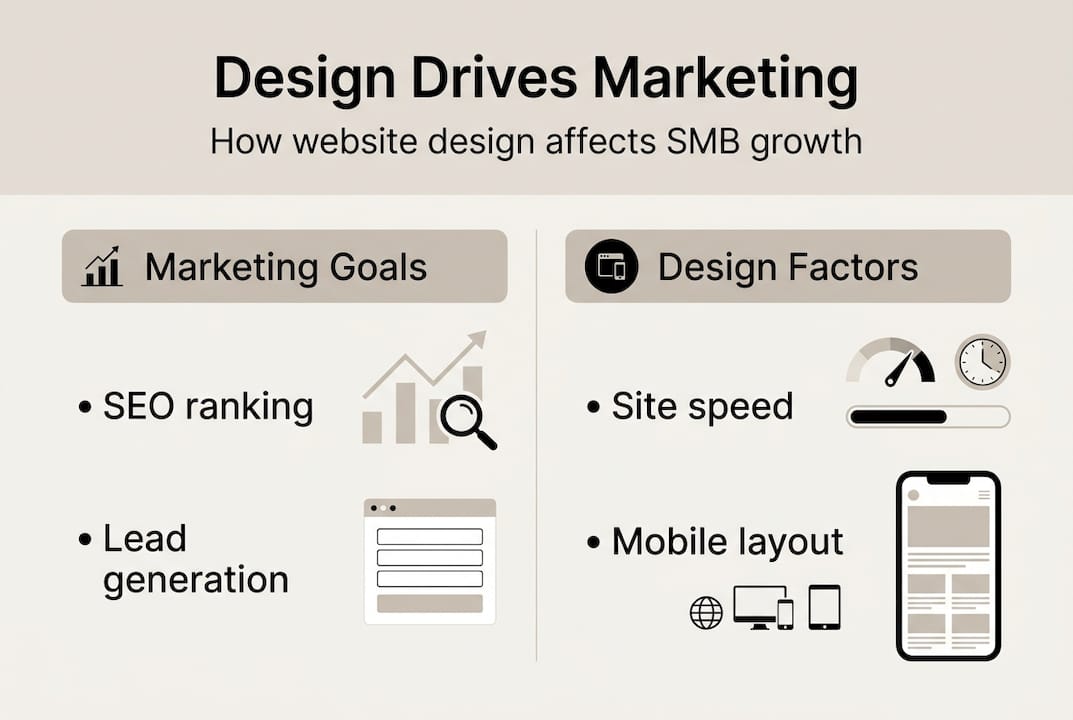
The businesses that treat website design as a growth driver rather than a one-time project consistently outperform competitors. They understand that every design decision either opens or closes a marketing door. Following website design best practices is not optional if you want real marketing ROI. It is the baseline. And investing in branding and UX design from the start ensures your site communicates the right message to the right audience, every time.
Core elements of high-performance marketing websites
Knowing the stakes, let us break down the ingredients of a high-performance, marketing-driven website. Not every site needs a massive redesign. But every site needs these fundamentals in place.
Mobile-first design is non-negotiable. More than half of all web traffic comes from mobile devices. If your layout breaks on a phone screen, you are losing leads before they even start reading. Responsive design adapts your site automatically to any screen size, keeping the experience smooth and conversion-ready.

Page speed and Core Web Vitals are equally critical. Google uses these performance signals as ranking factors. A one-second delay in load time can reduce conversions by up to 7%. That is not a rounding error. It is real revenue walking out the door.
Here is how common design approaches compare on key performance factors:
| Design approach | Mobile-friendly | Speed optimized | SEO-ready | Conversion-focused |
|---|---|---|---|---|
| Template site (unoptimized) | Sometimes | Rarely | Partially | Rarely |
| Custom-built marketing site | Yes | Yes | Yes | Yes |
| Outdated legacy site | No | No | No | No |
Beyond speed and mobile, your site needs:
- Clear, prominent CTAs on every key page
- Trust signals like reviews, certifications, and client logos
- Consistent brand visuals that match your other marketing materials
- SEO-structured content with proper headings, metadata, and internal linking
As HubSpot recommends, prioritizing mobile-first, performance-optimized, conversion-focused design integrated with SEO and content is the formula for marketing ROI. Investing in usability and UX design pays off across every channel. And if you are actively working on improving conversion rates, your design is always the first place to look.
Pro Tip: Run your site through Google PageSpeed Insights right now. If your mobile score is below 70, fixing it should be your first marketing priority this quarter.
How design decisions impact lead generation and SEO
With the essentials in mind, here is a closer look at how specific design choices move the marketing needle for SMBs.
Search engines crawl your site the way a reader scans a book. They follow links, read headings, and assess structure. If your navigation is confusing, your internal links are broken, or your pages have no clear hierarchy, crawlers struggle. That means lower rankings, which means fewer visitors, which means fewer leads.
For SMBs with websites, SEO drives 40% of leads. That number only holds if your design supports search visibility. Poor design actively blocks it.
Here is how design decisions flow through to lead generation:
- Site structure determines which pages get indexed and ranked.
- Page speed affects both rankings and whether visitors stay long enough to convert.
- CTA placement controls whether visitors know what to do next.
- Form design determines how many people actually complete a contact or sign-up form.
- Trust signals reduce hesitation and increase form submissions.
Think of your website like a funnel. Design is the shape of that funnel. A poorly designed funnel leaks leads at every stage. A well-designed one guides visitors naturally toward conversion.
Pro Tip: Place your primary CTA above the fold on every landing page. Visitors should never have to scroll to find out how to contact you or get started.
Developing website content for SEO is only effective when paired with strong design. Content without structure gets ignored by both users and search engines. Understanding website structure for SEO helps you build a site that ranks and converts. And grounding your approach in solid SEO principles ensures your design choices support long-term visibility, not just short-term traffic spikes.
Evaluating and optimizing your website for better marketing ROI
To go from theory to action, here are the steps you can take to ensure your design supports your next marketing leap.
Start with a baseline audit. You cannot improve what you do not measure. Check these areas first:
- Site speed: Use Google PageSpeed Insights or GTmetrix
- Mobile usability: Google Search Console flags mobile issues automatically
- SEO health: Look for missing meta tags, broken links, and thin content
- Conversion rate: Divide leads by total visitors to get your baseline percentage
- Lead source tracking: Set up Google Analytics 4 to see where your leads actually come from
Once you have your baseline, set up regular tracking. Monthly reviews of key metrics catch problems before they become expensive. Website performance metrics like bounce rate, session duration, and goal completions tell you whether your design is working or working against you.
Here is a simple optimization priority table:
| Issue found | Priority level | Estimated impact |
|---|---|---|
| Mobile score below 70 | Critical | High |
| Page load over 3 seconds | Critical | High |
| No clear CTA on key pages | High | High |
| Missing meta descriptions | Medium | Medium |
| Outdated visuals or branding | Medium | Medium |
Notably, 43% of SMBs plan performance upgrades to their websites. That means nearly half of your competitors are already moving. The businesses that act now will capture the lead generation gains before the others catch up. Pairing design improvements with strong content marketing strategies creates a compounding effect where better design amplifies better content, and vice versa.
Pro Tip: Study the top three competitors in your niche. Note what their CTAs say, where they place trust signals, and how fast their pages load. Use that as a benchmark, then aim to beat it.
Why most SMBs underestimate the power of great web design
Here is the uncomfortable truth: most business owners treat website design as an aesthetic decision. They ask, “Does it look good?” when they should be asking, “Does it convert?”
We have seen this pattern repeatedly. A company invests in Google Ads, hires a content writer, and runs social media campaigns. Then they send all that traffic to a slow, confusing website with no clear next step. The marketing spend evaporates. The leads never materialize. And the business blames the ad platform.
The real issue is that design was never integrated with the marketing strategy. Industry leaders treat their website as a living part of their marketing engine. They test CTAs, update landing pages, and refine their design for brand trust continuously. They do not launch a site and forget it.
This mindset shift is what separates the top performers from the 83% of SMBs whose websites quietly underperform. Design is not a one-time project. It is an ongoing marketing investment. The businesses that understand this stop losing leads to competitors with inferior products but superior websites.
Take your marketing further with expert web design
Ready to make your website a true marketing asset? The strategies above work best when design and marketing are built together from the ground up, not bolted on as afterthoughts. At Web Spider Solutions, we specialize in building websites that do more than look good. They generate leads, support SEO, and convert visitors into customers. Explore our custom web design packages to find the right fit for your business goals. Our approach is grounded in design best practices that align every visual and structural decision with your marketing outcomes. Let us help you turn your website into your strongest marketing channel.
Frequently asked questions
What are the must-have website design features for marketing?
Essential features include mobile responsiveness, fast load times, clear CTAs, trust signals, and SEO-ready content structure. Mobile-first, conversion-focused design integrated with SEO is the proven formula for marketing ROI.
How does website design affect lead generation?
Website design affects lead generation by improving site credibility, ease of navigation, and making CTAs prominent, which together increase conversion rates. For SMBs with websites, SEO drives 40% of leads, and design directly controls whether that traffic converts.
What web performance metrics should SMBs track for marketing success?
SMBs should track site speed, mobile usability, bounce rate, conversion rate, and SEO rankings to measure website marketing effectiveness. These metrics reveal exactly where your design is helping or hurting your results.
Why do many SMB websites fail to support effective marketing?
Most SMB websites lack strategic design focus, resulting in poor performance, low credibility, and missed lead generation opportunities. As the data shows, many SMB websites underperform simply because design was never aligned with marketing goals from the start.