





Chasing better ROI while juggling complex campaigns is a daily reality for SaaS marketing teams. Manual ad buying can slow you down, missing the precision and speed needed to reach decision makers when it matters most. Programmatic advertising answers this with software that automates placements, delivers precision targeting, and provides real-time analytics at scale. As over half of advertisers now allocate 41 percent or more of their digital ad budgets programmatically, understanding how it works could give your SaaS company a decisive edge.
Table of Contents
- What Is Programmatic Advertising Explained
- Major Types and Buying Methods Compared
- Choosing Your Method Based on Campaign Goals
- How Programmatic Platforms and Bidding Work
- Precise Targeting and Real-World Use Cases
- Risks, Costs, and Common Pitfalls to Avoid
Key Takeaways
| Point | Details |
|---|---|
| Programmatic Advertising Efficiency | Automates the buying and selling of digital ad space in real time, optimizing targeting and reducing manual effort. |
| Precise Targeting Capabilities | Allows for targeted advertising based on job titles, company sizes, and other criteria, enhancing ROI and minimizing wasted impressions. |
| Multiple Buying Methods | Offers different buying methods (RTB, PMP, Programmatic Guaranteed) tailored to various campaign goals and budget requirements. |
| Need for Monitoring and Optimization | Requires active management and monitoring to prevent cost inefficiencies, ensure brand safety, and harness the full potential of programmatic strategies. |
What Is Programmatic Advertising Explained
Programmatic advertising is the automated buying and selling of digital ad space in real time using algorithms and data. Instead of manually negotiating with publishers and placing ads one at a time, programmatic systems use software to purchase ad inventory automatically, matching your ads with the right audience at the right moment. Think of it like a stock exchange for advertising. Rather than calling a broker to buy individual stocks, you set your parameters and let the system execute thousands of transactions simultaneously based on your criteria.
Here’s what makes programmatic different from traditional advertising. Manual ad buying requires your team to contact publishers, negotiate prices, agree on placements, and monitor performance manually. This process is slow, inefficient, and limited by human capacity. Programmatic advertising eliminates these bottlenecks. Automated algorithms and machine learning optimize ad placement and targeting in milliseconds, adjusting bids based on performance data you set. For SaaS companies, this means your ads reach finance managers researching accounting software or operations directors looking for workflow tools automatically, without your team manually placing each ad.
The mechanics work through an ecosystem of platforms and exchanges. When someone visits a website, their attention (that ad space) gets offered to multiple buyers simultaneously through a programmatic exchange. Your bidding algorithm evaluates that person against your targeting criteria and decides whether to bid and how much to bid. This happens faster than you can blink. The winning bid displays your ad, and you only pay when someone sees it or clicks it, depending on your pricing model. The entire transaction occurs in real time, making it radically different from booking display ads weeks in advance.
What drives results for SaaS companies is the combination of three core capabilities. Precision targeting means you reach people with specific job titles, company sizes, or behaviors rather than broad audiences. Automation scales your efforts without proportional team growth. Your campaigns run 24/7, adjusting bids and targeting based on performance. Real-time analytics show you exactly which audiences convert, which channels waste budget, and where to shift investment. According to the 2023 IAB Europe report, over half of advertisers allocate 41% or more of their digital display, mobile, and video ad budgets programmatically, reflecting a fundamental shift in how competitive companies approach paid advertising.
For SaaS teams specifically, programmatic advertising solves real problems. Your sales cycle is long, your audience is specific, and waste is expensive. Running ads to irrelevant audiences drains your CAC and extends payback periods. Programmatic lets you exclude high schools when advertising HR software or eliminate company sizes that don’t match your pricing. You test messaging at scale, learning which value propositions resonate with different segments. You retarget decision makers who visited your pricing page. You scale winning campaigns while pausing losers automatically.
Pro tip: Start with one programmatic channel (display, video, or native) and one clear conversion goal (demo request, free trial signup, or pricing page view) before expanding across channels to avoid spreading your budget too thin while learning the platform.
Major Types and Buying Methods Compared
Programmatic advertising operates through three distinct buying methods, each serving different campaign objectives and risk profiles. Understanding which method fits your SaaS goals prevents you from overpaying or losing control of where your ads appear. The three core approaches are Real-Time Bidding (RTB), Private Marketplaces (PMP), and Programmatic Guaranteed. Each operates differently in terms of competition, pricing, brand safety, and the level of control you maintain over placements.
Real-Time Bidding (RTB) is the most open and competitive buying method. When a user visits a website, your bidding algorithm competes with hundreds or thousands of other advertisers in an instant auction. The highest bid wins, and your ad displays in milliseconds. RTB offers the lowest costs because supply vastly exceeds demand, and you only bid on impressions that match your targeting criteria. However, this openness creates challenges. Your ads might appear alongside low-quality content, your brand safety controls are limited, and competition drives bid prices up during peak times. For SaaS companies with tight CAC targets and strong brand positioning, RTB requires careful audience exclusions and brand safety filters. You exclude certain websites, categories, and contexts to prevent appearing next to irrelevant or harmful content.
Private Marketplaces (PMP) operate as invitation-only auctions. Publishers select which advertisers can bid on their premium inventory. You still participate in real-time auctions, but you’re competing against a curated group of buyers rather than the entire market. This exclusivity improves brand safety significantly. Your ads appear on quality publishers you trust. Costs fall between RTB and Programmatic Guaranteed because there’s less competition than RTB but you’re still bidding against other advertisers. PMP works well for SaaS companies targeting specific industries or high-value accounts. If you sell enterprise software to financial services firms, a PMP with financial publishers provides better targeting precision and brand alignment than open RTB. Real-Time Bidding and private marketplaces allow you to balance cost efficiency with brand control.
Programmatic Guaranteed (also called Programmatic Direct) removes the auction entirely. You negotiate directly with a publisher for specific inventory at a fixed price. You agree upfront on quantity, placements, timing, and pricing. Your ads run exactly where you want them on a schedule you control. This method costs more than RTB or PMP because you’re buying premium inventory guaranteed. But you eliminate uncertainty. For SaaS companies launching new products or targeting specific publisher audiences, Programmatic Guaranteed ensures your ads reach the right people in the right context. You might use Programmatic Guaranteed for a four-week awareness campaign on industry publications while running RTB campaigns to broader audiences simultaneously.
Here’s a comparison of programmatic ad buying methods for SaaS companies:
| Buying Method | Average Cost | Brand Safety | Best Use Case |
|---|---|---|---|
| Real-Time Bidding (RTB) | Lowest | Moderate | High-volume lead generation |
| Private Marketplace | Medium | High | Industry-specific or premium ads |
| Programmatic Guaranteed | Highest | Very High | Product launches, guaranteed impressions |
Choosing Your Method Based on Campaign Goals
The right choice depends on three factors: budget, timeline, and control requirements.
- RTB for scale and efficiency when your goal is volume leads at the lowest cost and you have strong data on what audiences convert
- PMP for precision and quality when you’re targeting specific industries or company types and brand safety matters significantly
- Programmatic Guaranteed for predictability when you need guaranteed impressions, specific placements, or you’re running time-sensitive campaigns
Most mature SaaS companies use all three methods simultaneously. You might allocate 60% of budget to RTB for volume, 25% to PMP for quality tier-one accounts, and 15% to Programmatic Guaranteed for key publisher relationships and product launches. This portfolio approach balances cost, control, and reach.
Pro tip: Start with RTB using conservative audience and brand safety settings to establish baseline performance data, then gradually introduce PMP deals with top-converting publishers before committing budget to Programmatic Guaranteed deals.
How Programmatic Platforms and Bidding Work
Programmatic advertising runs on a technology stack of specialized platforms that automate buying decisions in real time. The two core platform types are Demand-Side Platforms (DSPs) and Supply-Side Platforms (SSPs). Your DSP is where you, the advertiser, operate. It connects to multiple ad exchanges and publishers, allowing you to manage budgets, set targeting parameters, and bid on impressions across thousands of websites simultaneously. The publisher’s SSP sits on the other side, managing their ad inventory and maximizing revenue from available ad space. When a user visits a website, that impression gets offered through the SSP to multiple DSPs (like yours) at the same time. Your DSP evaluates whether that user matches your targeting criteria and decides whether to bid.
The bidding process happens in milliseconds. When someone lands on a web page, a request goes out to multiple DSPs: “This user is a 32-year-old finance professional in San Francisco who previously visited accounting software websites. Who wants to buy an ad impression here?” Your bidding algorithm receives this data and makes a split-second decision. It analyzes the user against your audience segments, checks your budget, evaluates historical performance of similar audiences, and calculates a bid price. Real-time bidding in programmatic systems means the highest bidder wins and their ad displays before the page finishes loading. You only pay your actual bid amount if you win, and you only pay for impressions that match your specifications. This happens thousands of times per day across your campaigns, creating a continuous feedback loop that optimizes itself.
What makes modern programmatic platforms powerful is machine learning optimization. Your DSP doesn’t just execute your manual instructions. Advanced algorithms using deep learning and reinforcement learning forecast auction conditions and market prices, then determine optimal bid amounts automatically. If your algorithm notices that finance managers convert better on Tuesday mornings, it gradually increases bids for that demographic and time. If it sees that impressions from a particular publisher rarely convert, it reduces bids or excludes that publisher entirely. The system learns which audience combinations, placements, and contexts produce the best ROI for your specific SaaS product. This automated optimization reduces the manual work your team performs while simultaneously improving results. You set the guardrails (maximum bid, minimum ROAS target, brand safety filters), and the platform operates within those boundaries to achieve your goals.

The Platform Ecosystem
Understanding how these platforms connect helps you set them up correctly. Here is how data flows:
- User visits a website with available ad space
- Publisher’s SSP sends impression data to ad exchanges
- Ad exchanges broadcast the opportunity to multiple DSPs simultaneously
- Your DSP receives user data and runs bidding algorithms in real time
- Bidding algorithm evaluates audience fit, calculates optimal bid, submits bid
- Ad exchange identifies highest bidder and returns winning ad
- Ad displays on the page and impression is recorded
- Payment occurs when conversion happens or impression loads, depending on your pricing model
This entire process takes 100 milliseconds. Your DSP communicates with multiple ad exchanges, each handling hundreds of publishers. A single campaign might bid on impressions from thousands of websites daily. Without automation, your team could never manage this volume manually. With programmatic, your algorithms handle the complexity while you focus on strategy.
For SaaS companies, this means your ads reach the right people automatically. You target by job title, company size, industry, behavior, location, and dozens of other data points. Your bids adjust based on likelihood to convert. Your budget scales across channels without proportional team growth. You get real-time reports showing which audiences, placements, and messages drive results. You pause losing campaigns and scale winners within hours instead of weeks.
Pro tip: Set up conversion tracking and audience segments before launching campaigns so your bidding algorithm has performance data to optimize against from day one rather than learning blindly for weeks.
Precise Targeting and Real-World Use Cases
Precise targeting is where programmatic advertising delivers its biggest advantage for SaaS companies. Traditional display advertising shows your product management software to broad audiences hoping some are interested. Programmatic targeting shows your ads only to people actively searching for solutions to problems your product solves. This precision dramatically improves ROI by reducing wasted impressions and focusing budget on high-probability conversions. The targeting capabilities available today would have been impossible five years ago. AI and machine learning enable real-time audience segmentation using massive datasets to identify and reach the exact people most likely to purchase.
Here’s how targeting works in practice. You can target by job title, so your HR software ads reach HR managers, not finance directors. You can target by company size, showing enterprise solutions only to mid-market and larger companies. You can target by industry vertical, geography, device type, and behavior. You can target people who visited your website but didn’t convert (remarketing). You can target people who visited your competitor’s website. You can create lookalike audiences based on your existing customers and reach similar prospects. You can target people who downloaded your free guide or attended your webinar. Each targeting layer narrows the audience to people with genuine buying intent. The result is ads that feel relevant rather than random.
Real-world SaaS use cases show the power of precision targeting. Consider a mid-market accounting software company spending $50,000 monthly on display advertising. Without programmatic targeting, they might show ads broadly to business professionals, achieving a 0.5% conversion rate. With programmatic, they narrow targeting to finance managers at companies with 50 to 500 employees in the US, add behavioral targeting for people researching accounting solutions, and retarget website visitors. Their conversion rate climbs to 2.1%, generating three times more leads from the same budget. Another example is a project management tool targeting product managers at SaaS companies specifically. They use firmographic data to identify companies using certain technologies (indicating they likely need project tools), layer in job title targeting, and add behavioral signals. Their cost per acquisition drops 43% compared to broad targeting.
AI-driven targeting refines audience segmentation by analyzing patterns in vast datasets that humans cannot process manually. The system identifies which audience combinations convert best for your product. It learns that marketing managers at companies with Series A funding in the cloud computing space convert at higher rates than other segments. It automatically increases bids for that combination while reducing bids for low-converting segments. This continuous optimization compounds over time. Your campaigns become progressively more efficient as the algorithm learns your specific conversion patterns.
Common SaaS Targeting Scenarios
These targeting strategies work across different SaaS business models.
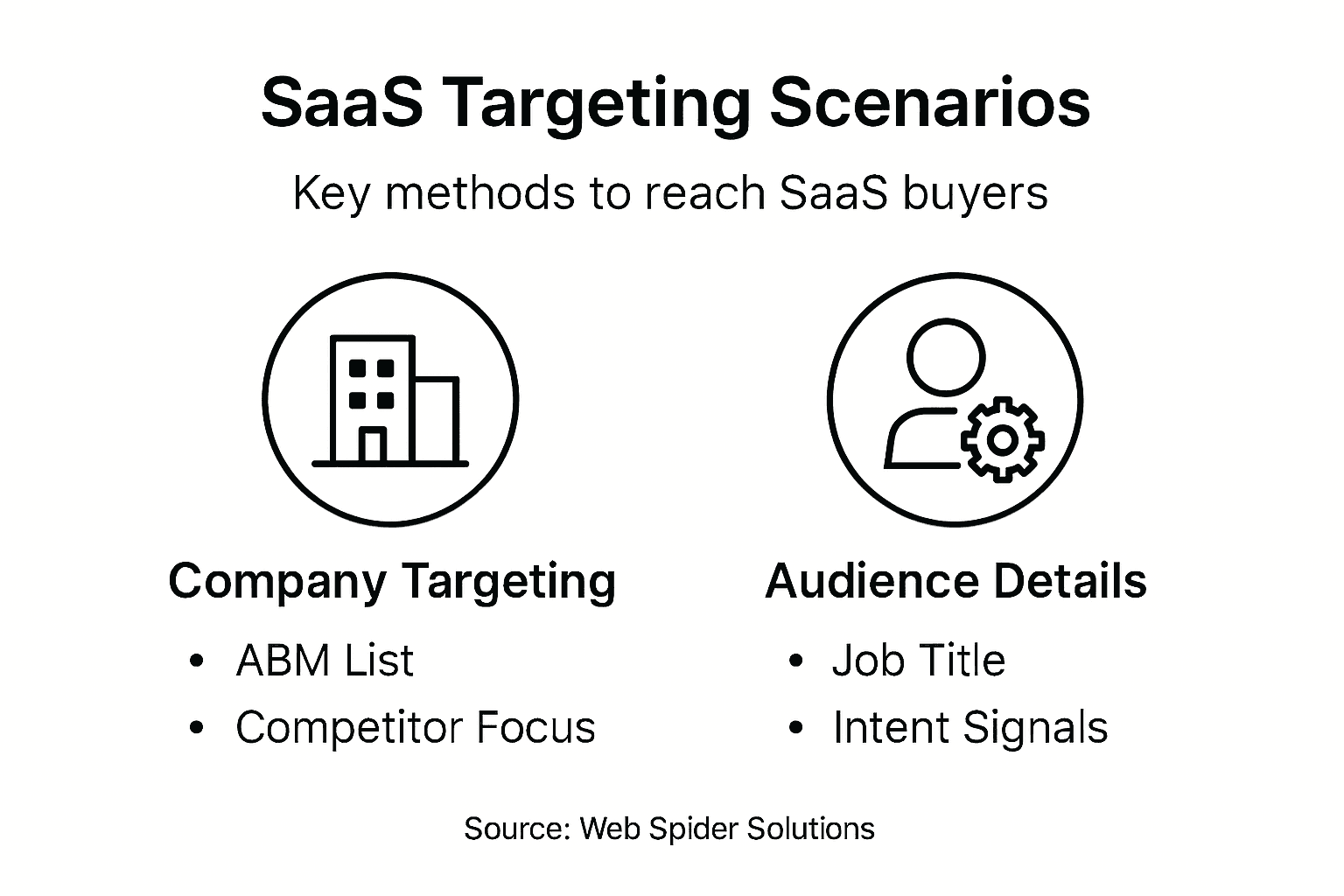
Account-Based Marketing (ABM): Target specific high-value companies by name. If you sell enterprise software, create a list of 200 target accounts and show ads to employees at those companies across all digital channels.
Geographic expansion: Launch in a new country by targeting similar professionals in that geography who match your existing customer profile.
Product-specific campaigns: Promote your most expensive product tier only to companies of sufficient size and users with relevant job titles.
Competitor conquest: Target people viewing competitor websites and landing pages, positioning your product as the superior alternative.
Intent-based targeting: Target users actively searching for keywords related to your solution or visiting relevant content, capturing them at moment of peak buying interest.
Seasonal campaigns: Adjust targeting and messaging during budget cycles or planning seasons when your audience actively evaluates solutions.
The precision available through programmatic means you stop paying for impressions with low conversion probability. Every dollar works harder. Your team scales campaigns across channels without manual effort. You test targeting strategies, identify winners, and scale them systematically. This is why leading SaaS companies allocate 40% or more of their digital ad budgets to programmatic.
Pro tip: Build a customer audience segment in your programmatic platform based on job title, company size, and industry matching your best existing customers, then use it as a targeting foundation and lookalike seed to reach similar prospects automatically.
Risks, Costs, and Common Pitfalls to Avoid
Programmatic advertising delivers impressive ROI when executed correctly, but the ecosystem has real dangers. Understanding these risks before launching campaigns prevents costly mistakes and wasted budget. The main pitfalls fall into three categories: cost inefficiencies, brand safety problems, and transparency issues. Many SaaS companies jump into programmatic expecting instant results, only to discover they’re hemorrhaging budget on bot traffic or paying hidden fees they didn’t anticipate. The technology is powerful, but without proper guardrails and monitoring, it becomes a money pit.
Cost surprises plague many first-time programmatic advertisers. You set a $10,000 monthly budget expecting clear spend allocation, but your invoice arrives showing charges beyond your budget with mysterious line items. This happens because programmatic costs extend beyond media spend. You pay for the DSP platform itself (typically 10 to 20% markup on media spend). You pay for audience data. You pay for viewability verification. Some DSPs add fees for creative optimization or attribution tracking. These layers compound quickly. A $10,000 media budget becomes $12,500 in actual cost when you factor in platform fees and data charges. Transparency issues and cost pressures plague the industry, with many advertisers uncertain about what they’re actually paying for and where their money goes.
Brand safety represents another major risk. Programmatic systems show your ads on thousands of websites automatically. Without careful controls, your professional project management software ends up displayed on low-quality sites, alongside inappropriate content, or in irrelevant contexts. Your ads appear on clickbait websites, fake news sites, or pages with minimal real traffic. Worse, ad fraud and bot traffic mean some of your impressions never reach human eyes. Bots generate fake page visits and clicks, inflating your metrics while draining your budget. You might report 100,000 impressions to your boss while actual humans saw only 40,000 of them. Brand safety filters help mitigate this, but they require intentional setup and ongoing monitoring.
Below is a summary of key risks in programmatic advertising and practical solutions:
| Risk Area | Example Problem | Recommended Safeguard |
|---|---|---|
| Cost Transparency | Hidden fees, overcharges | Detailed contracts, cost audits |
| Brand Safety | Ads on low-quality sites | Use strict filters and blocklists |
| Ad Fraud/Bot Traffic | Fake impressions, inflated clicks | Implement third-party verification |
| Data Privacy | Non-compliance, fines | Legal reviews, compliance monitoring |
Common Pitfalls and How to Avoid Them
These mistakes appear repeatedly across SaaS campaigns.
Pitfall 1: Launching without conversion tracking. You run campaigns for three weeks before realizing you cannot measure which audiences actually convert. Result: wasted budget learning what you should have known upfront. Set up conversion tracking on your website before launching any programmatic campaigns. Test it thoroughly to ensure tracking fires correctly.
Pitfall 2: Bidding too aggressively early. You set a maximum bid of $50 per click thinking you need high bids to win auctions. Your budget depletes in two days with minimal conversions. Programmatic algorithms work best with conservative bidding that trains over time. Start with lower bids and let the system learn which audiences convert.
Pitfall 3: Broad targeting without exclusions. You target all marketing professionals in the United States without excluding irrelevant industries. Your ads reach marketing managers at schools, nonprofits, and government agencies who will never purchase your enterprise software. Use exclusions aggressively. Exclude irrelevant company types, sizes, and industries from the start.
Pitfall 4: Ignoring data privacy regulations. You collect user data without proper disclosure or consent. GDPR, CCPA, and other regulations impose heavy fines for violations. Ensure your programmatic setup complies with applicable regulations in your target markets. Work with your legal team on data handling policies.
Pitfall 5: Fire and forget campaigns. You set up campaigns and check results monthly. Meanwhile, bids drift, performance deteriorates, and budget leaks occur. Programmatic requires active monitoring. Check daily for the first two weeks, then weekly thereafter. Look for unusual spend patterns, cost per conversion spikes, or trafficking anomalies.
Pitfall 6: Single platform reliance. You put all budget into one DSP and one exchange. If that exchange has quality issues or pricing spikes, you have no alternatives. Diversify across multiple DSPs and exchanges to reduce risk and compare performance.
Pro tip: Set daily spend caps 25 percent below your desired budget and require manual approval for any single creative exceeding 40 percent of daily spend, preventing runaway costs if a single ad performs unexpectedly well.
Maximize Your SaaS Growth With Expert Programmatic Advertising Support
Programmatic advertising offers SaaS companies unmatched precision and automation to target the right decision makers and reduce costly wasted ad spend. If you’ve experienced challenges like managing complex bidding strategies, ensuring brand safety, or optimizing your campaigns for sustained ROI, you are not alone. The intricate ecosystem of DSPs, RTB, and PMP requires specialized knowledge to fully harness its potential and avoid common pitfalls such as budget leaks or inefficient audience targeting.
At Web Spider Solutions, we understand these critical pain points and provide tailored digital marketing strategies that align with your SaaS business goals. Our expertise in Paid Advertising Archives – Web Spider Solutions ensures your programmatic campaigns utilize cutting-edge automation and precision targeting while maintaining strict brand safety standards. Leveraging insights from our B2B Marketing Archives – Web Spider Solutions, we help you engage high-value audiences with messaging that converts. Ready to stop wasting budget on ineffective ads and start scaling efficiently? Visit Web Spider Solutions today for a personalized consultation and discover how expert programmatic advertising can elevate your SaaS ROI now.
Frequently Asked Questions
What is programmatic advertising and how does it work?
Programmatic advertising is the automated buying and selling of digital ad space in real-time using algorithms and data. It allows advertisers to automate the placement of ads, matching them with the right audience instantly based on specified targeting criteria.
How can programmatic advertising improve ROI for SaaS companies?
Programmatic advertising enhances ROI for SaaS companies through precise targeting, automated bidding, and real-time analytics, ensuring that ads reach the most relevant audience while minimizing wasted ad spend on unqualified leads.
What are the different types of programmatic buying methods?
The three main buying methods in programmatic advertising are Real-Time Bidding (RTB), Private Marketplaces (PMP), and Programmatic Guaranteed. Each method has its own cost structure, brand safety measures, and control over ad placements, catering to different advertising needs.
What are some common pitfalls to avoid when using programmatic advertising?
Common pitfalls include launching campaigns without conversion tracking, overly aggressive bidding, broad targeting without exclusions, and neglecting to monitor campaign performance actively. Setting up proper audience exclusions and maintaining ongoing oversight is crucial for maximizing effectiveness.