






Defining clear subscriber segments often feels like searching for a formula that finally gets your B2B emails noticed. For digital marketing managers at thriving SaaS companies, connecting with decision makers in unique markets demands more than generic messaging. By focusing on B2B market segmentation and tailoring content to fit each distinct business profile, you gain the power to create newsletters that resonate, engage, and convert with precision.
Table of Contents
- Step 1: Define Targeted Subscriber Segments For B2B Outreach
- Step 2: Craft Compelling Newsletter Content And Visuals
- Step 3: Optimize Email Design For Mobile And Accessibility
- Step 4: Schedule And Automate Strategic Newsletter Delivery
- Step 5: Test And Analyze Campaign Performance Metrics
Quick Summary
| Key Insight | Explanation |
|---|---|
| 1. Segment Your Subscriber Audience | Target specific business profiles for personalized content by analyzing firmographics and behavioral data. |
| 2. Create Engaging Newsletter Content | Use scannable text, diverse formats, and responsive visuals to capture attention and deliver value. |
| 3. Optimize for Mobile and Accessibility | Ensure your newsletters adapt to various devices and are accessible for all users to enhance engagement. |
| 4. Automate Strategic Delivery | Use intelligent triggers and workflows to optimize the timing and relevance of your email communications. |
| 5. Analyze Performance Metrics | Track key indicators to refine your strategy, improving content relevance and subscriber engagement over time. |
Step 1: Define targeted subscriber segments for B2B outreach
Successfully segmenting your email newsletter audience is crucial for delivering personalized content that resonates with specific business profiles. B2B market segmentation breaks down your total addressable market into strategic, manageable groups that enable more precise targeting.
To create effective subscriber segments, focus on multiple dimensional characteristics beyond basic demographics. Start by analyzing firmographics such as company size, industry vertical, annual revenue, and technological infrastructure. Then layer in behavioral data like purchasing history, engagement patterns, and specific pain points unique to each business type. This multifaceted approach allows you to craft hyper targeted messaging that speaks directly to each segment’s specific needs and challenges.
When developing your segmentation strategy, consider creating distinct groups like technology startups, enterprise corporations, midmarket service providers, and industry specific niches. Each segment will require a nuanced communication approach that addresses their particular business context and professional objectives.
Pro Tip: Regularly reassess and refine your subscriber segments every six months to ensure they remain accurate and reflective of evolving market dynamics and your current customer base.
To clarify subscriber segmentation approaches, here is a comparison of common B2B audience groups:
| Segment Type | Typical Attributes | Optimal Content Strategy |
|---|---|---|
| Technology Startups | Small teams, rapid growth focus | Actionable tips, industry news |
| Enterprise Corporations | Large size, complex hierarchy | Deep insights, case studies |
| Midmarket Service Firms | Moderate size, niche expertise | Research findings, benchmarks |
| Industry-Specific Niches | Focused sector, unique challenges | Solution-oriented content |
Step 2: Craft compelling newsletter content and visuals
Designing an engaging B2B newsletter requires strategic content creation that captures your audience’s attention and delivers genuine value. B2B newsletters must treat email as a direct conversation offering expert insights that build trust and demonstrate professional authority.
Focus on creating content that is immediately scannable and digestible. Use short paragraphs, bold text for key points, and clear subheadings to help busy professionals quickly understand your message. Include a mix of content types such as industry news updates, actionable professional tips, exclusive research findings, and concise case studies that showcase real world problem solving. Visually break up text with relevant graphics, infographics, or screenshots that illustrate your points and maintain reader engagement.
Ensure your newsletter maintains consistent branding across design elements including color schemes, typography, and layout. Optimize the design for mobile devices, as many professionals read newsletters on smartphones during transit or between meetings. Use compelling subject lines that promise specific value and preview the insights waiting inside your newsletter.

Pro Tip: Implement A/B testing for different content formats and visual designs to systematically understand what resonates most with your specific audience segments.
Step 3: Optimize email design for mobile and accessibility
Ensuring your B2B email newsletters are accessible and mobile friendly is no longer optional but a critical requirement for effective communication. Mobile responsive email design has become essential, with over 60% of emails now opened on mobile devices across various screen sizes and operating systems.
To create a truly accessible email template, implement a simple and logical layout that adapts seamlessly across devices. Use responsive HTML tables with percentage widths, inline CSS, and a single column design that scales automatically. Prioritize readability by selecting clear fonts with minimum 14 point size, maintaining high color contrast, and including alternative text for all images. This approach ensures your content remains legible and navigable for professionals using smartphones, tablets, and desktop computers.
Pay special attention to accessibility features that accommodate users with different abilities. Implement keyboard navigable elements, provide descriptive link text, and design with sufficient color contrast to support users with visual impairments. Test your email design across multiple email clients and devices to guarantee a consistent, professional appearance that reflects your brand’s commitment to inclusive communication.
Pro Tip: Utilize email testing tools that simulate different device displays and screen readers to validate your newsletter’s mobile responsiveness and accessibility before sending.
Step 4: Schedule and automate strategic newsletter delivery
Mastering strategic newsletter delivery requires a sophisticated approach to audience engagement and communication timing. Automated newsletter workflows enable precise targeting and intelligent subscriber management that adapts to changing audience behaviors and preferences.
Implement an automation strategy that goes beyond simple scheduling. Configure intelligent triggers that dynamically adjust email frequency based on individual subscriber engagement levels. Use personalization tokens to customize content automatically, ensuring each recipient receives relevant information tailored to their professional interests and interaction history. Set up systematic workflows that automatically remove inactive subscribers, segment audiences based on behavior, and optimize sending times according to each recipient group’s peak engagement windows.
Continuously monitor and analyze your newsletter performance metrics to refine your automation strategy. Track key indicators such as open rates, click through rates, and conversion metrics to understand how different segments respond to your content. Develop a data driven approach that allows you to iteratively improve your newsletter delivery mechanism, ensuring your communication remains both efficient and highly targeted.
Pro Tip: Select email marketing platforms with advanced segmentation and automation capabilities that provide granular control over subscriber interactions and comprehensive performance analytics.
Step 5: Test and analyze campaign performance metrics
Successfully measuring your B2B email newsletter performance requires a comprehensive approach to tracking and interpreting key indicators. Analyzing B2B email campaign metrics empowers marketers to make data driven decisions that continuously improve communication strategies.
Focus on tracking critical performance indicators including open rates, click through rates, conversion rates, bounce rates, and unsubscribe rates. Utilize advanced analytics tools to gather granular insights into subscriber behavior and engagement patterns. Compare your results against industry benchmarks and your own historical data to understand relative performance. Implement A/B testing methodologies to experiment with different subject lines, content formats, sending times, and design elements that could potentially enhance your newsletter effectiveness.
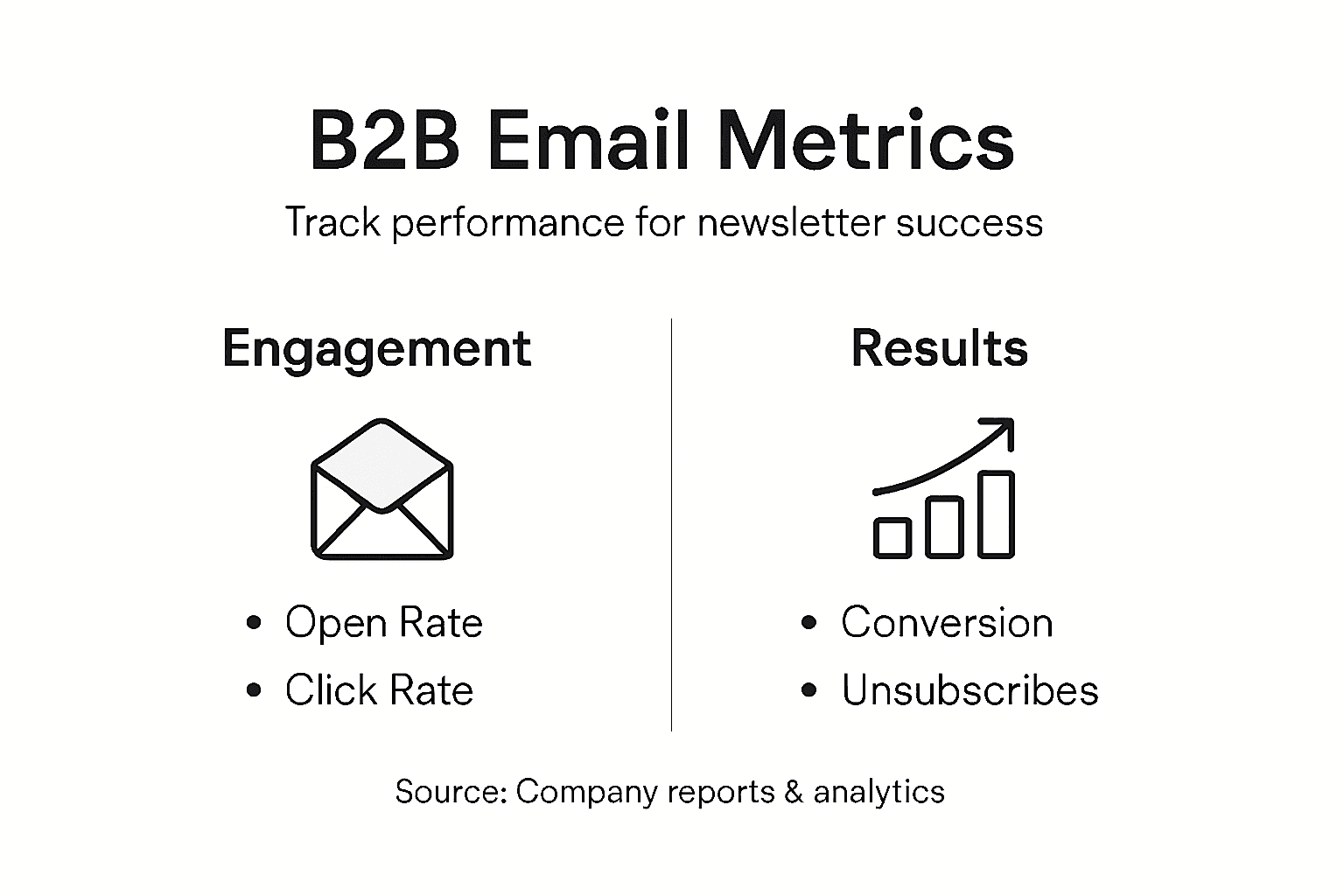
Develop a systematic approach to performance analysis by creating detailed reports that highlight trends, anomalies, and opportunities for optimization. Look beyond surface level metrics to understand deeper patterns such as engagement duration, content interaction rates, and how different audience segments respond to specific types of messaging. Use these insights to iteratively refine your newsletter strategy, ensuring your communication becomes increasingly targeted and valuable to your professional audience.
Pro Tip: Create a standardized monthly dashboard that tracks key performance metrics and allows quick visualization of newsletter campaign progress and areas requiring strategic adjustments.
Below is a summary of key metrics to monitor when analyzing B2B newsletter campaign success:
| Performance Metric | Measures What | Why It Matters |
|---|---|---|
| Open Rate | Initial recipient interest | Reveals subject line effectiveness |
| Click Through Rate | Engagement with content | Shows content relevance |
| Conversion Rate | Desired action completion | Reflects business impact |
| Bounce Rate | Deliverability issues | Identifies list health problems |
| Unsubscribe Rate | Content fit for audience | Signals need for content review |
Unlock Your B2B Email Newsletter Potential with Expert Digital Marketing Solutions
Crafting an effective B2B email newsletter is no simple task. You face challenges like precise audience segmentation, delivering personalized content, and ensuring mobile friendly designs that engage busy professionals. These pain points demand a strategic partner who understands how to transform your newsletter efforts into measurable business results. At Web Spider Solutions, we specialize in solutions that boost your newsletter impact through data driven marketing techniques and customized campaigns.
Whether you need help fine tuning your paid advertising strategies, enhancing your content marketing, or improving technical SEO for better visibility, our team is ready to empower your B2B communication. Discover practical insights and case studies in our Stories Archives – Web Spider Solutions. Take advantage of targeted ad campaigns featured in our Paid Advertising Archives – Web Spider Solutions and explore comprehensive digital growth tactics on our main site Web Spider Solutions.
Ready to elevate your B2B email newsletter performance and capture the attention your business deserves Act now and connect with us for a free consultation to start maximizing your digital marketing success today.
Frequently Asked Questions
How can I effectively segment my B2B email newsletter audience?
To effectively segment your B2B email newsletter audience, analyze firmographics like company size and industry, alongside behavioral data such as engagement patterns. Create specific groups, like technology startups or enterprise corporations, to tailor your messaging. Review your segments every six months to ensure they remain relevant.
What types of content should I include in my B2B newsletter?
Include a mix of industry news, actionable tips, exclusive research findings, and concise case studies in your B2B newsletter. Make sure the content is scannable, utilizing short paragraphs and visuals to engage busy professionals. Aim for clear, valuable insights that directly address your audience’s needs.
How do I ensure my email newsletters are mobile-friendly?
To ensure your email newsletters are mobile-friendly, use a single column design and responsive HTML tables that adjust on different devices. Select clear fonts with a minimum size of 14 points and include high color contrast for readability. Test your design on various devices to guarantee a consistent appearance.
What key performance metrics should I monitor for my B2B email newsletters?
Monitor key performance metrics, including open rates, click-through rates, conversion rates, bounce rates, and unsubscribe rates. Analyzing these metrics will help you understand audience engagement and identify areas for improvement. Create a monthly dashboard to visualize progress and make data-driven adjustments.
How often should I send out my B2B email newsletter?
Send your B2B email newsletter at a frequency that matches your audience’s engagement levels; starting with a monthly cadence is often effective. Experiment with different sending times and analyze responses to optimize your schedule. Adjust frequency based on engagement trends over time to maintain interest.