






Every startup knows how crucial it is to turn interested website visitors into loyal customers. For marketing managers trying to drive conversions, an effective call to action can be the difference between missed opportunities and measurable results. Mastering the art of the CTA means focusing on actionable language, strategic placement, and motivational triggers to guide users from intent to engagement. This guide unpacks the proven strategies and practical elements that transform your digital campaigns into high-performing conversion engines.
Table of Contents
- What Makes A Call To Action Effective
- Key Types Of Digital CTAs Explained
- Critical CTA Elements For Higher Conversion
- Placement And Design For Optimal Impact
- Common CTA Mistakes And How To Avoid Them
Key Takeaways
| Point | Details |
|---|---|
| Effective CTAs are clear and urgent | Use straightforward language and create a sense of urgency to motivate users to take immediate action. |
| Align CTAs with user motivations | Connect calls to action with specific user needs and intrinsic motivations to enhance engagement. |
| Strategic placement enhances visibility | Position CTAs in key locations such as above the fold or at content endings to guide user attention effectively. |
| Test and optimize for best results | Continuously A/B test CTA variations to refine messaging and design, ensuring maximum impact on conversion rates. |
What Makes a Call to Action Effective
A call to action (CTA) represents the critical bridge between user interest and actual conversion. Far from being a simple button or phrase, an effective CTA strategically motivates users to take immediate, specific steps that align with their goals and psychological motivations.
Research indicates that powerful CTAs share several essential characteristics. Specific, observable behaviors form the foundation of compelling conversion strategies. This means moving beyond abstract requests and creating clear, actionable instructions that prompt users to engage.
Key elements of an effective call to action include:
- Clarity: Use straightforward, unambiguous language
- Urgency: Create a sense of time-sensitive opportunity
- Relevance: Align the action with user’s specific needs
- Value Proposition: Clearly communicate what users gain
- Psychological Triggers: Connect with user’s intrinsic motivations
Successful CTAs connect with individuals’ identities by framing actions as meaningful and achievable. This approach transforms a simple request into a compelling invitation that resonates on a deeper psychological level.
The most powerful CTAs transform abstract intentions into concrete actions. They break down complex processes into simple, digestible steps that feel both approachable and exciting.
Pro tip: Design your CTA to answer the user’s unspoken question: “What’s in it for me?” by clearly articulating the immediate benefit of taking action.
Key Types of Digital CTAs Explained
Digital marketing relies on strategic call to action approaches that guide users through specific engagement pathways. Marketing CTAs vary strategically depending on the desired outcome and user journey stage.
The primary types of digital CTAs can be categorized into three main strategic groups:
- Transactional CTAs: Directly encourage purchasing or sales conversions
- Engagement CTAs: Prompt content interaction and user participation
- Lead Generation CTAs: Collect user information and build potential customer relationships
Each CTA type serves a unique purpose in the digital marketing ecosystem. Transactional CTAs typically use direct language like “Buy Now” or “Add to Cart,” designed to create immediate conversion opportunities. Engagement CTAs might include phrases such as “Read More,” “Watch Video,” or “Explore Now,” aimed at increasing user interaction with content.
Lead generation CTAs focus on building potential customer relationships through strategic information gathering. These might include “Download Free Guide,” “Get Your Consultation,” or “Sign Up for Exclusive Insights,” which offer value in exchange for user contact details.
Here’s a comparison of the three main digital CTA types and their business impact:
| CTA Type | Typical Application | User Motivation | Business Impact |
|---|---|---|---|
| Transactional | Purchase or direct sale actions | Desire for immediate value | Drives direct conversions |
| Engagement | Content interaction or participation | Interest in content | Increases user retention |
| Lead Generation | Collecting contact information | Seeking exclusive benefit | Expands potential reach |
Pro tip: Customize your CTA language and design to match the specific stage of the user’s journey, ensuring the call to action feels natural and compelling.
Critical CTA Elements for Higher Conversion
Creating high-performing calls to action requires strategic design and precise execution. Critical CTA elements significantly impact conversion rates by transforming passive user interactions into active engagement.
The most effective CTAs incorporate several key strategic components:
- Action-Driven Language: Use powerful, direct verbs
- Clear Value Proposition: Communicate immediate benefits
- Visual Contrast: Design CTAs that stand out from page content
- Strategic Placement: Position CTAs where users naturally engage
- Psychological Triggers: Create urgency and emotional connection
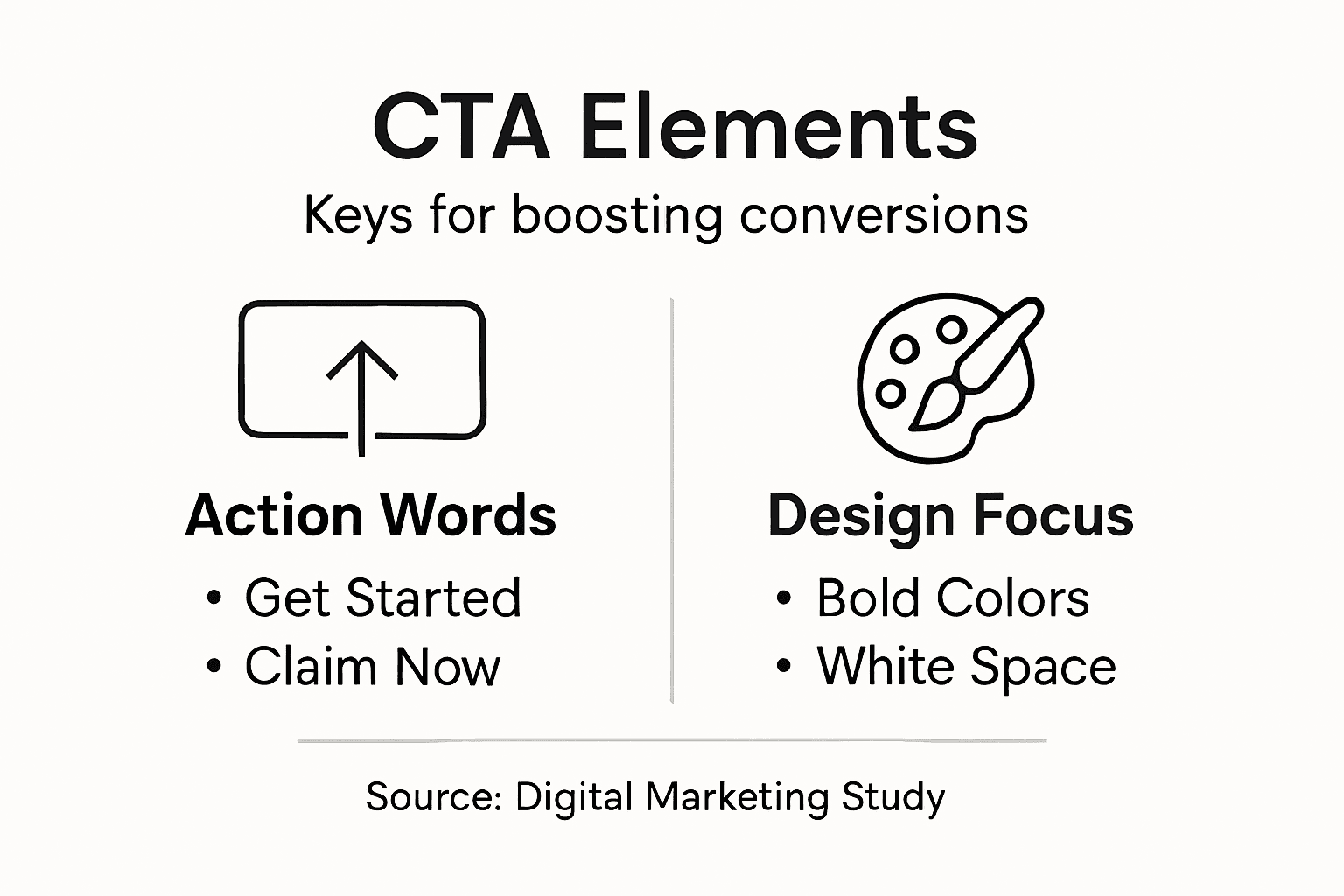
Compelling CTAs leverage strong action words like “Get Started,” “Claim Now,” or “Unlock Exclusive Access.” These phrases create immediate psychological momentum, encouraging users to take the next step. The language must be unambiguous and promise a specific, tangible outcome that resonates with the target audience.

Visual design plays a crucial role in CTA effectiveness. Strategic use of bold, contrasting colors, ample white space, and intuitive button design can dramatically increase visibility and clickthrough rates. The goal is to make the CTA feel like a natural, inviting next step in the user’s journey.
Pro tip: Continuously A/B test your CTA variations, experimenting with different wording, colors, and placements to discover what most effectively motivates your specific audience.
Placement and Design for Optimal Impact
Calls to action are not just about compelling text – their visual presentation and strategic positioning are equally critical. CTA placement dramatically influences conversion rates by guiding user attention and creating intuitive interaction pathways.
Key strategic placement locations include:
- Above the Fold: Immediately visible without scrolling
- Content Endings: Natural conclusion points for user journeys
- Sticky Buttons: Persistent visibility across page scrolling
- Contextual Positioning: Adjacent to relevant information
- Mobile-Friendly Locations: Easy touch access on smaller screens
Visual design represents another crucial conversion lever. Effective CTAs leverage visual hierarchy through strategic color contrast, appropriate sizing, and thoughtful whitespace. The button should stand out without feeling disconnected from the overall page design, creating a seamless yet attention-grabbing element that naturally draws the user’s eye.
Responsive design becomes paramount in modern digital experiences. CTAs must adapt flawlessly across devices, maintaining readability and touch-friendly dimensions on smartphones, tablets, and desktop screens. This means considering button size, spacing, and interaction models that work universally while preserving the core messaging and visual impact.
Pro tip: Create multiple CTA variations and conduct systematic A/B testing to discover the precise design and placement that resonates most powerfully with your specific audience.
Common CTA Mistakes and How to Avoid Them
Effective call to action strategies require understanding potential pitfalls that can dramatically reduce conversion potential. Common CTA mistakes significantly undermine marketing efforts by creating confusion and diminishing user engagement.
The most critical CTA mistakes to avoid include:
- Vague Language: Using generic, non-specific action phrases
- Poor Visibility: Designing CTAs that blend into page design
- Misaligned Intent: Creating CTAs disconnected from user journey
- Mobile Negligence: Ignoring responsive design principles
- Lack of Testing: Failing to optimize through continuous experimentation
Generic CTAs often suffer from unclear messaging that leaves users uncertain about the next step. Instead of using bland phrases like “Click Here,” marketers should craft specific, benefit-driven language that clearly communicates the value proposition. A CTA like “Unlock Your Free Marketing Guide” provides much more context and motivation than a generic “Submit” button.
Overloading websites with multiple competing CTAs can create decision fatigue, reducing overall conversion rates. Strategic CTA placement means carefully selecting one primary action per page and designing it to stand out without overwhelming the user experience. The goal is to guide users naturally toward the most important conversion path.
Use this quick reference to avoid common CTA mistakes:
| Mistake | Negative Effect | Improvement Strategy |
|---|---|---|
| Vague Language | Low user engagement | Use specific, action-driven words |
| Poor Visibility | Missed conversion | Employ strong color and placement |
| Misaligned Intent | User confusion | Align CTA with content purpose |
| Mobile Negligence | Lost mobile users | Optimize CTA for device compatibility |
| Lack of Testing | Suboptimal results | Run A/B tests and analyze outcomes |
Pro tip: Create a “CTA scorecard” that evaluates each call to action against clarity, visibility, relevance, and potential user value before implementation.
Elevate Your Conversion Rates with Expert Call to Action Strategies
If crafting effective calls to action feels challenging, you are not alone. This article highlights key pain points such as vague messaging, poor visibility, and misaligned intent that often prevent users from taking the next step. At Web Spider Solutions, we understand the power of clear, urgent, and value-driven CTAs that resonate emotionally and drive results. Whether you need stronger transactional CTAs or smarter engagement tactics, our team customizes every element to boost your conversions and meet your business goals.
Explore our success stories in the Stories Archives to see how strategic paid advertising and finely tuned CTAs have transformed client campaigns. Ready to transform your digital presence with optimized calls to action that convert visitors into customers now? Visit Paid Advertising Archives and contact us through Web Spider Solutions today to get started on your tailored marketing strategy that drives real growth.
Frequently Asked Questions
What are the key characteristics of an effective call to action?
An effective call to action (CTA) features clarity, urgency, relevance, a clear value proposition, and psychological triggers. These elements motivate users to take immediate and specific actions that align with their goals.
How do different types of CTAs impact user engagement?
There are three main types of CTAs: transactional, engagement, and lead generation. Transactional CTAs focus on direct sales, engagement CTAs encourage content interaction, and lead generation CTAs aim to collect user information for potential future contact. Each type plays a unique role in enhancing user engagement and conversion rates.
What common mistakes should be avoided when creating CTAs?
Common mistakes include using vague language, poor visibility, misaligning intent with the user journey, neglecting mobile optimization, and failing to test different variations. Addressing these issues can significantly improve the effectiveness of CTAs.
How can I design CTAs for optimal visibility and impact?
To ensure optimal visibility, use contrasting colors, clear and actionable language, and strategically place CTAs where users naturally engage, such as above the fold or at the end of content. It’s also important to test different designs and placements to find what works best for your audience.