






Managing SaaS customer journeys demands more than just sleek interfaces or catchy email campaigns. The real challenge lies in coordinating every touchpoint—website, ads, demos, support—into a seamless experience that answers varied stakeholder needs and drives real trust. By focusing on a comprehensive customer journey view, you gain an edge in mapping interactions, resolving friction, and ultimately converting interest into long-term loyalty that outpaces your competition.
Table of Contents
- Customer Journey Definition And Core Concepts
- Stages And Types Of Customer Journeys
- Key Touchpoints In Saas Customer Experience
- Mapping And Optimizing The Journey
- Common Mistakes And How To Avoid Them
Key Takeaways
| Point | Details |
|---|---|
| Understanding the Customer Journey | The customer journey is a continuous process involving touchpoints, stages, and customer behavior that influences purchase decisions. |
| Importance of Touchpoint Design | Well-designed touchpoints at each stage significantly affect conversion rates and customer satisfaction in SaaS. |
| Mapping and Optimization | Regularly mapping the customer journey ensures optimization efforts are data-driven and address real user frustrations. |
| Segment-Specific Strategies | Different customer journey types require tailored content and engagement strategies to maximize conversion potential. |
Customer Journey Definition and Core Concepts
The customer journey represents the complete pathway a buyer travels from initial awareness through purchase and beyond. It encompasses every interaction, touchpoint, and experience a customer has with your SaaS product across all channels and stages.
This isn’t a single transaction or one-time event. It’s a continuous process where customers form impressions, build trust, and make decisions at multiple decision points. Understanding this comprehensive view changes how you market and convert.
What Makes Up the Customer Journey
A proper customer journey includes:
- Touchpoints: Every place customers encounter your brand (ads, website, email, social media, support)
- Stages: Distinct phases from awareness through advocacy
- Customer behavior: Actions, preferences, and decision-making patterns at each stage
- Experience design: How interactions are orchestrated across channels
- Engagement mechanisms: Features and strategies that drive participation and loyalty
Research mapping customer journey themes and outcomes shows these elements work together to shape customer decisions and satisfaction levels.
Why This Matters for SaaS Conversions
SaaS buying cycles involve multiple stakeholders, extended evaluation periods, and high scrutiny. One poorly designed touchpoint early in the journey often kills deals months later. A fragmented experience across email, website, and sales interactions confuses buyers and reduces conversion rates.
The opposite is true too. Strategic alignment across stages compounds your advantage.
A well-designed customer journey directly correlates with conversion rates, retention, and customer lifetime value across all SaaS segments.
Core Concepts You Need to Know
Customer engagement acts as the bridge between touchpoints and outcomes. It’s how customers interact with content, products, and your team at each stage.
Journey mapping visualizes this entire process, revealing gaps, redundancies, and opportunities for optimization. It shows you where customers drop off and where they accelerate.
Antecedents are the conditions before the journey begins (market research, competitive awareness, budget availability). Moderators are factors that change how customers experience each touchpoint (company size, industry, buying authority).
Understanding these components lets you design experiences that account for your specific audience dynamics, not generic buyer personas.
When building SaaS strategies, consider how a sales funnel structure maps to your customer journey stages, ensuring messaging alignment from awareness through decision.
Pro tip: Map your current customer journey by interviewing 5-10 customers who recently purchased and 5-10 who abandoned. Note exact touchpoints, decision triggers, and friction points they mention—this real data beats assumptions every time.
Stages and Types of Customer Journeys
Customer journeys aren’t one-size-fits-all. Different buyers move through distinct stages at different speeds, with varying needs and pain points at each phase. Understanding these variations helps you build strategies that actually match how real customers behave.
The traditional framework divides journeys into three core phases. However, modern research shows customer perception and decision-making operate differently than static stage models suggest.
The Three Core Journey Stages
Most SaaS journeys follow this structure:
- Pre-purchase stage: Awareness, research, evaluation, and decision-making before committing
- Purchase stage: Active buying, contract negotiation, implementation setup, and onboarding
- Post-purchase stage: Usage, support, renewal decisions, and potential expansion
Each stage requires different messaging, content types, and engagement strategies to move customers forward.

Touchpoint Ownership Matters
Within these stages, decision-making touchpoints fall into three categories: brand-owned (your website, email, sales calls), partner-owned (reseller sites, integration partners), and uncontrolled (reviews, social media, industry forums).
You control brand touchpoints directly. Partner touchpoints require collaboration. Uncontrolled touchpoints demand reputation management and proactive content strategy.
Ignoring uncontrolled touchpoints costs conversions. A negative review early in research derails deals you didn’t even know were in motion.
Below is a quick reference for SaaS touchpoint ownership roles:
| Touchpoint Category | Ownership | Required Action |
|---|---|---|
| Brand-Owned | SaaS provider | Messaging alignment |
| Partner-Owned | Integration partners | Collaboration, co-marketing |
| Uncontrolled | Public/third parties | Reputation management |
The Customer-Centric Perspective
Here’s what many marketers miss: customers don’t segment their journey based on traditional stages. They segment based on meaningful changes and interactions they experience.
One customer might see distinct chapters at awareness, consideration, and decision. Another customer’s journey breaks differently—maybe at initial conversation, technical proof, and negotiation phases. Research shows customers remember and organize their journey based on perceived changes rather than your predetermined funnel.
This distinction matters. When you map stages around customer experience rather than your sales process, conversion friction drops noticeably.
Multiple Journey Types Exist Simultaneously
Your organization likely handles multiple customer journey types at once:
- Self-serve journeys: Mostly digital, fast, low-touch with minimal sales interaction
- Sales-assisted journeys: Mix of content and personal communication across longer timelines
- Enterprise journeys: Complex, multi-stakeholder, extended evaluation with custom requirements
- Expansion journeys: Existing customers discovering new features or products within your ecosystem
Each type demands different content, messaging cadence, and success metrics. Enterprise journeys need executive content and technical deep-dives. Self-serve journeys need clear product comparisons and transparent pricing.
Here’s how different customer journey types compare in SaaS businesses:
| Journey Type | Typical Timeline | Primary Buyers | Key Conversion Focus |
|---|---|---|---|
| Self-Serve | Hours to days | Individual users | Clear product UI, easy trial |
| Sales-Assisted | Weeks to months | Mid-sized companies | Personalized demos, follow-up |
| Enterprise | Months to year | Decision committees | Custom proposals, deep integration |
| Expansion | Varies by customer | Existing clients | Upsell features, retention strategy |
When building SaaS marketing strategies, align your marketing funnel stages with these specific journey types rather than forcing all customers through identical paths.
Journey stage optimization increases conversion rates when stages match actual customer decision-making patterns, not theoretical sales models.
Pro tip: Conduct customer interviews asking how they mentally divide their buying journey, not about your stages. Record exact phrases they use to describe phase changes, then restructure your messaging around those real transition points.
Key Touchpoints in SaaS Customer Experience
Every interaction a prospect or customer has with your SaaS company shapes their perception. A clunky onboarding email, a slow product interface, or an unhelpful support response can derail a deal that seemed locked in. These moments matter more than your marketing messaging.
SaaS touchpoints span from the first ad impression through renewal negotiations. Understanding which ones matter most for your specific customers transforms how you allocate resources and design experiences.
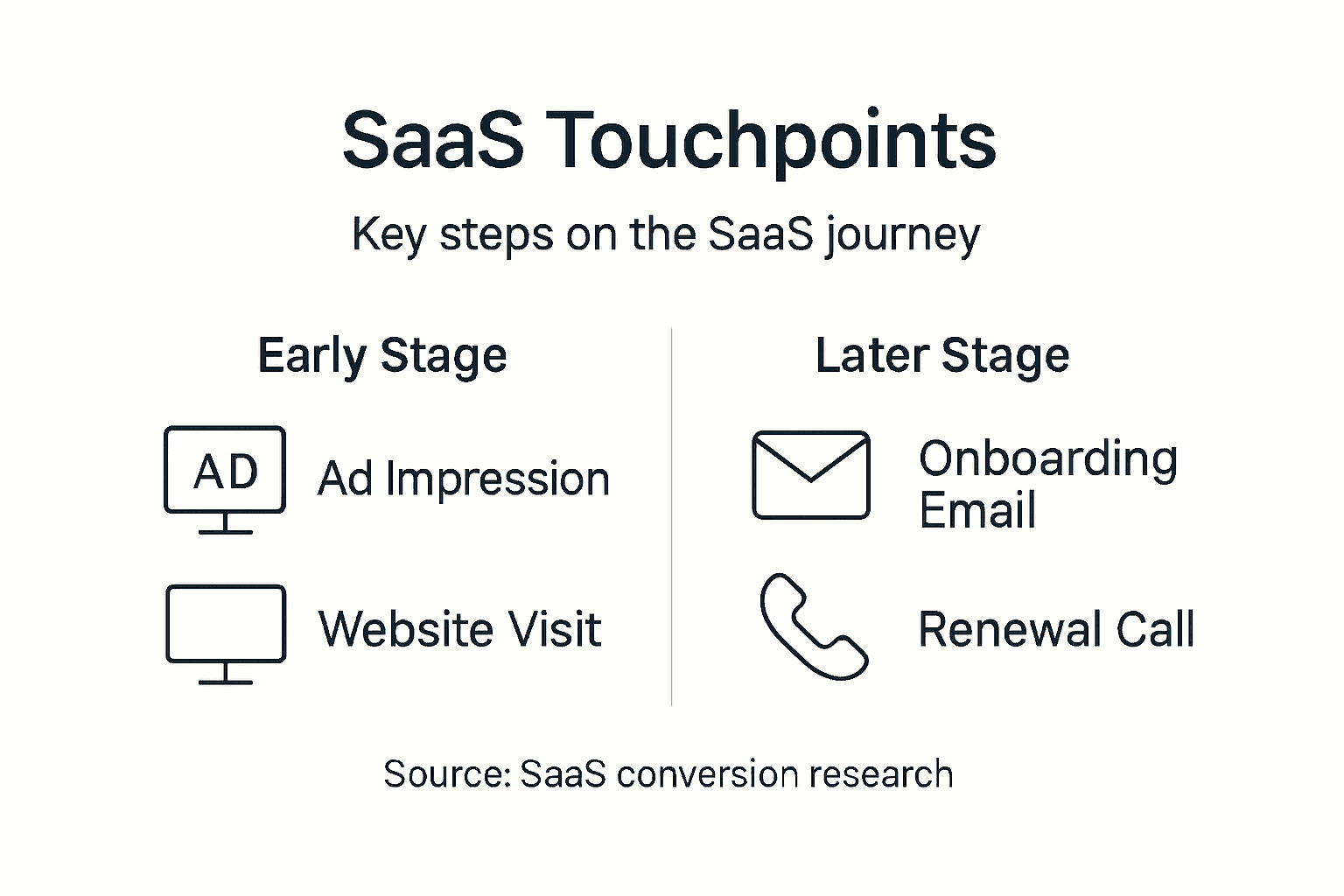
Awareness and Discovery Touchpoints
Customers first encounter your brand through:
- Search results and organic content: Blog articles, comparison guides, SEO rankings
- Paid advertising: Google Ads, LinkedIn campaigns, display networks
- Social media: LinkedIn posts, Twitter conversations, industry groups
- Word of mouth and reviews: Peer recommendations, G2 ratings, Capterra scores
- Industry events and webinars: Virtual or in-person gatherings where you participate
These early touchpoints determine whether prospects even consider you. A negative review at this stage kills deals before sales conversations begin. Building customer trust through transparent communication at discovery touchpoints establishes credibility before you pitch.
Evaluation and Engagement Touchpoints
Once prospects decide to learn more, they encounter:
- Website and product demos: Interactive product tours, recorded walkthroughs
- Sales conversations: Email sequences, sales calls, live product demos
- Documentation and knowledge bases: Setup guides, feature explanations, troubleshooting
- Free trials or freemium access: Direct product interaction without commitment
- Pricing pages and proposal documents: Transparent cost information and customized quotes
Different stakeholder roles need distinct information at each touchpoint. Technical users care about integration capabilities. Finance buyers focus on ROI and security compliance. Decision-makers want vendor stability and support quality.
Missing one audience means losing that deal.
Onboarding and Activation Touchpoints
After purchase, your real work starts. New customers experience:
- Onboarding emails: Welcome sequences, setup instructions, best practice guides
- In-product guidance: Tooltips, feature walkthroughs, progress indicators
- Live training sessions: Group or personalized training calls
- Customer success check-ins: Proactive outreach to ensure adoption
- First value realization: Helping customers achieve initial success quickly
Onboarding determines whether customers stick around or churn. A 30-day gap between purchase and first meaningful interaction often leads to cancellation.
Ongoing Experience Touchpoints
Your product and support teams manage daily touchpoints:
- In-app experience: Navigation, performance, new features
- Support interactions: Help center, email support, live chat
- Billing communications: Invoice delivery, upgrade notifications, payment reminders
- Community and peer forums: User-to-user interaction and shared knowledge
- Feedback channels: Surveys, feature request processes, customer advisory boards
Effective SaaS companies coordinate across all touchpoints to ensure consistent messaging, avoid duplication, and create seamless experiences that drive retention and expansion revenue.
Each of these touchpoints either reinforces your value or creates friction. When they’re fragmented or poorly coordinated, customers get confused and churn.
Pro tip: Map every touchpoint your customers experience and assign ownership to specific teams. Identify gaps where customers fall through cracks or receive conflicting information, then redesign those transitions before chasing new customer acquisition.
Mapping and Optimizing the Journey
You can’t improve what you don’t measure. Most SaaS teams have a vague idea of their customer journey but lack a visual, data-driven map. That’s where conversion opportunities hide.
Journey mapping transforms your assumptions into actionable intelligence. It reveals where customers stall, where they accelerate, and exactly which touchpoints drive conversion.
Why Mapping Matters Before Optimization
Mapping serves three critical purposes:
- Identifies friction points: Where do prospects abandon? Which emails go unanswered? What features confuse new users?
- Reveals hidden opportunities: Which touchpoints currently underperform but could drive massive conversion gains?
- Aligns teams: Sales, marketing, product, and support finally agree on the actual customer experience instead of working in silos.
Without a map, you’re optimizing blindly. You might improve email open rates while customers are actually dropping off during product onboarding.
The Mapping Process
Start by gathering real customer data, not assumptions:
- Conduct customer interviews: Ask 10-15 customers and churned prospects about their exact journey steps and decision moments
- Audit your analytics: Track actual user paths through your website, product, and email sequences
- Document touchpoints: List every interaction—email, call, page visit, support ticket, in-app event
- Capture decisions and emotions: Note where customers felt confident, confused, or skeptical
- Identify stage transitions: Where exactly do prospects move from awareness to consideration to decision?
This creates your baseline. Now you have something real to optimize against.
Static Maps to Dynamic Optimization
Here’s the breakthrough: customer journey mapping combined with real-time data analytics transforms your map from a static artifact into a living optimization engine.
Instead of updating maps quarterly, you track customer behavior continuously. You see when conversion rates drop on a landing page within hours, not weeks. You identify which customer segments experience different journeys and adjust messaging accordingly.
AI-powered analysis predicts which prospects will churn before they leave, allowing proactive intervention.
Optimization Priorities
Once mapped, optimize in this order:
- Biggest drop-off points first: Fix the stage where 40% of prospects abandon before tackling stages with 10% attrition
- High-impact touchpoints: Prioritize optimization on touchpoints that influence conversion most (usually your landing page and first sales email)
- Segment-specific experiences: Create different journeys for self-serve buyers versus enterprise decision committees
Optimize landing page elements based on where your map shows prospects entering your evaluation stage, ensuring messaging aligns with their current mindset.
A mapped, data-driven customer journey reveals where your conversion leaks hide and which fixes deliver the highest return on effort.
Most teams waste 60% of optimization effort on low-impact changes. Mapping helps you focus ruthlessly on what matters.
Pro tip: Start with one segment (e.g., small business self-serve buyers) and map their complete journey with real data. Optimize that segment to peak performance before expanding to other customer types—this compounds your learning and reveals patterns you can replicate.
Common Mistakes and How to Avoid Them
Most SaaS teams make the same journey optimization mistakes repeatedly. They invest months building beautiful customer journey maps, then watch them gather dust while conversions stall. The problem isn’t the maps—it’s how they’re built and used.
Understanding these pitfalls helps you avoid wasting resources on initiatives that don’t drive real results.
Mistake 1: Maps Without Business Goals
Creating a journey map for its own sake wastes time. Many teams map everything but connect nothing to actual conversion metrics.
Your map must link directly to measurable outcomes. Instead of documenting touchpoints generically, ask: which touchpoints correlate with conversion? Which ones create churn?
Ask yourself these questions before mapping:
- What conversion rate increase do we need?
- Which stage has the biggest drop-off?
- What’s our target customer acquisition cost?
- Where does profit hide in the journey?
Without these anchors, optimization becomes guesswork.
Mistake 2: Vague Insights, No Actions
Journey mapping mistakes often stem from producing insights without clear, actionable recommendations. Your map reveals problems but doesn’t tell teams how to fix them.
Transform observations into specific actions:
- Bad: “Prospects struggle with the pricing page”
- Good: “Add a pricing comparison table and reduce page load time from 4 to 2 seconds to increase click-through rate by 18%”
Every insight needs an owner, a deadline, and expected impact. Without these, nothing changes.
Mistake 3: Treating Maps as Static Documents
You mapped your journey once, presented it, then filed it away. Meanwhile, your customers changed their behavior, your product evolved, and your market shifted.
Maps become obsolete in weeks if they’re not continuously updated. Assign a team member to review data monthly and update customer segments, touchpoints, and conversion metrics.
Failing to update maps costs you because you’re optimizing against yesterday’s customer behavior.
Mistake 4: Misaligned Teams and Ownership
Sales maps journeys one way. Marketing sees it differently. Product doesn’t care about either map. Everyone optimizes their own touchpoints without coordinating.
Result: fractured customer experience and zero leverage from journey optimization.
Assign a cross-functional owner who coordinates journey improvements across teams. This person ensures everyone works toward the same conversion goals.
Mistake 5: Ignoring Initiative Maturity
Startups and enterprises have different journey optimization capabilities. Trying to implement enterprise-level strategies when you lack basic analytics kills momentum.
Start with what you can actually execute:
- Level 1: Document basic customer path with interviews and analytics
- Level 2: Map touchpoints by stage with data-driven insights
- Level 3: Continuous optimization with AI-powered behavior tracking
- Level 4: Predictive modeling and proactive interventions
Build systematically. Don’t skip levels.
Mistake 6: Ignoring SEO Visibility in Discovery
Many teams map journeys while overlooking how prospects find them initially. Common mistakes in early-stage marketing compound downstream. If prospects can’t find you through search, your perfect journey map serves no one.
Journey maps fail when they’re disconnected from business goals, treated as static artifacts, or built without clear accountability and action plans.
The maps themselves aren’t valuable. Execution against the map is everything.
Pro tip: Before building any journey map, define three measurable outcomes you want to achieve. After mapping, identify the top three highest-impact changes. Execute those three changes completely before starting new initiatives—momentum and proof matter more than comprehensive mapping.
Enhance Your SaaS Customer Journey and Boost Conversions Today
Mastering the customer journey is crucial for SaaS businesses facing challenges like fragmented touchpoints and unclear engagement strategies. This article highlights pain points such as misaligned messaging, lack of real-time data, and missed optimization opportunities that cause prospects to drop off before purchase or renewal. By understanding concepts like journey mapping, touchpoint ownership, and customer-centric segmentation, you gain the insight needed to reduce friction and increase conversion rates.
If you want to transform insights into action and create seamless customer experiences that drive growth explore how digital marketing solutions can support you. We specialize in crafting tailored strategies including SEO optimization, paid advertising, content marketing, and user experience enhancements designed specifically to align with your unique customer journey stages. Start building a measurable and dynamic path to success now and avoid costly guesswork. Visit Web Spider Solutions to request a free consultation and discover how to connect every touchpoint with purpose and drive meaningful SaaS conversions.
Frequently Asked Questions
What is the customer journey in SaaS?
The customer journey in SaaS refers to the complete pathway a buyer travels from initial awareness to purchase and post-purchase interactions, encompassing all touchpoints and experiences with your product.
Why is mapping the customer journey important for SaaS conversions?
Mapping the customer journey is crucial for SaaS conversions as it helps identify friction points, reveals optimization opportunities, and aligns teams towards a common goal, ultimately enhancing the customer experience and increasing conversions.
What are the key stages of a customer journey in a SaaS business?
The customer journey in a SaaS business typically includes three core stages: the pre-purchase stage (awareness and evaluation), the purchase stage (contract negotiation and onboarding), and the post-purchase stage (usage, support, and renewal decisions).
How can I optimize touchpoints in the customer journey?
To optimize touchpoints in the customer journey, first map out all customer interactions, then identify high-impact areas for improvement, such as enhancing content clarity during the evaluation stage or streamlining onboarding processes for new users.