






TL;DR:
- Choose agencies based on clear needs, goals, and realistic budgets tailored to your growth stage.
- Prioritize structured evaluations, referrals, and firm scoring to select the best fit.
- Establish specific KPIs and checkpoints post-contract to ensure accountability and measure success.
Picking a digital marketing agency feels straightforward until you’re six months in, your budget is gone, and your traffic hasn’t moved. Thousands of SMB owners make this mistake every year, choosing based on a slick pitch or a low price, only to realize the agency never understood their business in the first place. The cost isn’t just financial. It’s lost time, missed opportunities, and the frustration of starting over. This guide walks you through a structured, evidence-backed process for finding an agency that actually fits your goals, your budget, and your growth stage.
Table of Contents
- Assess your business needs and set realistic budgets
- Decide between specialist and full-service agencies
- Run a structured search and shortlisting process
- Evaluate proposals: Scorecards, red flags, and selection criteria
- What most agency selection guides miss: Chemistry and accountability
- Get expert support for your digital growth
- Frequently asked questions
Key Takeaways
| Point | Details |
|---|---|
| Set clear goals & budget | Know your marketing priorities and set a budget of 7-12% of revenue before contacting agencies. |
| Choose agency type wisely | Match your needs with either a specialist, full-service, or hybrid agency for best results. |
| Use a structured selection process | Shortlist through referrals and directories, then use a scorecard for objective agency comparisons. |
| Watch for agency red flags | Avoid agencies that promise guaranteed ROI or provide one-size-fits-all proposals. |
| Prioritize chemistry and monitoring | Long-term fit and 90-day performance check-ins are more important than credentials alone. |
Assess your business needs and set realistic budgets
Before you contact a single agency, get clear on what you actually need. This sounds obvious, but most SMBs skip it. They approach agencies with vague goals like “more traffic” or “better social media” and then wonder why results fall short. Specificity is everything.
Start by identifying your primary digital marketing goals. Common priorities for SMBs include:
- Lead generation through paid search or content marketing
- Local SEO to capture nearby customers actively searching for your services
- E-commerce growth via product listing optimization and shopping ads
- Brand awareness through social media and display advertising
- Reputation management to maintain and improve your online reviews
Once you know what you need, match it to a realistic budget. A common benchmark: SMBs should allocate 7-12% of annual revenue toward agency marketing spend. In dollar terms, that typically translates to $2,500 to $10,000 per month for quality support, depending on your industry and competitive landscape.
Here’s a rough breakdown of what different budget levels typically get you:
| Monthly budget | What it typically covers |
|---|---|
| $1,000 to $2,500 | Basic SEO or social media management only |
| $2,500 to $5,000 | One to two channels with light strategy support |
| $5,000 to $10,000 | Multi-channel campaigns with dedicated account management |
| $10,000 and above | Full-service integrated strategy with analytics and reporting |
A well-built digital marketing strategy planning process will help you connect these budget tiers to measurable outcomes before you ever sign a contract.
Pro Tip: Always separate your retainer fee from your media or ad spend in your planning. If an agency quotes you $3,000 per month and that includes your Google Ads budget, you may only have $1,000 left for actual strategy work. Get both numbers in writing before you commit.
Decide between specialist and full-service agencies
Once you know your goals and budget, the next question is what type of agency to hire. This decision shapes everything from how you communicate to how results get measured.
Specialist agencies focus on one channel or discipline, like SEO, PPC, or social media management. They tend to go deep rather than wide. Full-service agencies handle multiple channels under one roof, coordinating strategy across search, social, content, and paid advertising. Hybrid agencies sit in between, offering a primary specialty but with the capacity to expand.

As research on agency models confirms, specialist agencies work best for single-channel needs, while full-service agencies are better suited for integrated SMB growth, and hybrid models are increasingly popular for businesses in transition.
| Agency type | Best for | Limitation |
|---|---|---|
| Specialist | Focused, single-channel goals | Limited cross-channel coordination |
| Full-service | Integrated, multi-channel strategy | Can be more expensive; less depth in each area |
| Hybrid | Growing SMBs with evolving needs | Requires clear scope definition upfront |
You probably need a full-service or hybrid agency if:
- You’re running campaigns across more than two platforms
- Your team has no internal marketing expertise
- You need strategy, execution, and reporting all in one place
- Your competitive industry demands coordinated messaging across channels
Pro Tip: Even if you start with a specialist, look for one that can scale. Your needs will grow, and switching agencies mid-growth is painful. Ask upfront whether they can expand their scope if your business evolves.
If you’re unsure which model fits, reviewing comprehensive digital services from agencies that operate at scale can help you benchmark what integrated support actually looks like in practice.
Run a structured search and shortlisting process
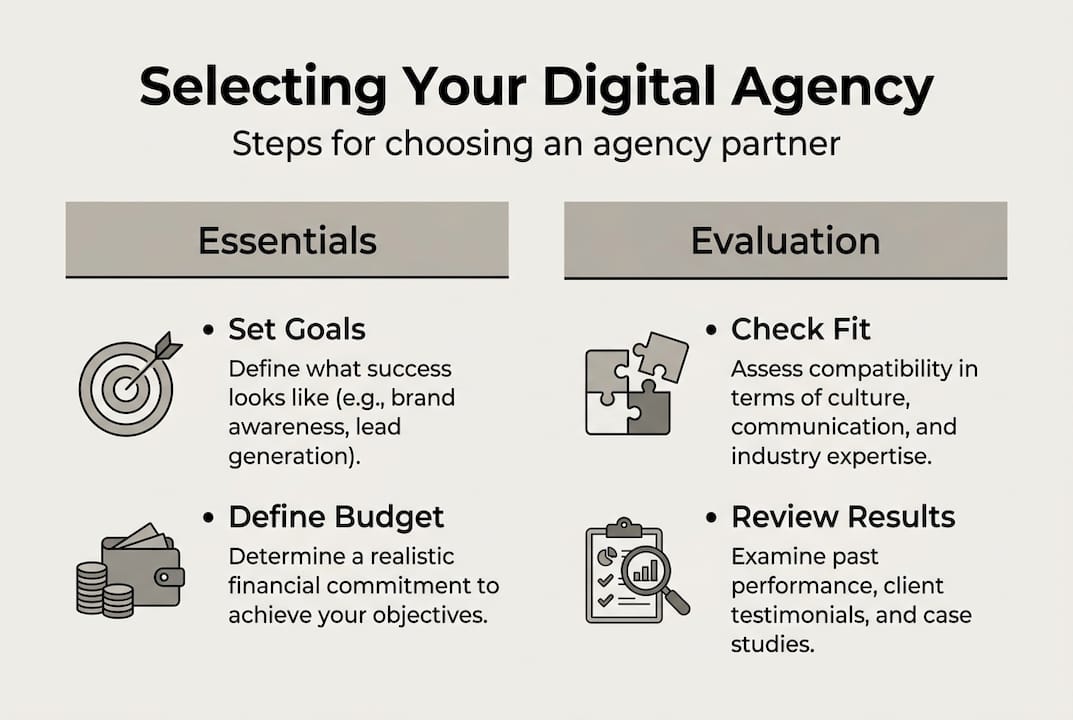
With your agency type in mind, the next step is building a solid candidate list. This is where most SMBs either get lazy or get overwhelmed. A structured approach prevents both.
Follow this three-step process:
- Collect referrals first. Ask other business owners in your network who they use and trust. Referrals outperform directories or cold outreach for SMBs because they come with real accountability and honest feedback.
- Check reputable directories. Platforms like Clutch, G2, and UpCity list agencies with verified client reviews, industry specializations, and pricing ranges. Use them to expand your list beyond your immediate network.
- Issue a formal RFP for larger engagements. If your monthly budget exceeds $5,000, a structured RFP process is worth the extra effort. It forces agencies to respond to your specific needs rather than sending a generic pitch deck.
Skipping this process has real consequences. SMBs that jump straight to signing without a structured shortlisting step report significantly higher dissatisfaction in year one, with some estimates putting that figure at 60% or more.
When you contact agencies, request these materials before any sales call:
- Case studies from clients in your industry or with similar goals
- Team bios so you know who will actually work on your account
- Strategic frameworks that show how they approach campaign planning and optimization
- Sample reports to understand how they communicate results
One underrated factor: personal chemistry. Chemistry matters more than credentials for long-term fit. You’ll be working closely with this team for months or years. If the communication feels off during the sales process, it won’t improve once you’re a client.
For SMBs in competitive sectors, reviewing how top SaaS marketing agencies structure their client relationships can give you a useful benchmark for what good agency communication and reporting looks like.
Evaluate proposals: Scorecards, red flags, and selection criteria
You have your shortlist. Now comes the part most business owners rush: actually comparing proposals. Gut feeling alone isn’t enough here. Use a weighted scorecard.
A weighted scorecard approach consistently leads to better agency fit. A reliable breakdown looks like this:
- Strategy quality: 30% — Does their proposed approach match your goals? Is it specific to your business or clearly templated?
- Relevant experience: 30% — Have they delivered results for businesses like yours? Can they prove it with data?
- Pricing transparency: 20% — Is the pricing clear, itemized, and aligned with your budget structure?
- Cultural and communication fit: 20% — Do they ask smart questions? Do they listen more than they pitch?
Score each agency out of 10 in each category, apply the weights, and compare totals. It removes emotion from a decision that often gets made on personality alone.
Knowing what to look for in top agency qualities helps you set your scorecard benchmarks before proposals arrive. You can also cross-reference the digital marketing skills you expect the team to demonstrate, and compare how agencies position themselves across a digital marketing platforms comparison.
Watch for these red flags in any proposal:
- Guaranteed rankings or ROI — No ethical agency promises specific search positions or return figures
- Vague metrics — If they can’t define what success looks like, they can’t be held accountable
- No questions asked — A good agency asks about your customers, your competitors, and your past results
- Generic proposals — If the document could apply to any business in any industry, it wasn’t written for you
“The biggest warning sign is an agency that tells you exactly what you want to hear. Real results require honest conversations about timelines, effort, and realistic expectations.” — Forbes Business Council, 2025
What most agency selection guides miss: Chemistry and accountability
Here’s what most guides won’t tell you: even a perfect selection process can fail if you treat signing the contract as the finish line. The relationship is just beginning.
Too much attention goes to credentials and case studies, and too little goes to what happens after onboarding. We’ve seen businesses hire technically impressive agencies and still get poor results, because neither side established clear accountability from day one.
Set 90-day checkpoints with defined deliverables before you sign anything. Not vague goals like “improve visibility,” but specific outcomes: keyword rankings, lead volume, cost per acquisition. These checkpoints create natural moments to assess whether the relationship is working.
Tracking measuring marketing ROI at regular intervals keeps both sides honest and prevents the slow drift toward underperformance that many SMBs only notice after a year of wasted spend.
And if results or communication fall short after 90 days? Don’t wait another quarter hoping things improve. Be willing to have the hard conversation or make the change. Loyalty to the wrong agency is one of the most expensive mistakes a growing business can make.
Get expert support for your digital growth
If you’re ready to put these principles to work, Web Spider Solutions offers the kind of tailored, accountable digital marketing support this article describes. From building a solid SEO strategy guide to managing your social media management services and running high-performance SEO campaigns, the team brings both strategic depth and transparent reporting to every engagement. Whether you’re just starting your agency search or reassessing a current partnership, explore the resources and service pages to see how a structured, results-focused approach can accelerate your online growth.
Frequently asked questions
How much should small businesses budget for a digital marketing agency?
Most SMBs should plan to spend 7-12% of annual revenue, or about $2,500 to $10,000 per month for quality support, excluding ad spend.
Should I choose a specialist or a full-service digital marketing agency?
Pick a specialist agency if you only need one service and already have strategy in place; full-service suits integrated needs better for cross-channel or multi-platform growth.
What are the biggest red flags when considering an agency?
Be wary if an agency guarantees rankings or ROI, refuses to answer specifics, has poor marketing for itself, or sends generic proposals.
How do I shortlist and evaluate agencies effectively?
Start with referrals, request case studies, then use a structured scorecard ranking each agency on strategy, experience, pricing, and cultural fit.
Recommended