





TL;DR:
- PPC is a pay-only-for-clicks model offering targeted, cost-efficient advertising for SMBs.
- Effective campaigns require thorough keyword research, relevant ad copy, optimized landing pages, and proper bidding strategies.
- Balance manual control with automation; start manual, build data, then incorporate AI bidding for best results.
Most business owners assume that spending more on ads automatically means more customers. It doesn’t. Pay per click advertising rewards precision, not just deep pockets. SMBs that understand the core mechanics of PPC consistently outperform competitors who simply throw budget at campaigns and hope for the best. This guide breaks down what PPC means, how its components work together, and the strategic decisions that separate campaigns that drain your budget from ones that genuinely grow your business.
Table of Contents
- What is pay per click (PPC) and how does it work?
- Core components of a successful PPC campaign
- Keyword research and targeting for PPC success
- Balancing automation and manual control in PPC management
- Why mastering PPC fundamentals beats chasing the latest hacks
- Take your PPC campaigns further with expert guidance
- Frequently asked questions
Key Takeaways
| Point | Details |
|---|---|
| Master PPC basics | Understanding keywords, ads, and landing pages lets you control costs and conversions. |
| Choose targeting wisely | Smart keyword and audience targeting makes your campaigns more competitive and effective. |
| Balance automation and control | Use AI-powered tools when you have strong data, but don’t ignore the need for manual adjustments. |
| Test, measure, iterate | Ongoing testing and results tracking help you adapt and improve PPC over time. |
What is pay per click (PPC) and how does it work?
PPC is a digital advertising model where you pay only when someone clicks your ad. You’re not charged for impressions or visibility alone. That single distinction makes it one of the most budget-efficient advertising methods available to SMBs, because every dollar you spend is tied to an actual interaction with a potential customer.
The most widely used PPC platforms are Google Ads, Microsoft Advertising (formerly Bing Ads), and paid social networks like Meta and LinkedIn. Each platform operates on a similar core principle: you define who sees your ads through keywords and audience settings, and the platform runs an auction to decide which ads appear and in what order.
Here’s what that auction actually considers:
- Your bid: the maximum amount you’re willing to pay per click
- Quality Score: a platform rating based on ad relevance, expected click-through rate, and landing page experience
- Ad rank: the combined result of bid and Quality Score that determines placement
- Audience signals: demographic, behavioral, and geographic data that refines who sees your ad
The auction-based pricing and ad placement system means a higher bid doesn’t always win. A well-crafted, highly relevant ad from a smaller advertiser can outrank a larger competitor’s generic ad. That’s the opportunity most SMBs miss.
“PPC gives businesses measurable, controllable exposure. You set the budget, define the audience, and only pay when someone takes action.”
Understanding how PPC campaigns work at this level lets you make smarter decisions from day one, rather than learning through expensive trial and error.
With the overview in mind, let’s break down the essential building blocks every effective PPC campaign shares.
Core components of a successful PPC campaign
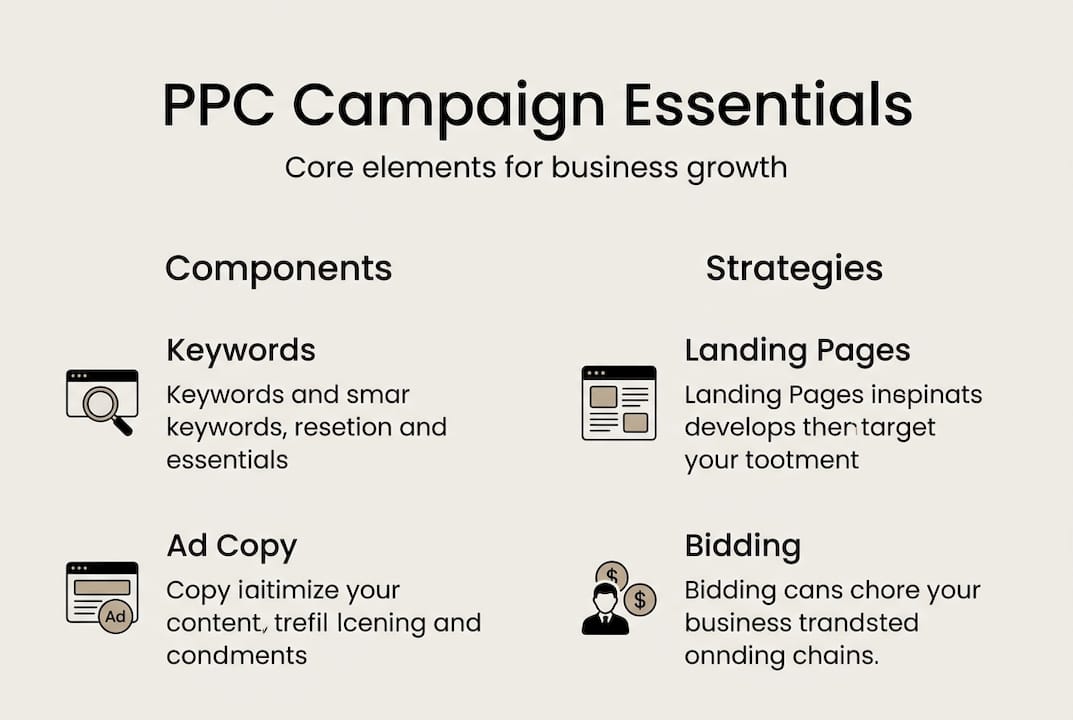
Every PPC campaign is built from the same foundational elements. Neglecting even one of them creates a weak link that undermines the rest. Here’s how the major components interact:
| Component | What it does | Risk if ignored |
|---|---|---|
| Keyword research | Targets the right search queries | Wasted spend on irrelevant traffic |
| Ad copy | Captures attention and drives clicks | Low CTR, poor Quality Score |
| Landing page | Converts visitors into leads or buyers | High bounce rates, low conversions |
| Bidding strategy | Controls cost and competitiveness | Overspending or underperforming |
| Campaign structure | Organizes ad groups for relevance | Diluted targeting and reporting |
Keyword research is where campaigns win or lose before they even launch. You need to identify terms your ideal customers actually search for, not just terms that describe your product. Match types (broad, phrase, and exact) control how closely a user’s search must align with your keyword before your ad shows. Negative keywords are equally important. They tell the platform which searches should never trigger your ad.

Ad copy must align tightly with search intent. If someone searches for “affordable CRM for small teams” and your headline says “Enterprise Software Solutions,” they’ll scroll past you. Your headline should mirror the problem they’re trying to solve.
Optimizing landing pages is one of the highest-leverage activities in PPC. A well-targeted ad that sends users to a slow, confusing, or irrelevant page wastes every click. Your landing page tips checklist should include a clear headline, a single call to action, fast load time, and mobile responsiveness.
Bidding strategies range from manual CPC (you set bids yourself) to automated options like Maximize Conversions and Target ROAS (return on ad spend). Each has its place depending on your data volume and campaign maturity.
Pro Tip: Structure your campaign with tightly themed ad groups. One ad group per product or service category keeps your keywords, ads, and landing pages tightly aligned, which directly improves Quality Score and lowers your cost per click.
Now that you know the PPC basics, it’s critical to see how keywords and targeting strategy function in real campaigns.
Keyword research and targeting for PPC success
Keywords are the engine of your PPC campaign. Choose the wrong ones and you’ll pay for clicks that never convert. Choose the right ones and you’ll reach buyers at exactly the right moment in their decision process.
Start by mapping keywords to business goals. A law firm targeting personal injury cases needs different keywords than one focused on estate planning. Use competitor research tools to identify what terms rivals are bidding on, then evaluate whether those terms align with your actual services and margins.
Understanding match types is non-negotiable. Here’s a quick comparison:
| Match type | How it works | Best for |
|---|---|---|
| Broad match | Triggers on related searches, synonyms | Discovery, large audiences |
| Phrase match | Triggers when query contains your phrase | Balanced reach and control |
| Exact match | Triggers only on near-identical queries | High-intent, precise targeting |
As match types and negative keywords directly impact how efficiently your budget is spent, getting this right is one of the fastest ways to improve campaign performance.
Here’s a practical targeting process for SMBs in competitive sectors:
- Build a core keyword list around your highest-margin products or services
- Add phrase and exact match variants to control spend early
- Identify and add negative keywords before launch (not after)
- Set up geo-targeting to focus on your actual service area
- Use device targeting to prioritize mobile or desktop based on your conversion data
Brand defense is a tactic many SMBs overlook. Competitors can bid on your business name, showing their ads when someone searches specifically for you. Bidding on your own brand terms keeps you in that top position and protects your reputation.
For a broader view of how paid and organic strategies compare, the SEO vs PPC comparison is worth reviewing. And if you’re still weighing whether PPC is right for your business, the PPC benefits for business breakdown and our PPC guide for 2026 offer clear, practical context.
Pro Tip: Review your search term reports weekly during the first month of any new campaign. This reveals exactly what queries triggered your ads and gives you a goldmine of new negative keywords to add.
With your keywords and target audience in place, it’s time to make high-stakes decisions about PPC management style.
Balancing automation and manual control in PPC management
Google’s AI-powered bidding tools have become genuinely powerful. But they’re not magic, and treating them as a hands-off solution is one of the most common and costly mistakes SMBs make.
Automated bidding strategies like Smart Bidding use machine learning to optimize bids in real time based on signals like device, location, time of day, and user behavior. When they work, they work well. The problem is they require a steady flow of quality conversion data to function properly.
AI bidding without sufficient data can actually increase your cost per acquisition rather than reduce it. Google’s systems need roughly 30 to 50 conversions per month at the campaign level before Smart Bidding becomes reliable. Below that threshold, manual CPC gives you more predictable control.
Here’s what to watch for when using automation:
- Conversion tracking must be airtight: if you’re not tracking real business outcomes (form fills, calls, purchases), the AI optimizes for the wrong signals
- Broad match plus Smart Bidding can expand reach aggressively: without strong negative keyword lists, this combination can burn budget fast
- Performance Max campaigns require robust first-party data and clear lifetime value inputs to perform well for SMBs
- Regular audits are non-negotiable: automation doesn’t mean set-and-forget
“The biggest mistake isn’t choosing automation or manual control. It’s choosing automation before your account has the data to support it.”
As overreliance on automation is a documented cause of wasted budgets, the smarter approach is to start with manual bidding, build your conversion history, then layer in automation strategically.
For more on managing PPC campaigns effectively and boosting PPC ROI with the right strategy, these resources offer practical next steps.
Why mastering PPC fundamentals beats chasing the latest hacks
Every few months, a new PPC tactic gets hyped as a game-changer. A new campaign type, a new bidding strategy, a new audience signal. And every time, a wave of SMBs abandons what’s working to chase the shiny new thing. Most of them regret it.
We’ve seen it repeatedly. Businesses that obsess over fundamentals, tight keyword targeting, strong ad-to-landing-page alignment, consistent conversion tracking, and data-driven iteration, consistently outperform businesses that jump from tactic to tactic.
The reality is that PPC tests reveal context-specific winners, not universal hacks. What works for a SaaS company won’t automatically work for a local service business. The only way to know what works for your business is to test methodically against business-level KPIs, not vanity metrics.
Chasing trends also fragments your data. Every time you restructure a campaign or switch strategies prematurely, you reset the learning period and lose the conversion history that makes automation effective. Consistency compounds. The businesses that win at PPC long-term are the ones that commit to business ROI with PPC as a strategic discipline, not a quick-fix channel.
Take your PPC campaigns further with expert guidance
Equipped with new PPC knowledge, here’s how you can take your campaigns and results even further with the right guidance. Understanding the fundamentals is a strong start, but executing them consistently across competitive markets takes experience and ongoing optimization. Our in-depth PPC guide walks through advanced strategies that build directly on what you’ve learned here. If you want to understand the full value of paid advertising, the benefits of PPC advertising page covers the measurable impact across industries. And for businesses ready to pair paid ads with organic growth, our SEO campaigns for growth approach delivers compounding results over time. Reach out to our team for a consultation tailored to your business goals.
Frequently asked questions
What are the most important PPC metrics to track?
Track click-through rate (CTR), cost per click (CPC), conversion rate, and return on ad spend (ROAS) for a clear view of campaign performance. Monitoring Quality Score and ROAS is especially critical for reducing costs while improving results.
Should small businesses use automated bidding or manage PPC manually?
Start with manual bidding to gain control and build conversion data, then consider automation once you have consistent volume and reliable tracking. Automated bidding works best with sufficient conversion history; without it, manual management is the safer choice.
How do negative keywords improve my PPC results?
Negative keywords prevent your ads from appearing for irrelevant searches, which saves budget and increases overall ad relevance. Using negative keywords to filter out unqualified traffic is one of the fastest ways to improve campaign efficiency.
How much should I budget for a PPC campaign?
Your budget depends on your goals, competition level, and industry; start small and scale based on what your data tells you about ROI. There’s no universal minimum, but having enough budget to generate meaningful conversion data is essential before drawing conclusions.