






TL;DR:
- SMBs spend seven times more on PPC than SEO for immediate, targeted results.
- PPC operates through an auction system influenced by Quality Score, affecting ad position and cost.
- Combining PPC’s quick wins with SEO’s long-term organic growth maximizes digital marketing success.
Small and medium-sized businesses spend 7x more on PPC than on SEO, which flips the conventional wisdom that organic search is always the smarter investment. That gap exists for a reason: PPC delivers results fast, and for businesses competing in crowded markets, speed matters. Pay-per-click advertising puts your brand in front of buyers who are actively searching for what you sell, often within hours of launching a campaign. This guide walks you through what PPC is, how it actually works, which strategies produce real returns for SMBs, and how to blend it with SEO for sustainable growth.
Table of Contents
- What is PPC and why does it matter for SMBs?
- How does PPC really work? Auction mechanics, Quality Score, and cost drivers
- Key PPC strategies for SMBs: Campaign structures, targeting, and smart setup
- Winning with PPC: Smart bidding, platform automation, and expert tips
- PPC vs SEO: Contrasts, synergies, and which to prioritize
- Why most SMBs miss out on PPC’s true value (and how to fix it)
- Unlock more traffic and leads with expert PPC and SEO support
- Frequently asked questions
Key Takeaways
| Point | Details |
|---|---|
| PPC delivers quick results | Pay-per-click advertising can drive immediate, targeted traffic to your business at any budget level. |
| Campaign structure matters | Tight ad groups, laser-focused targeting, and clear tracking are key to effective PPC outcomes. |
| Smart bidding boosts ROI | Switch to automated bidding only after enough data, and always monitor for efficiency over raw volume. |
| Blend PPC with SEO | Combining PPC for instant wins with SEO for sustained growth is proven to maximize your digital marketing returns. |
| Continuous learning yields results | Frequent testing, reviewing, and human creativity keep PPC campaigns cost-effective and competitive. |
What is PPC and why does it matter for SMBs?
PPC stands for pay-per-click, an online advertising model where you pay only when someone clicks your ad. You’re not paying for impressions or brand awareness alone. You’re paying for action. That distinction makes it one of the most budget-efficient tools available to businesses that can’t afford to waste a dollar.
The major platforms include Google Ads, Microsoft Advertising (Bing), and social network ad platforms like Meta and LinkedIn. Google Ads dominates because it captures intent at the moment of search. Someone types “emergency plumber near me” and your ad appears at the top of the results. That’s not luck. That’s a system you control.
Here’s why PPC punches above its weight for resource-strapped businesses:
- Immediate visibility: Your ads can appear within hours of launch, unlike SEO which takes months.
- Hyper-targeted reach: Target by location, device, time of day, demographics, and search intent.
- Full budget control: Set daily caps and never overspend.
- Measurable ROI: Every click, conversion, and dollar spent is trackable.
- Scalability: Start small and scale what works.
According to paid search benchmarks, SMBs typically start PPC campaigns with daily budgets between $20 and $200, depending on industry competitiveness. Here’s a quick look at how platforms and costs compare:
| Platform | Avg. CPC | Best for |
|---|---|---|
| Google Ads | $1 to $6 | High-intent search traffic |
| Microsoft Ads | $0.75 to $3 | Cost-efficient B2B reach |
| Meta Ads | $0.50 to $2 | Awareness and retargeting |
| LinkedIn Ads | $5 to $15 | B2B lead generation |
For most SMBs, Google Ads is the starting point because it captures buyers with the highest purchase intent. But the platform you choose should match where your customers actually spend their time.
How does PPC really work? Auction mechanics, Quality Score, and cost drivers
Every time someone searches on Google, an automated auction runs in milliseconds. You don’t bid against other advertisers in real time manually. Instead, you set a maximum cost-per-click (Max CPC) and Google’s algorithm determines where your ad appears.
The key formula is Ad Rank = Max CPC x Quality Score x Ad Extensions. Your ad’s position isn’t just about who bids the most. A lower bid with a higher Quality Score can outrank a competitor spending twice as much. That’s the part most SMBs miss.
Ad Rank determines both your ad position and what you actually pay per click. Your actual CPC is often lower than your Max CPC because you only need to beat the next competitor’s Ad Rank by a small margin.
Quality Score is rated from 1 to 10 and is built from three components:
- Expected click-through rate (CTR): How likely users are to click your ad based on historical data.
- Ad relevance: How closely your ad matches the search query.
- Landing page experience: How useful, fast, and relevant your landing page is after the click.
Here’s a comparison of low versus high Quality Score impact:
| Quality Score | Effect on Ad Rank | Effect on CPC |
|---|---|---|
| 3 or below | Significantly lower | Higher cost per click |
| 5 to 6 | Average positioning | Standard market rate |
| 8 to 10 | Top placement | Lower cost per click |
To improve your Quality Score, align your ad copy tightly with the keywords in each ad group, send users to landing pages that directly answer their search query, and monitor CTR weekly. Following PPC best practices around ad relevance and landing page quality can meaningfully reduce your cost per click over time.
“A Quality Score of 8 or higher can reduce your CPC by up to 50% compared to a score of 4 or below.”
The practical takeaway: spend as much energy on your landing page as you do on your ad copy. Both are scored, and both affect what you pay.
Key PPC strategies for SMBs: Campaign structures, targeting, and smart setup
Understanding PPC’s machinery sets the foundation. Now let’s translate that into practical steps for your next campaign.
The biggest structural mistake SMBs make is grouping too many unrelated keywords into one ad group. Tight ad groups with 5 to 20 tightly themed keywords consistently outperform broad setups because they allow you to write ads that are highly relevant to each specific search query. Better relevance means better Quality Scores and lower costs.
Here’s how to build a campaign that works from day one:
- Start with exact and phrase match keywords: These give you control over which searches trigger your ads. Broad match can drain budget on irrelevant traffic early on.
- Add negative keywords immediately: Block terms that attract clicks but not buyers. If you sell premium software, add “free” as a negative keyword from the start.
- Use long-tail keywords: Phrases like “affordable CRM software for small teams” convert better than “CRM software” because they capture specific intent.
- Apply geo-targeting: Focus your budget on the cities or regions where your customers actually are.
- Set up conversion tracking before launch: Without it, you’re flying blind. Track form fills, calls, purchases, whatever action matters most to your business.
For SMBs competing with larger brands, the advantage isn’t budget size. It’s precision. A $30 per day campaign targeting three tightly focused ad groups will outperform a $300 per day campaign with sloppy structure.

Pro Tip: Run A/B tests on your ad headlines from week one. Test one variable at a time, such as a question versus a statement, or a price point versus a benefit. Small copy changes can shift CTR by 20% or more.
Understanding PPC for business growth starts with treating your first $20 to $50 daily budget as a research investment. The data you collect in the first two weeks is worth more than any optimization you could make later. Use the marketing research process to inform your keyword and audience choices before you spend a dollar. Once you know what converts, check your PPC ROI guide to scale confidently.
Winning with PPC: Smart bidding, platform automation, and expert tips
With your campaign structure in place, let’s fine-tune how those ad dollars work and when to trust the robots.
Bidding strategy is where many SMBs either leave money on the table or burn through budget unnecessarily. Here’s the breakdown:
- Manual CPC: You control every bid. Best for new accounts with limited data. Gives you maximum visibility into what’s happening.
- Target CPA (Smart Bidding): Google’s AI optimizes bids to hit a target cost per acquisition. Needs at least 30 to 50 conversions per month to work reliably.
- Target ROAS: Optimizes for return on ad spend. Best for e-commerce with clear revenue data.
- Portfolio bidding: Applies a single strategy across multiple campaigns. Useful once you’re managing several campaigns simultaneously.
According to PPC bidding strategy research, Smart Bidding requires a 7-day learning period and performs poorly when conversion data is thin. Turning it on too early is one of the most common and costly mistakes SMBs make.
Two things to avoid early on: Broad Match and Performance Max campaigns. Both hand significant control to Google’s algorithm, and without enough conversion data, the algorithm optimizes for the wrong signals. You can compete with big brands more effectively by staying precise rather than going broad.
Also protect your budget from click fraud. Use tools that monitor invalid clicks and consider server-side conversion tracking for more accurate data. Learn more about how PPC works and explore the benefits of PPC to understand when automation genuinely helps.
Pro Tip: Human-written ad copy consistently outperforms AI-generated ads for SMBs. Your specific offer, local context, and customer language are things a generic AI prompt can’t replicate. Write your own headlines first, then test.
PPC vs SEO: Contrasts, synergies, and which to prioritize
To maximize digital growth, it’s crucial to know how PPC works alongside SEO, rather than in isolation.
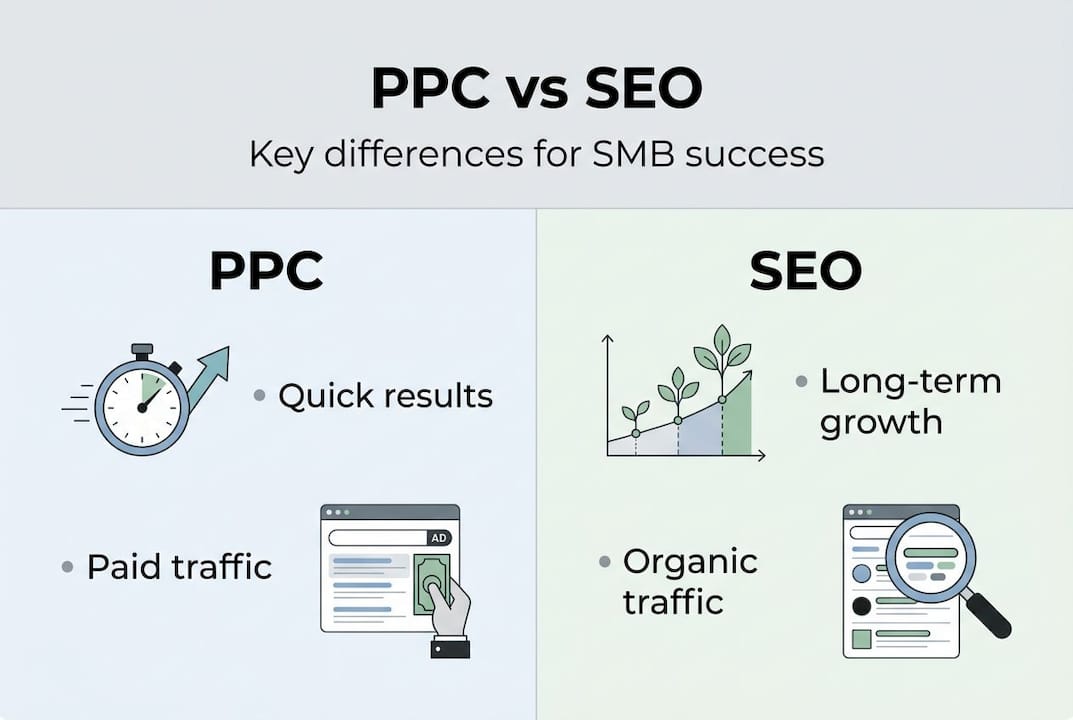
Here’s the honest comparison:
| Metric | PPC | SEO |
|---|---|---|
| Time to results | Hours to days | 3 to 12 months |
| Traffic share | 27% of web traffic | 53% of web traffic |
| Avg. conversion rate | 10% | 14.6% |
| ROI timeline | Immediate but ongoing cost | Long-term, up to 12.2x ROI |
| Cost model | Pay per click | Time and content investment |
PPC is your instant traffic lever. SEO is your compounding asset. Neither is universally better. The smartest SMBs use both.
Here’s when blending both channels creates outsized results:
- Branded searches: Run PPC on your own brand name to protect against competitors bidding on it, while SEO builds organic authority.
- Data sharing: Use PPC keyword data to inform your SEO content strategy. High-converting PPC keywords are often strong SEO targets.
- Coverage gaps: If your SEO rankings are weak in a high-value category, PPC fills the gap immediately while SEO catches up.
- Retargeting: Use PPC to re-engage visitors who found you through organic search but didn’t convert.
For a detailed breakdown, explore the SEO vs PPC comparison and the broader SEO vs PPC impact analysis. One SMB we’ve worked with unlocked scalable growth by running PPC to test which product pages converted best, then investing SEO resources into exactly those pages. The result was lower PPC spend over time as organic rankings improved.
Why most SMBs miss out on PPC’s true value (and how to fix it)
After working with dozens of SMBs on paid campaigns, the pattern is consistent: businesses chase volume instead of efficiency. They want more clicks, more impressions, more reach. But PPC rewards precision, not scale.
The most damaging habit is ignoring Quality Score and negative keywords in the first month. Both are free optimizations that directly reduce cost per click and improve results. Skipping them is the equivalent of leaving cash on the table.
The second mistake is trusting automation before the data supports it. Smart Bidding is genuinely powerful, but only after your account has enough conversion history. Turning it on at week one with 5 conversions is not a strategy. It’s a guess.
Our honest recommendation: treat every $20 to $50 daily campaign as a learning lab. Review performance weekly, adjust bids manually, and track which keywords and ads actually convert. Combine those insights with your SEO data for a feedback loop that compounds over time. Check the PPC ROI for SMBs breakdown to set realistic benchmarks before you start.
Human judgment in creative and targeting still reliably beats AI-only setups for most SMBs. Use automation as a tool, not a replacement for strategy.
Unlock more traffic and leads with expert PPC and SEO support
If this guide has clarified how PPC can work for your business, the next step is putting it into practice with the right support behind you. At Web Spider Solutions, we help SMBs build campaigns that are precise, data-driven, and built to scale. Whether you’re starting your first campaign or optimizing an existing one, our team brings the strategic depth that turns ad spend into measurable growth. Explore PPC explained in detail, review the benefits of PPC, and pair it with our comprehensive SEO strategy guide to build a complete digital growth engine. Book a free consultation and let’s map out your next move.
Frequently asked questions
Is PPC effective for small businesses with limited budgets?
Yes, PPC can deliver targeted traffic and quick results even with small budgets when tightly focused strategies are used. SMBs gain immediate visibility and full cost control at any budget level.
How soon can PPC ads generate leads or sales?
PPC ads can generate qualified traffic and potential leads within hours or days of launch. Instant visibility is one of PPC’s core advantages over SEO’s longer ramp-up period.
What is the difference between PPC and SEO for my business?
PPC produces immediate but paid results, while SEO builds sustainable organic growth over the long term. Both serve distinct roles and work best when used together.
When should I use manual bidding versus automated Smart Bidding?
Manual bidding is best for new or low-data accounts; switch to Smart Bidding once you have 30 to 50 conversions per month. Manual CPC gives control while Smart Bidding thrives in data-rich environments.
How do I measure PPC success for my SMB?
Measure PPC success using ROAS, total conversions, and cost per conversion as your primary metrics. Tracking ROAS and conversions gives SMBs a clear picture of actual campaign impact.
Recommended