






Most american businesses today face stiff competition online, yet only about 42 percent have a documented content marketing strategy guiding their efforts. Content marketing matters because it shapes how your brand communicates, builds trust, and creates value for your audience in ways traditional ads cannot. Understanding the core principles gives you an edge, helping you craft messages that stand out and connect with people who matter most to your business.
Table of Contents
- Defining Content Marketing Core Principles
- Major Types of Content Marketing Strategies
- How Content Marketing Drives Business Growth
- Measuring ROI and Long-Term Value
- Common Challenges and How to Overcome Them
- Comparing Content Marketing With Other Tactics
Key Takeaways
| Point | Details |
|---|---|
| Audience-Centric Approach | Focus on understanding and addressing specific audience needs for effective content marketing. |
| Value-First Delivery | Prioritize providing actionable and meaningful information to foster engagement. |
| Strategic Distribution | Utilize appropriate channels for content distribution to maximize audience reach. |
| Continuous Adaptation | Regularly analyze audience responses and refine content strategies to maintain relevance. |
Defining Content Marketing Core Principles
Content marketing represents a strategic approach to creating and distributing valuable, relevant, and consistent content designed to attract and retain a clearly defined audience. According to Indian Institute of Mass Communication, effective digital communication hinges on three fundamental principles: clarity, conciseness, and scannability.
Core Principles of content marketing go beyond simple information delivery. They encompass a holistic strategy that transforms traditional marketing approaches by prioritizing audience value over direct sales pitches. These principles include:
- Audience-Centric Approach: Understanding and addressing specific audience needs
- Value-First Delivery: Providing actionable, meaningful information
- Consistent Storytelling: Maintaining a coherent narrative across different platforms
- Strategic Distribution: Targeting content through appropriate channels
For businesses seeking to implement content marketing effectively, the goal is not just generating content but creating meaningful connections. Understanding Content Marketing: A Complete Introduction provides deeper insights into developing a robust content strategy that resonates with target audiences. By focusing on delivering genuine value, businesses can transform their marketing from interruption-based tactics to engagement-driven communication that builds trust and credibility.
Successful content marketing requires a sophisticated blend of strategic thinking, creative storytelling, and data-driven insights. Professionals must continuously adapt their approach, analyzing audience responses and refining content to maintain relevance and impact in an increasingly competitive digital landscape.

Major Types of Content Marketing Strategies
Content marketing strategies represent diverse approaches businesses can leverage to engage audiences and drive meaningful interactions. These strategies are not one-size-fits-all but require careful customization based on specific business goals, target demographics, and industry dynamics. Smart Content Marketing Strategies 2025 highlights the evolving landscape of digital communication techniques.
Key Content Marketing Strategy Types include:
- Blog Content Strategy
- Long-form educational articles
- Industry insights and thought leadership
- Search engine optimization focused content
- Video Content Marketing
- Explainer videos
- Product demonstrations
- Customer testimonial narratives
- Social Media Content Strategy
- Platform-specific engagement tactics
- Interactive multimedia posts
- Community building initiatives
- Email Marketing Campaigns
- Personalized newsletter sequences
- Segmented audience targeting
- Automated drip campaigns
- Podcast and Audio Content
- Expert interview series
- Industry trend discussions
- Narrative-driven storytelling
Successful content marketing requires a nuanced understanding of each strategy’s unique strengths and potential limitations. Professionals must remain adaptable, continuously testing and refining their approach to match evolving audience preferences and technological capabilities.
Modern content marketing transcends traditional advertising by focusing on providing genuine value. By creating informative, engaging, and relevant content across multiple channels, businesses can build trust, establish thought leadership, and create meaningful connections with their target audiences.
The key is not just producing content, but crafting strategic narratives that resonate deeply with specific consumer segments.
How Content Marketing Drives Business Growth
Content marketing has emerged as a powerful engine for business growth, transforming how organizations connect with potential customers and drive revenue. According to Digital Brolly, strategic content marketing supports every stage of the sales funnel, from initial awareness to final purchase decision, creating a comprehensive approach to business expansion.
Key Growth Mechanisms of content marketing include:
- Organic Traffic Generation
- Improving search engine rankings
- Attracting qualified leads
- Reducing customer acquisition costs
- Brand Authority Development
- Establishing thought leadership
- Building customer trust
- Differentiating from competitors
- Customer Engagement Acceleration
- Creating meaningful interactions
- Providing value beyond products
- Nurturing long-term relationships
7 Key Benefits of Content Marketing for Your Business reveals that businesses leveraging comprehensive content strategies can experience significant competitive advantages. These strategies transform traditional marketing approaches by focusing on creating genuine value for target audiences.
The most successful content marketing approaches go beyond mere promotion, instead creating educational, entertaining, and informative experiences that naturally draw customers toward business solutions. By consistently delivering high-quality content across multiple channels, organizations can build robust digital ecosystems that continuously attract, engage, and convert potential customers, ultimately driving sustainable business growth through strategic communication and value delivery.
Measuring ROI and Long-Term Value
Measuring the return on investment (ROI) for content marketing requires sophisticated analytical approaches that go beyond traditional metrics. According to JETIR Research, effective content marketing measurement demands a strategic focus on distinguishing between different content types and implementing data-driven strategies to track performance comprehensively.
Key Performance Indicators (KPIs) for Content Marketing ROI include:
- Engagement Metrics
- Website traffic
- Time spent on page
- Social media interactions
- Comment and share rates
- Conversion Metrics
- Lead generation
- Conversion rates
- Customer acquisition cost
- Sales pipeline growth
- Long-Term Value Indicators
- Brand awareness
- Customer loyalty
- Repeat purchase rates
- Referral generation
Understanding the ROI of Content Marketing for Businesses emphasizes that true value extends far beyond immediate financial returns. Businesses must adopt a holistic view that considers both quantitative and qualitative impacts of their content marketing efforts.
Successful ROI measurement requires continuous monitoring, adaptive strategies, and a willingness to experiment. By implementing robust tracking mechanisms, businesses can transform content marketing from a cost center into a strategic asset that drives sustainable growth, builds brand authority, and creates meaningful connections with target audiences across multiple touchpoints.
Common Challenges and How to Overcome Them
Content marketing presents numerous complex challenges that require strategic and adaptive approaches. According to JETIR Research, successful content strategies demand clear differentiation between content types and customer-oriented, data-driven methodologies to effectively overcome potential obstacles.
Primary Content Marketing Challenges include:
- Content Consistency
- Maintaining regular publishing schedules
- Ensuring consistent brand voice
- Creating high-quality content consistently
- Audience Engagement
- Understanding target audience preferences
- Creating truly valuable content
- Cutting through digital noise
- Resource Limitations
- Managing content production costs
- Allocating appropriate time and talent
- Balancing quantity and quality
- Measurement and Attribution
- Tracking meaningful content performance
- Connecting content to revenue generation
- Developing accurate ROI metrics
Strategic solutions require a multifaceted approach that combines technological tools, creative thinking, and data-driven insights. 7 Effective Content Marketing Ideas for Business Growth offers comprehensive strategies for navigating these challenges effectively.
Overcoming content marketing obstacles demands continuous learning, experimentation, and a willingness to adapt. Successful organizations view these challenges not as barriers but as opportunities for innovation, using each obstacle as a chance to refine their approach, develop more sophisticated content strategies, and ultimately create more meaningful connections with their target audiences.
Comparing Content Marketing With Other Tactics
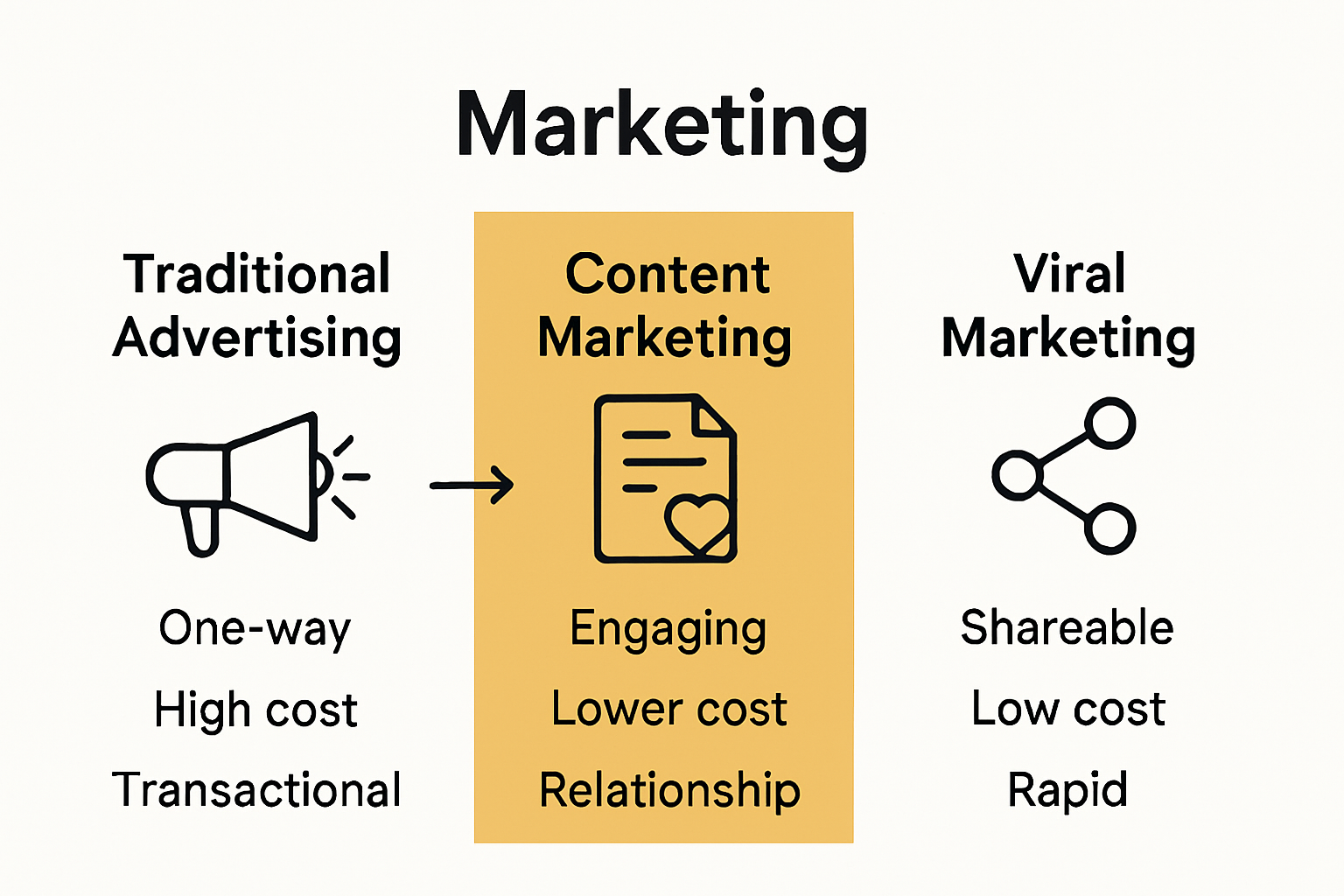
Marketing strategies have evolved dramatically, with content marketing emerging as a sophisticated alternative to traditional promotional techniques. According to Arxiv Research, innovative approaches like the Amphibious Influence Maximization (AIM) model demonstrate how integrated marketing strategies can significantly outperform single-channel tactics by combining content marketing with viral network strategies.
Comparative Marketing Approach Analysis:
- Traditional Advertising
- One-way communication
- Interruption-based approach
- Higher customer acquisition costs
- Limited audience engagement
- Content Marketing
- Two-way interactive communication
- Value-driven engagement
- Lower customer acquisition costs
- Builds long-term relationships
- Viral Marketing
- Rapid, unpredictable spread
- Emotion-driven content
- High potential reach
- Less controlled messaging
Research from Arxiv highlighting viral advertising strategies reveals that emotional engagement plays a crucial role in content sharing and audience interaction. Content Marketing Trends for 2024 provides additional insights into how modern marketing approaches are transforming digital communication strategies.
The most effective marketing approaches now recognize that audience value trumps traditional promotional tactics. By integrating multiple strategies and focusing on genuine, meaningful communication, businesses can create more authentic connections that transcend conventional advertising limitations, ultimately driving more sustainable and engaging customer relationships.
Unlock Your Business Potential with Expert Content Marketing Solutions
If you are facing challenges like maintaining consistent content, engaging your target audience, or measuring meaningful ROI as discussed in the article “Why Use Content Marketing: Complete Guide for 2025,” you are not alone. These common pain points require a strategic approach that focuses on delivering value-driven, audience-centric content across the right channels. Implementing an effective content marketing strategy is key to building trust, increasing organic traffic, and ultimately driving long-term business growth.
At Web Spider Solutions, we specialize in crafting personalized digital marketing campaigns that address these challenges head-on. Explore our B2B Marketing Archives to see how we help companies like yours amplify their digital presence through targeted content and strategic optimization. Ready to transform your marketing efforts and beat the competition? Visit our site today to learn how our integrated solutions can deliver measurable results and schedule your free consultation. Act now to start building meaningful connections that convert.
Frequently Asked Questions
What are the core principles of content marketing?
The core principles of content marketing include an audience-centric approach, value-first delivery, consistent storytelling, and strategic distribution. These principles focus on addressing audience needs and building meaningful connections rather than just promoting products.
How does content marketing drive business growth?
Content marketing drives business growth by generating organic traffic, developing brand authority, and accelerating customer engagement. It supports all stages of the sales funnel, helping to attract qualified leads and reduce customer acquisition costs.
What types of strategies are included in content marketing?
Key types of content marketing strategies include blog content, video marketing, social media engagement, email marketing campaigns, and podcasts. Each strategy has unique strengths and can be customized to meet specific business goals and audience preferences.
How can businesses measure the ROI of their content marketing efforts?
Businesses can measure the ROI of content marketing by analyzing engagement metrics, conversion rates, and long-term value indicators. This includes tracking website traffic, lead generation, customer loyalty, and brand awareness to evaluate overall performance.
Recommended